

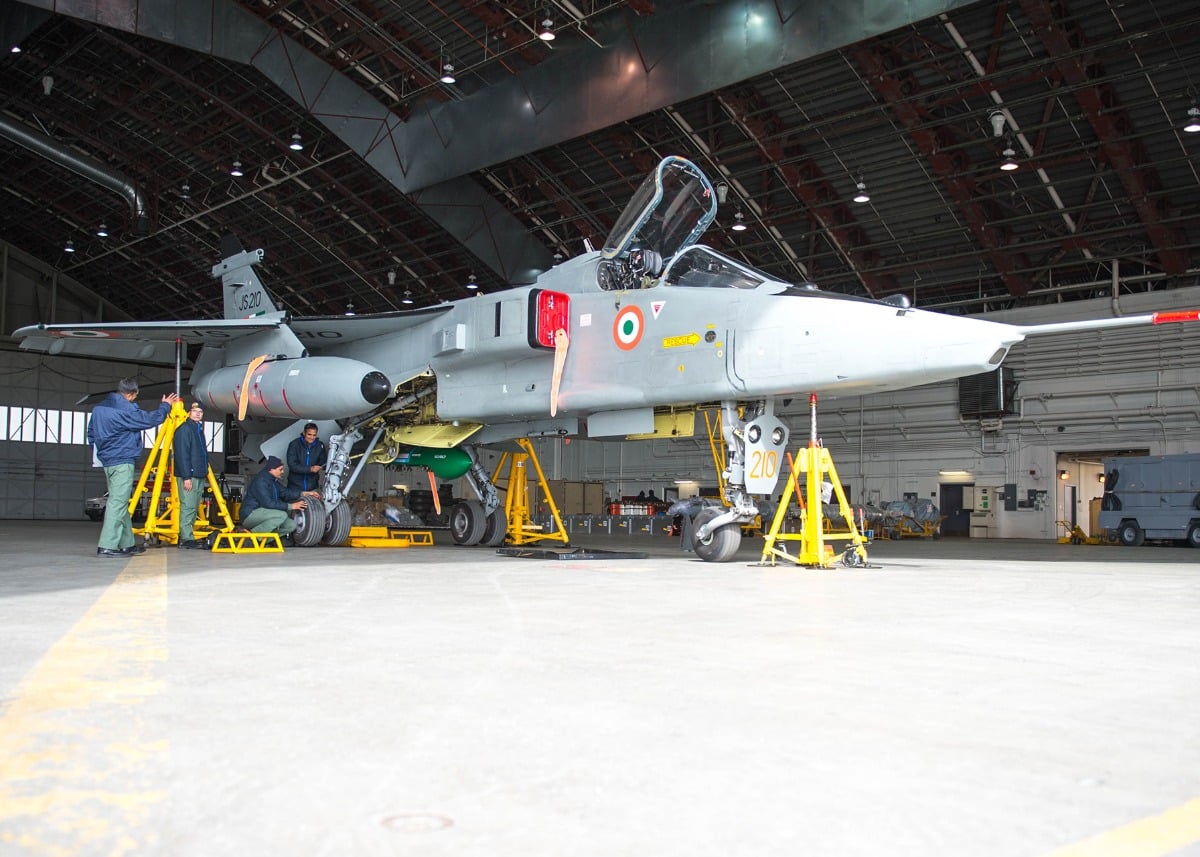
- The UK Ministry of Defence still holds 42 SEPECAT Jaguar aircraft and has transferred nine to the Indian Air Force.
- Minister Luke Pollard disclosed the figures in a written parliamentary answer on July 3, 2026.
Britain’s Ministry of Defence is still sitting on 42 SEPECAT Jaguar attack jets nearly two decades after the Royal Air Force retired the type, and nine more have already been shipped off to India to keep that country’s aging combat fleet flying, the UK Defence Journal reported.
The figures came from a written parliamentary answer delivered on July 3, 2026, by Luke Pollard, the UK’s Minister for Defence Readiness and Industry, responding to a question from Conservative MP Ben Obese-Jecty about how many GR1 and T2 variant Jaguars the department still holds in its inventory. The numbers confirm what open-source trackers and Indian defense outlets had already reported earlier in the summer, that a batch of retired British jets was quietly making its way toward the world’s last operational Jaguar fleet.
The Jaguar itself was born from an unusual level of Cold War cooperation, developed jointly by Britain and France under a joint venture called SEPECAT that combined the British Aircraft Corporation with the French firm Breguet, one of the earliest major collaborative fighter programs between the two countries. The aircraft entered Royal Air Force service in 1974 as a low-level strike and reconnaissance jet, flew combat missions during the 1991 Gulf War, and continued operating over Iraq and the Balkans through the 1990s before Britain withdrew the type from service in 2007, retiring the fleet earlier than originally planned as a cost-cutting measure. Rather than scrapping every airframe, the Ministry of Defence retained a substantial number of Jaguars after retirement, with most stationed at RAF Cosford, where the School of Technical Training has used the jets for decades as ground instructional airframes that teach RAF engineering technicians how to work on real aircraft systems, a role that has kept many of the retired jets in remarkably complete condition despite sitting grounded for nearly twenty years.
Pollard’s written answer broke down exactly how many of those aircraft have moved and how many remain.
“A total of nine Jaguar aircraft have been transferred to the Indian Air Force. Of these, five were the GR1 variant, and four the T2 variant,” the minister said.
That transfer lines up with reports that first surfaced in mid-June 2026, when Indian defense outlets and open-source trackers spotted several former RAF Jaguars wrapped in white protective coverings at a British port awaiting shipment, alongside what industry sources described as more than 150 categories of spare parts and components destined for India’s air force. Pollard’s answer also detailed the composition of what Britain still has on hand.
“Of the 42 Jaguar aircraft the Ministry of Defence still holds, 13 are the GR1 variant and none are the T2 variant,” Pollard said.
The written answer did not specify the variants making up the remaining 29 airframes, since Obese-Jecty’s original question only asked about the GR1 and T2 marks specifically, though the balance of Britain’s surviving fleet would be expected to include later versions such as the upgraded GR3 series and the T4 two-seat trainer variant. Neither did the answer describe the physical condition of the 42 retained aircraft, though they are understood to serve purely as ground instructional airframes rather than flight-capable jets.
India remains the sole nation still flying the Jaguar operationally, having license-built the aircraft domestically through Hindustan Aeronautics Limited since the early 1980s and christening it the Shamsher in Indian Air Force service. The IAF currently operates roughly 110 to 120 Jaguars spread across six squadrons, a fleet that has served continuously since 1979 and remains one of the service’s primary deep-penetration strike platforms even as India’s overall fighter squadron strength sits at only 29 squadrons against a sanctioned requirement of 42, a shortfall that has made every operational aircraft, including aging Jaguars, more valuable to keep flying rather than retiring early. With the Jaguar long out of production anywhere in the world and original manufacturing lines for its components permanently shut down, sourcing spare parts has become an increasingly difficult and creative exercise for the Indian Air Force, one that has previously involved acquiring retired airframes from France, which transferred 31 Jaguars free of cost in 2018, and from Oman, which supplied additional aircraft along with Rolls-Royce Adour engines and thousands of lines of spare components as recently as 2025.
This latest transfer from Britain follows that same pattern, providing India with airframes to dismantle for components including engines, avionics, landing gear, and hydraulic systems rather than aircraft intended to actually fly again. India’s Ministry of Defence formally requested this specific package of British Jaguars and spares back in 2024, and Indian officials have said the components will support the country’s Jaguar fleet through a modernization program known as DARIN-III, which has equipped many of the aircraft with upgraded avionics, more modern cockpit displays, and improved weapons integration capable of sustaining the type in frontline service for roughly another decade. India has indicated plans to begin phasing out the Jaguar starting around 2029, with the most heavily upgraded DARIN-III airframes expected to remain in service into the mid-2030s as newer indigenous fighters, including the Tejas Mk1A and eventually more advanced homegrown designs, gradually take over the deep-strike mission the Jaguar has performed for nearly half a century.