

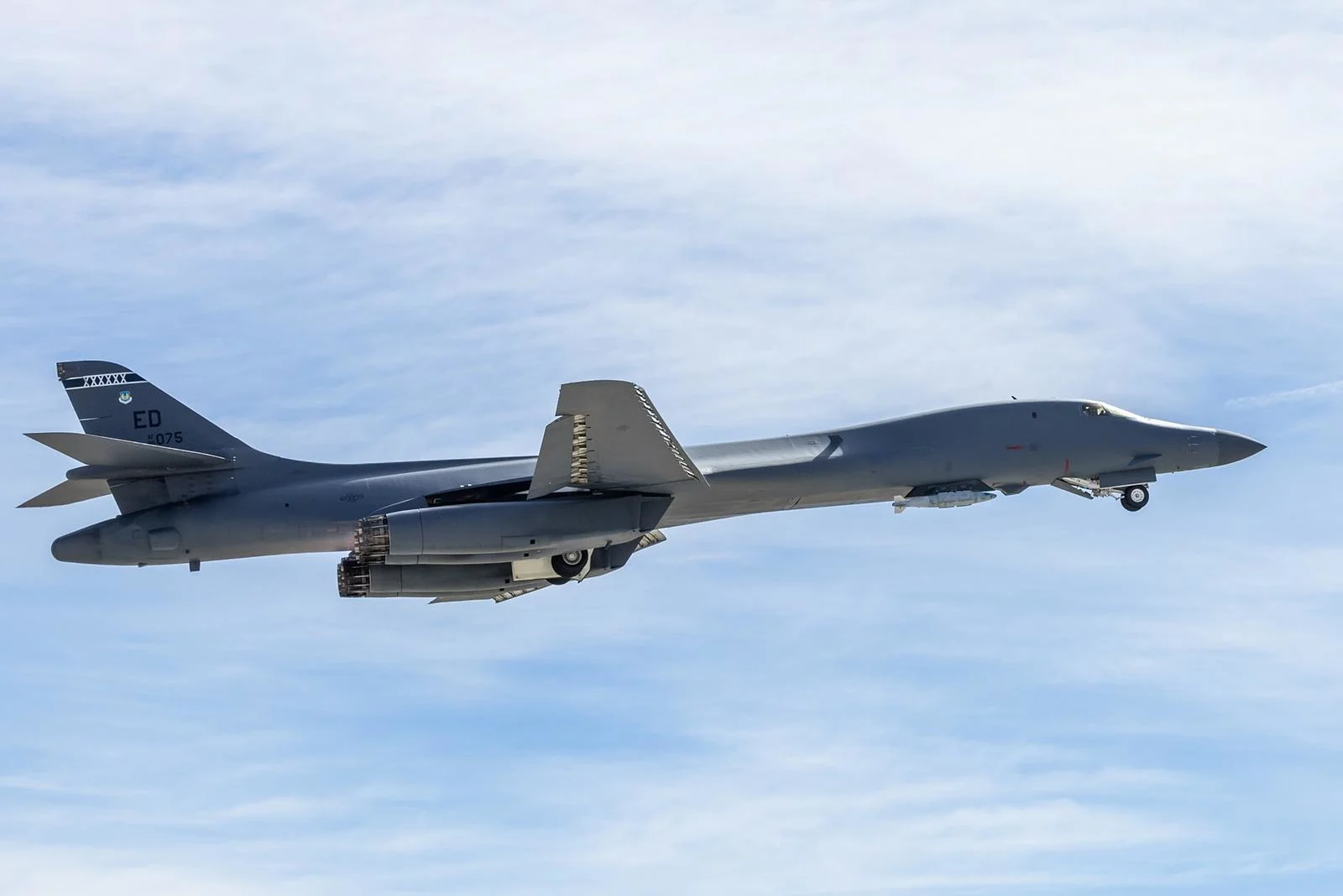
The U.S. Air Force has awarded Boeing a contract to deliver Load Adaptable Modular (LAM) pylons designed to expand the payload and flexibility of the B-1 bomber fleet.
Boeing says the pylons, which the company’s team designed and prototyped using independent research and development funds ahead of a formal Air Force request, will allow the B-1 to carry 50% more weapons, including larger and heavier payloads.
“Our team identified an opportunity to help the U.S. Air Force achieve their mission even more effectively,” said Troy Dawson, Bombers Development vice president. “They found a creative and innovative way to get new capability to the warfighter to stay ahead of current and emerging threats. They helped ensure the B-1 will be a key part of the U.S. bomber force for decades to come.”
The initiative cut over two years off the development timeline, speeding combat capability upgrades to the flight line. Each B-1 can accommodate six pylons, each capable of loading two 2,000-pound-class weapons or a future weapon exceeding 5,000 pounds. The Air Force plans to use the upgraded B-1 fleet to test hypersonic weapons in the near term.
Thank you, @USAirForce, for selecting us to deliver Load Adaptable Modular (LAM) pylons for your B-1 fleet. The LAM pylons will bring new capabilities and allow the B-1 to continue to adapt to evolving needs.
Learn more: https://t.co/3dc9vh13JN
📷 @EdwardsAFB pic.twitter.com/J0IFPeOv0A— Boeing Defense (@BoeingDefense) July 9, 2025
“The pylon provides more mass and flexibility in rapidly evolving combat environments,” Dawson said. “When operational with the fleet, the LAM Pylon will allow the B-1, already packing the largest weapon load in the Air Force, to make an even bigger contribution to U.S. global striking power.”
Dan Ruder, Bombers Advanced Programs manager, called the LAM Pylon a “new chapter in the B-1’s story,” expanding its role in the Air Force’s future operational capabilities. Historically, the B-1 has evolved from a strategic bomber to a multi-role platform capable of conventional bombing, close air support and long-range strike missions.
The U.S. Air Force’s 412th Test Wing at Edwards Air Force Base, California, evaluated the pylon’s performance in initial flight and ground testing, which demonstrated its capability to carry inert munitions. “Testing proved that our rapid development met the Air Force requirements,” Ruder said. “We know that this type of innovation can be a vital asset for the U.S. Air Force and help the B-1 platform continue to adapt to evolving operational needs.”
Additional testing at Edwards AFB will continue as the Air Force prepares to integrate the LAM pylons across the entire B-1 fleet.