

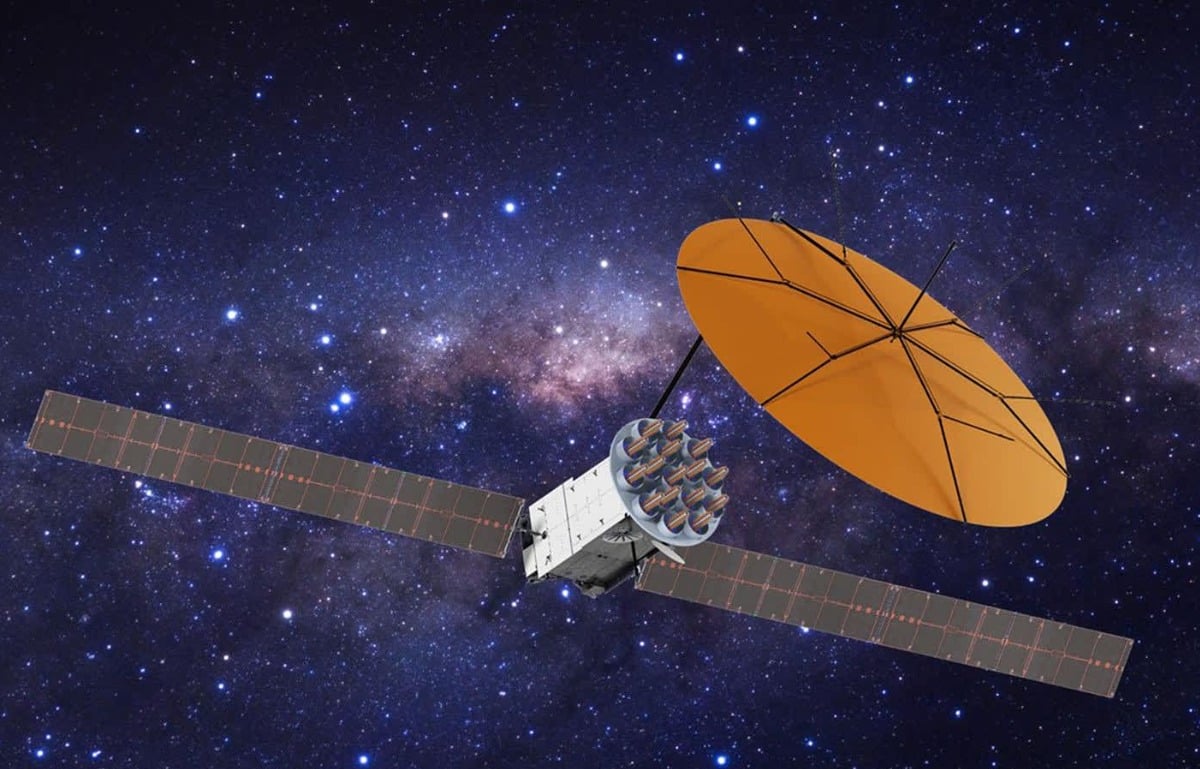
- The U.S. Space Force awarded Boeing a contract worth up to $2 billion on June 25, 2026, to build two MUOS SLE narrowband communications satellites.
- Boeing will use its 702MP spacecraft platform; the first satellite is scheduled for delivery in 2031 and the second in 2032.
Boeing secured a contract worth up to $2 billion from the U.S. Space Force on June 25 to build two new satellites that will extend the life of the military’s primary secure voice communications network, knocking out the constellation’s original builder, Lockheed Martin, in the process.
The program is called the Mobile User Objective System Service Life Extension (MUOS SLE), and its purpose is straightforward: keep the satellite network that connects soldiers, sailors, pilots, and special operations forces talking to each other long after the current constellation reaches the end of its design life.
The first of the two new Boeing satellites is scheduled for delivery in 2031, with the second following in 2032. Both will fly on Boeing’s 702MP spacecraft platform, a medium-power geostationary satellite bus introduced in 2009 that the company has also used for the Space Force’s Wideband Global Satcom constellation and for major commercial operators including Intelsat and Viasat. Boeing has been delivering 702MP satellites at production pace since the fourth quarter of 2025, giving it an active manufacturing line it can fold the MUOS work directly into.
The existing MUOS constellation consists of five satellites sitting in geostationary orbit roughly 35,786 km (22,236 miles) above the Earth, providing global coverage for military users who need secure communications when other options fail them. Think of it as the military’s version of a cellular network, but hosted in space and designed specifically to function where terrestrial cell towers and satellite systems that rely on higher-frequency signals cannot. The constellation replaced the legacy Ultra-High Frequency Follow-On satellite system, which entered service in the 1990s and could offer roughly a tenth of the capacity that MUOS provides. By adapting commercial third-generation cellular architecture — the same WCDMA technology behind early 3G mobile networks — and running it through geosynchronous satellites instead of ground-based towers, MUOS delivers voice, video, and data at speeds up to 384 kilobits per second to users anywhere on the globe, including in locations that have historically been dead zones for military communications.
The frequency band MUOS uses, ultra-high frequency, sits between 300 MHz and 3 GHz, a range the military has relied on for decades precisely because of its physical properties. UHF signals propagate differently than the higher-frequency bands used by most commercial satellite systems: they penetrate forest canopy where higher frequencies would scatter and attenuate, push through urban canyons where line-of-sight communications fail, and hold up under weather conditions that degrade other systems. A special operations team moving through dense jungle, a submarine crew attempting to communicate while near the surface, a pilot in a mountainous environment — these are the users MUOS was built for, and keeping that capability online past the current constellation’s service life is the driving rationale behind the SLE contract.
Boeing’s role in the existing MUOS program makes it a logical choice for the extension work, even though Lockheed Martin was the prime contractor and spacecraft builder for all five current satellites. Boeing developed and delivered the payloads — the communications electronics at the heart of each satellite — for the current constellation, giving it deep familiarity with the system’s architecture, waveform requirements, and operational demands. That payload heritage matters enormously when designing replacement satellites intended to extend and improve an existing network rather than replace it wholesale.
“We’re grateful for the trust the U.S. Space Force has placed in our team for a capability that matters to military users around the world,” said Sam Greaves, Boeing’s vice president of Space Mission Systems. “For the people who depend on this connectivity, the need is clear: secure communication that works in demanding conditions. Our team knows this mission and is ready to help the customer extend and improve a system they count on every day.” Ryan Reid, Boeing’s senior director of Space Communications Programs, framed the 702MP production line as a direct schedule advantage: “By building on our active 702MP spacecraft production line, we bring immediate execution momentum, proven reliability, and schedule predictability to the U.S. Space Force.”
The 702MP platform itself carries payload power ranging from 6 to 12 kilowatts and has a demonstrated track record across both military and commercial programs. For MUOS SLE, Boeing says the approach is designed to increase overall communications capacity, reduce interference, and improve connectivity for global military operations into the next decade — improvements that matter as the number of military users demanding secure beyond-line-of-sight communications has grown substantially since the current constellation was designed in the 2000s.
What the MUOS SLE contract ultimately represents is a decision by the Space Force to sustain and upgrade a proven network rather than wait for next-generation alternatives. The current constellation was declared fully operational in 2019, and its satellites carry 15-year design lives, meaning the coverage gap the SLE satellites are designed to fill is a foreseeable problem being addressed on a responsible timeline rather than in crisis mode.