

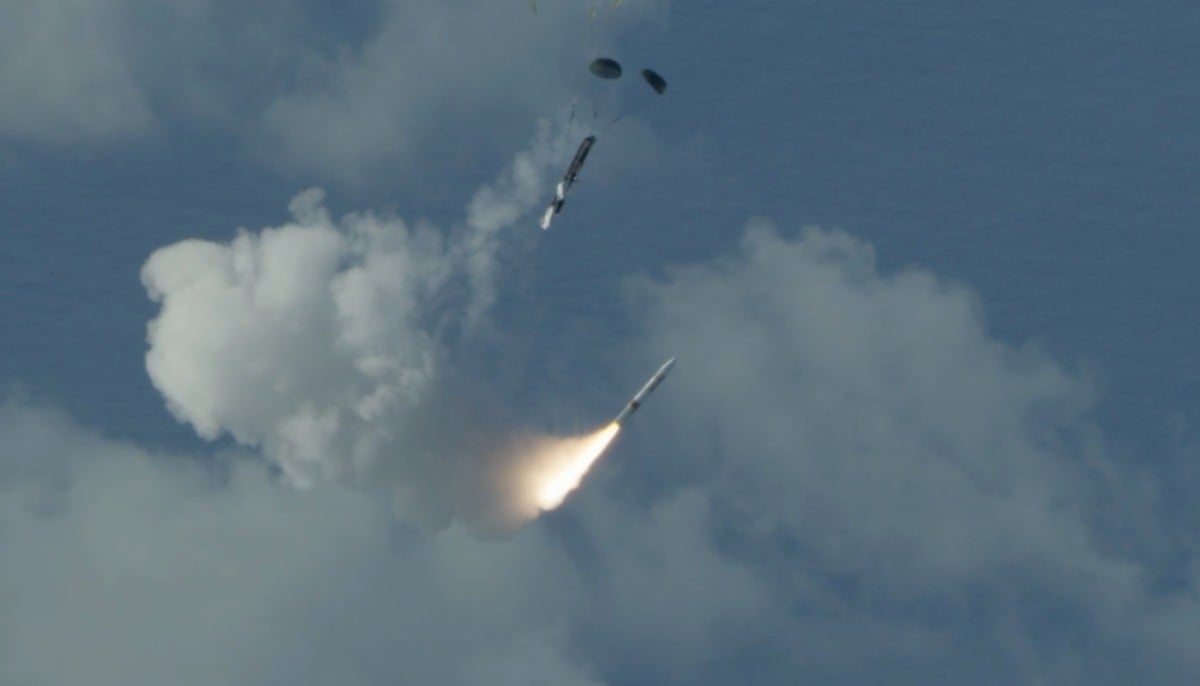
- The Missile Defense Agency published the Mobile Integrated Launch Capability solicitation on June 25, 2026, seeking mobile missile launch platforms to replace C-17 air drop target launches for missile defense testing.
- The two-phase program requires detailed design within six months and a live launch demonstration within twenty-four months, with ground, sea, and air launch concepts all eligible.
America’s missile defense testing program has a logistics problem, and the Pentagon wants industry to solve it: the Missile Defense Agency, the organization responsible for developing and testing America’s shield against ballistic missile attack, has issued a formal solicitation seeking mobile launch platforms that can fire test missiles from virtually anywhere on earth at dramatically lower cost than the current method of dropping them from C-17 cargo aircraft.
The solicitation, published June 25, 2026, under the designation Mobile Integrated Launch Capability, or MILC, opens a competition for industry to design, prototype, and demonstrate ground, sea, or air-launched mobile systems capable of putting target missiles into the sky from multiple worldwide locations with enough flexibility and speed to support the testing cadence that the expanding American missile defense architecture demands.
The solicitation period runs through September 30, 2028, giving companies nearly two and a half years to submit white papers describing their proposed approaches, with the Missile Defense Agency able to select and fund promising concepts at any point throughout that window rather than waiting for a single closing date.
The operational context for this solicitation is the way the United States currently tests its missile defense systems, a process that requires firing target missiles that simulate the trajectories and characteristics of adversary ballistic missiles so that interceptors can demonstrate they can destroy them. Those target missiles have historically been launched primarily from C-17 Globemaster III transport aircraft through an air drop sequence, a method that works but carries inherent constraints: C-17 availability competes with other military airlift demands, the aircraft must be positioned in specific locations to achieve the required trajectory, the cost per test event is substantial, and the process does not easily support the kind of rapid, high-frequency testing cadence that the Missile Defense Agency wants to achieve as it validates new interceptors, new sensors, and new layers of the Golden Dome domestic missile defense architecture. A mobile ground, sea, or air launch platform that can be positioned almost anywhere, requires no dedicated strategic airlift, and can be reset and relaunched rapidly would eliminate most of those constraints simultaneously.
The solicitation specifically calls for concepts capable of launching target vehicles across the full range of threat categories that American missile defense systems must be tested against. The solicitation documentation lists ballistic targets, maneuvering reentry vehicles, hypersonic glide vehicles, fractional orbital bombardment systems, maneuvering orbital bombardment systems, and air-breathing targets, covering the spectrum from short-range ballistic missiles to intercontinental range systems and the newest generation of hypersonic threats that have driven the most urgent investment in American missile defense in decades. The ability to test against all of those target categories from a mobile, rapidly deployable platform rather than from fixed test ranges or dedicated aircraft would significantly expand the Missile Defense Agency’s testing flexibility.
The program divides into two phases with explicitly compressed timelines that reflect the agency’s urgency. Phase I, covering detailed design and engagement analysis, carries an objective completion period of three months with a maximum threshold of six months, a schedule that requires competitors to focus on integrating commercially available off-the-shelf components rather than developing new technologies from scratch. Phase II, covering prototyping, ground testing, and an actual launch demonstration from a designated location, carries an objective period of twelve months with a maximum threshold of twenty-four months. At the end of Phase II, the winning vendor delivers one complete launch platform along with the services required to integrate, transport, and launch a target vehicle system. The entire program from contract award to live launch demonstration is designed to complete within thirty months at the outside, an aggressive schedule by any standard for a system that must handle classified target vehicles and operate in compliance with missile technology export controls.
The solicitation explicitly encourages concepts based on modular, open architecture designs that use commercial and military standard components, maximize use of previously developed subsystems, and employ rapid low-cost manufacturing practices. That preference for commercially grounded engineering over purpose-built military development reflects both the cost reduction imperative the solicitation emphasizes and the practical reality that the six-month Phase I timeline does not permit extensive new technology development. Competitors who can demonstrate integration of existing liquid or solid propellant launch systems with mobile platform concepts will have a structural advantage over those proposing novel propulsion or launch mechanism designs that would require the development time the schedule prohibits.
The solicitation accepts ground, sea, and air-launched concepts, opening the competition to a wide range of platform types that might include truck-mounted mobile launchers similar in concept to those used by various countries for ballistic missile launch, ship-based launch systems adapted from naval missile programs, or aircraft-based launch solutions that differ from the C-17 air drop method in cost, availability, or operational flexibility. The decision to keep platform type open rather than specifying a single approach reflects the Missile Defense Agency’s interest in seeing what industry proposes rather than presupposing that any single launch modality is optimal across all the trajectory requirements the testing program demands.
The gap between a missile defense system that works in carefully controlled tests from fixed ranges and one that can be validated against the full diversity of real-world threat trajectories is narrower than it appears, but it matters enormously for confidence in the system’s actual performance. MILC is the Missile Defense Agency’s attempt to close that gap.