

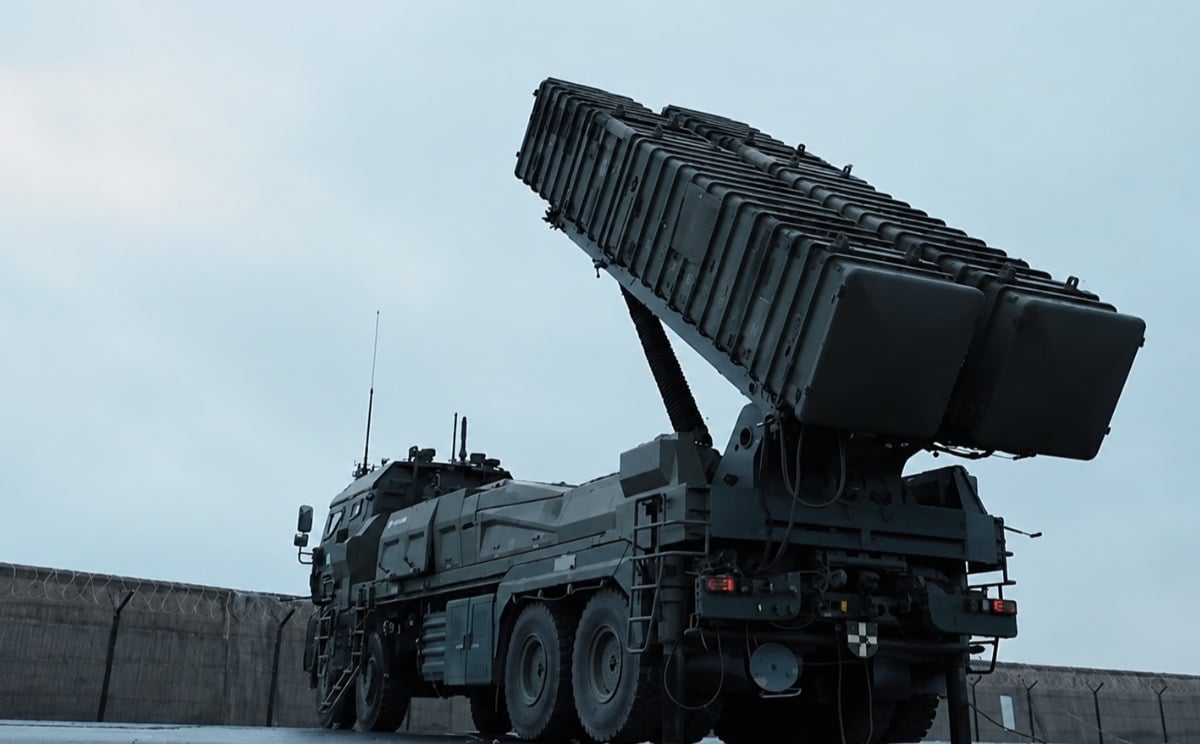
- Turkey's Ministry of National Defense confirmed ROKETSAN delivered TAYFUN Block-2 ballistic missiles to the Turkish Armed Forces, with quantities undisclosed, in a second consecutive monthly delivery.
- The delivery batch also included weapon carrier vehicles and Karayel Hull Boat Systems, accepted by Turkey's Special Forces Command.
Türkiye has quietly expanded its arsenal of domestically produced ballistic missiles, with the country’s Ministry of National Defense confirming that ROKETSAN has delivered additional TAYFUN Block-2 missiles to the Turkish Armed Forces, continuing a delivery program that has now seen at least two confirmed batches reach military hands within consecutive months.
The Turkish Ministry of National Defense posted the confirmation on its official social media account, noting that its Special Forces Command had completed inspection and acceptance activities for various quantities of TAYFUN Block-2 missiles, along with weapon carrier vehicles and Karayel Hull Boat Systems.
ROKETSAN, Türkiye’s state-affiliated missile and rocket manufacturer and one of the most consequential defense companies to emerge from any NATO member nation’s domestic industry in the past two decades, confirmed on its own account that deliveries of the TAYFUN Block-2 were continuing to the Turkish Armed Forces. The quantity delivered was not disclosed, consistent with Türkiye’s practice of withholding numerical details on strategic missile deliveries.
The TAYFUN is Türkiye’s first domestically developed short-range ballistic missile, a category of weapon that carries strategic significance well beyond its range class. Unlike cruise missiles, which fly at low altitude on a sustained powered flight path and can be intercepted by conventional air defense systems designed for aircraft, ballistic missiles follow a high-arcing trajectory that takes them briefly into the upper atmosphere before they descend at hypersonic speeds toward their targets. That flight profile makes them considerably harder to intercept than cruise missiles, requiring specialized missile defense systems of the kind that only a handful of countries operate. TAYFUN flies to a range of approximately 561 km (349 miles), according to publicly available information from previous Turkish defense announcements, placing targets across a substantial portion of the eastern Mediterranean, the Black Sea region, and neighboring countries within reach of Turkish ground forces without requiring aircraft to penetrate contested airspace.
The Block-2 designation indicates an upgraded variant of the baseline TAYFUN system, though Türkiye has not publicly detailed the specific improvements the Block-2 incorporates over the original configuration. In ballistic missile development, block upgrades typically address one or more of the following: guidance precision, warhead options, reliability improvements drawn from operational experience, or modifications to the propulsion system to adjust range or trajectory characteristics. The fact that Türkiye has moved to serial delivery of the Block-2 rather than the original variant suggests the upgraded configuration has completed whatever development and testing cycle preceded this production phase.
ROKETSAN’s role in Türkiye’s missile independence story is difficult to overstate. The company, headquartered in Ankara and majority-owned by the Turkish Armed Forces Foundation alongside other Turkish institutional shareholders, has grown from a producer of unguided rockets in the 1990s into a developer of precision-guided missiles, cruise missiles, ballistic missiles, anti-tank systems, and air defense interceptors. Its product portfolio now spans capabilities that most NATO members source from American or European suppliers, and Türkiye’s domestic production of these systems has given Ankara a degree of strategic autonomy that distinguishes it from virtually every other alliance member. The ability to develop, produce, and deliver a short-range ballistic missile without dependence on foreign suppliers or technology transfer permissions reflects investments in the Turkish defense industrial base that span three decades and accelerated sharply after 2019, when the United States removed Turkey from the F-35 program following Ankara’s purchase of the Russian S-400 air defense system.
The delivery package confirmed in the Ministry announcement also included missile carrier vehicles, the mobile launchers that give TAYFUN its operational flexibility by allowing missiles to be repositioned rapidly between firing positions, a survivability characteristic that fixed-site ballistic missile systems cannot match. Mobile ballistic missile systems complicate adversary targeting by denying a static aim point, and the inclusion of additional weapon carrier vehicles in this batch suggests Türkiye is building not just missile stocks but the complete mobile firing infrastructure that makes those stocks operationally useful. The Karayel Hull Boat System included in the same acceptance batch is a separate program, an unmanned surface vehicle developed for naval mine laying and reconnaissance operations, though its inclusion in a combined delivery suggests Turkey is managing multiple advanced systems programs simultaneously at a delivery tempo that reflects a defense industry operating at sustained high output.