

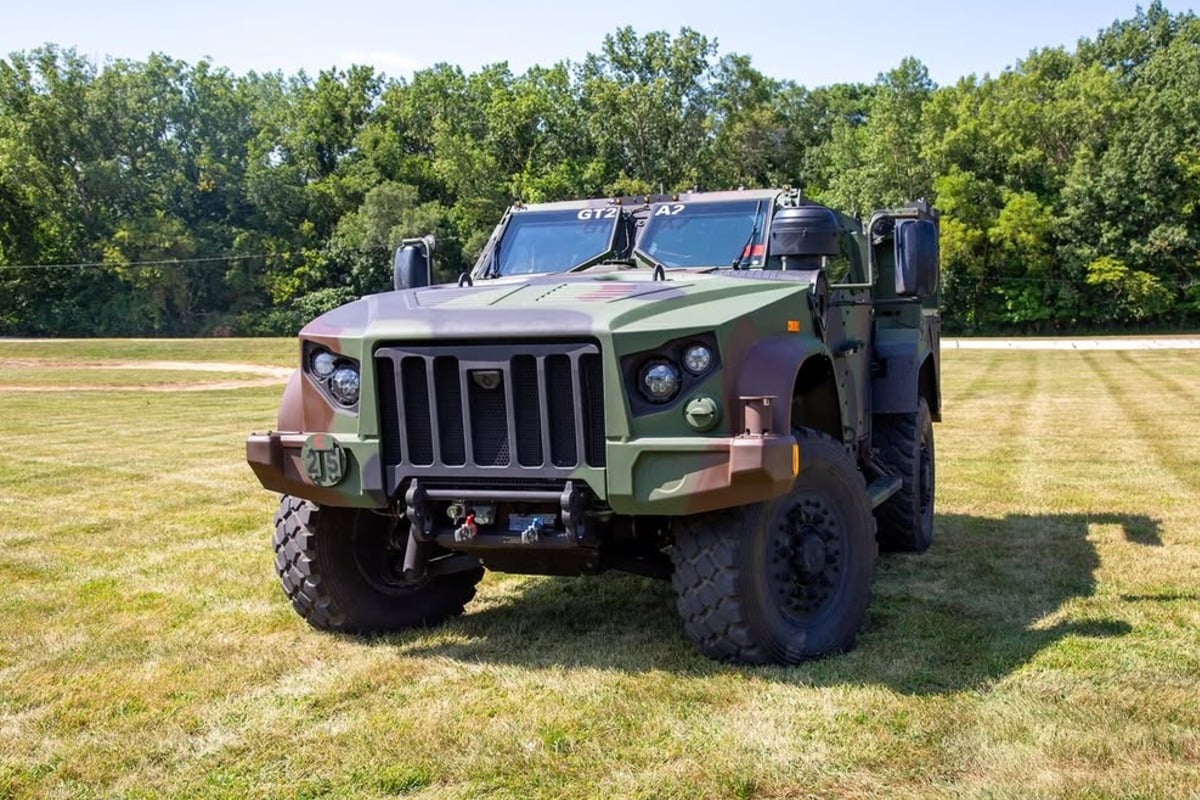
- AM General CEO John Chadbourne issued a public statement June 26, 2026, defending the JLTV A2 program amid congressional funding cuts and a Marine Corps search for a second supplier.
- The House Appropriations defense subcommittee cited the program as more than 20 months behind schedule with approximately 2,000 vehicles in arrears.
The CEO of AM General stepped into a rapidly widening political fight on June 26, publishing a public statement defending his company’s handling of the JLTV A2 program as Congress moved to slash funding, the Marine Corps hunted for a backup supplier, and lawmakers in Washington called the program a readiness crisis in the making.
John Chadbourne, President and CEO of AM General, issued the statement from the company’s South Bend, Indiana headquarters as the House Appropriations defense subcommittee was preparing to cut $133 million from the Marine Corps’ proposed $245 million JLTV A2 procurement budget for fiscal year 2027. The subcommittee described a program more than 20 months behind schedule with approximately 2,000 vehicles in arrears. The Marine Corps had already paused new JLTV A2 procurement in its fiscal year 2026 budget to allow AM General time to clear its delivery backlog — a concession that itself signaled the depth of the problem. What began as a contract transition dispute has become a full-scale political confrontation with an $8.66 billion program hanging in the balance.
The JLTV is the vehicle the U.S. Army and Marine Corps have been buying to replace the aging Humvee — the iconic but increasingly vulnerable light tactical truck that served through Desert Storm, Iraq, and Afghanistan before the realities of improvised explosive devices made clear it was never designed for the threat environment it kept being sent into. The JLTV weighs roughly 6,350 kg (14,000 lb), nearly twice a Humvee’s curb weight, yet manages a top speed exceeding 160 km/h (100 mph) and 70 percent better off-road mobility than the vehicle it replaces, thanks to an intelligent independent suspension system and a blast-deflecting V-shaped hull designed from the outset to resist the kind of roadside bombs that cost so many lives in Iraq. It is a heavily armored truck that moves like a capable off-road vehicle and protects its crew like something far heavier.
The original JLTV production contract went to Oshkosh Defense in August 2015, valued at $6.75 billion, and produced more than 24,000 vehicles before the Army put the contract back out for competition in 2023. AM General won that recompete in February of that year, beating Oshkosh with what the Army described as the best overall value determination, earning a five-year contract with five one-year options covering up to 20,682 vehicles and up to 9,883 trailers at a total ceiling of $8.66 billion. Oshkosh protested the award, the Government Accountability Office denied the protest, and AM General began the work of standing up production of a vehicle it did not design and had never built before — manufacturing Oshkosh’s own platform at the South Bend facility.
That transition proved far harder than anticipated. “Transitions of major defense production programs from one manufacturer to another are inherently complex,” Chadbourne wrote. “The JLTV A2 transition proved especially challenging due to the unforeseen condition of the technical baseline we inherited, the engineering effort required to mature the design for production, and supplier transition issues encountered during execution.” Since contract award, AM General processed more than 2,100 supplier change requests, corrected deficiencies in the inherited technical baseline, addressed component obsolescence, and qualified entirely new suppliers while simultaneously making significant investments to build a stable production capability. That scale of remediation work — over 2,100 supplier change requests alone — paints a picture of a program that encountered foundational problems before a single production vehicle rolled out the door.
The A2 variant is not simply a rebadged version of the Oshkosh-built A1. AM General claims the JLTV A2 incorporates more than 250 engineering enhancements covering reliability, maintainability, manufacturability, sustainability, and operational capability, with the company arguing these improvements reduce lifecycle costs over the platform’s service life. A key architectural change confirmed in the Army’s original contract announcement is the A2’s baseline integration of lithium-ion batteries, making it the first tactical wheeled vehicle in the Army inventory with that capability built in from the ground up — a feature that enables anti-idle operation, reducing fuel consumption and heat signature during stationary missions.
None of that engineering work insulated the program from its schedule problems, and the political pressure escalated sharply through mid-2026. Despite nearly $2 billion obligated to AM General since contract award, the Department of War had yet to accept a single production-standard JLTV A2 by the time lawmakers moved against the program. The Marine Corps, counting on the A2 to replace its entire Humvee fleet, issued a request for information seeking a potential second supplier. Oshkosh Defense moved quickly to position itself as the only company capable of filling that gap on the timeline the Marines needed, pointing to its history of producing more than 24,000 A1 vehicles and its experience surging production on prior programs. The original designer of the platform, having lost the recompete three years earlier, was now arguing the Army had made a mistake it could not afford.
AM General described its approach as a parallel path strategy — simultaneously ramping production while supporting the government’s ongoing test and evaluation program through the remainder of 2026. The company expects to reach full production in 2027 and describes demand as strong, with a funded backlog of $2 billion across Army, Marine Corps, and international customers. “Every transmission we deliver contributes to the dependability and availability of the platforms that our Warfighters depend on around the world,” Chadbourne wrote, framing the delays as the cost of doing the transition correctly rather than quickly.
The broader fight that makes this dispute particularly consequential is the Army’s own evolving posture on the program. As part of its 2025 transformation initiative, the Army signaled it intended to stop buying JLTVs entirely, categorizing the platform alongside other systems it considered no longer suited to the force structure it wanted to build. Congressional appropriators pushed back hard, including $345 million for continued Army procurement in the final fiscal year 2026 defense spending bill — nearly $300 million above what the Army had requested. The Army has since clarified it does not plan to divest the JLTVs already in its fleet, but the procurement picture remains unsettled, shifting even more weight onto Marine Corps demand to justify the industrial base AM General built in South Bend.
The statement Chadbourne published is, at its core, a CEO arguing that his company inherited a broken technical baseline, did the work to fix it, and deserves the chance to see the production ramp through rather than having the contract restructured or redirected before full-rate production begins in early 2027. Whether that argument lands with the lawmakers who control the funding, or with a Marine Corps that measures readiness by vehicles available today rather than promises about next year, will determine whether AM General holds the contract it won — or watches Oshkosh Defense walk back into a program it never wanted to leave.