

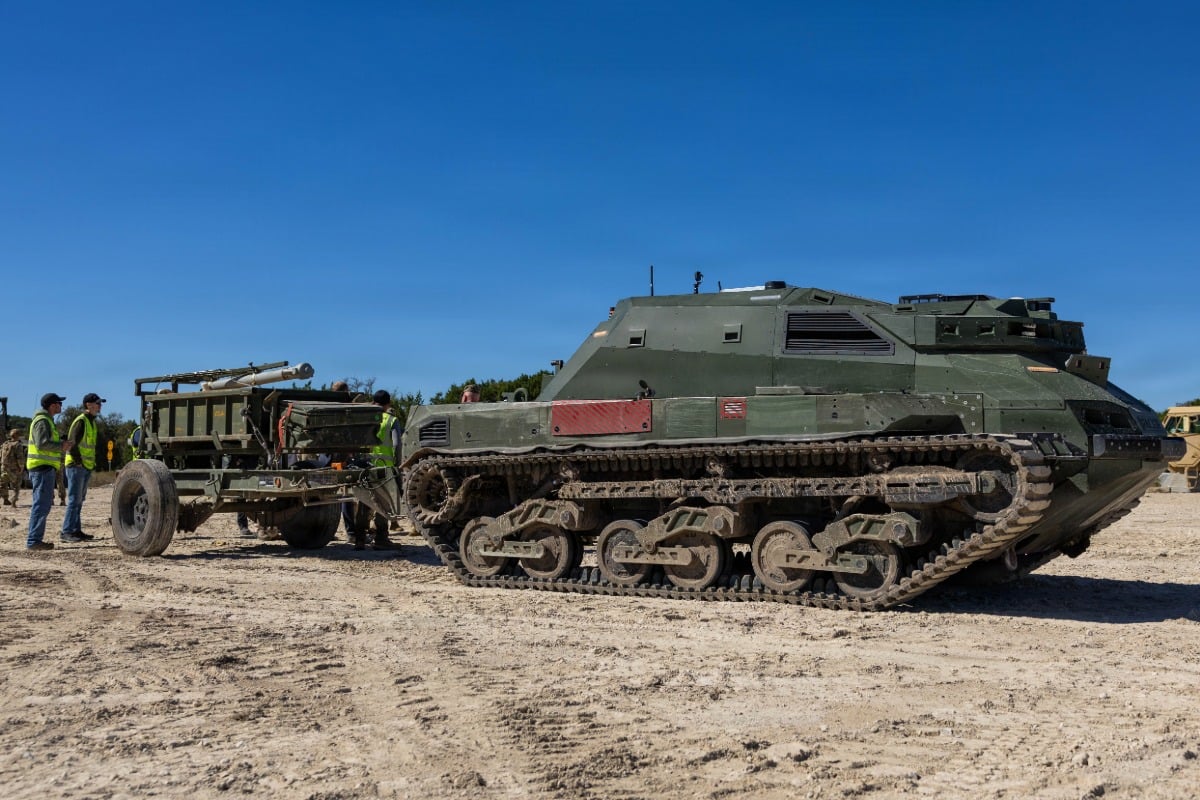
- LTC Richard Brennan III's AUSA Land Warfare Paper argues the U.S. military risks doctrinal obsolescence by treating autonomous systems as supplements rather than core warfighting tools.
- Brennan recommends creating a Joint Robotics Agency, standardizing robotic definitions across services, and transforming leadership and recruitment to match the demands of autonomous warfare.
The United States military risks suffering a “robotic blitzkrieg” if it continues treating autonomous systems as supplements to existing doctrine rather than as the central instruments of a new era of warfare, argues a serving U.S. Army strategist whose Land Warfare Paper published by the Association of the United States Army lays out one of the most comprehensive frameworks for military robotics transformation to appear in American defense literature.
Lieutenant Colonel Richard Brennan III, currently serving as Country Director for Bahrain and Qatar at the Office of the Under Secretary of War for Policy and a former strategy branch chief for the Joint Counter-Small Unmanned Aircraft Systems Office, published the paper through AUSA’s Land Warfare Paper series under the title “The Robotification of Warfare: Strategic Imperatives for the Robotic Age.” The paper draws on Brennan’s direct experience redesigning the Department of War’s counter-drone enterprise and authoring department-wide policy on countering unmanned systems, giving his analysis an operational grounding that distinguishes it from purely academic assessments of the same subject.
Brennan’s central argument is organized around a historical analogy that military historians will recognize immediately and general readers will find illuminating. He compares the current transition to robotic warfare with the mechanization revolution of the 1920s and 1930s, when the internal combustion engine transformed cavalry and infantry into armored formations, and when militaries that failed to adapt their doctrine to match their new equipment suffered catastrophic consequences. France built the Maginot Line rather than developing mobile armored doctrine, and Germany exploited that doctrinal stagnation with blitzkrieg. Brennan warns that the United States now faces a structurally identical choice, and that focusing primarily on countering enemy drones while neglecting to transform American doctrine around autonomous systems would produce what he explicitly calls a “robotic Maginot Line,” misusing transformational technology to sustain outdated methods of warfare rather than understanding how those technologies are redefining the battlefield itself.
The paper defines robotification as the integration of autonomous machines to replace human roles in combat and support functions, a definition that deliberately emphasizes replacement rather than augmentation. This distinction matters because it shapes the entire analytical framework: if robots merely enhance human capability, existing doctrine requires refinement; if robots replace human roles, existing doctrine requires replacement. Brennan argues for the latter interpretation, and supports it with case studies from Ukraine, China, Israel, and the United States that illustrate how each approaches the problem differently.
Ukraine’s Operation Spiderweb in June 2025, which used 117 low-cost first-person-view drones to damage Russian strategic bombers across five airbases, receives significant attention as a demonstration of what Brennan calls low-cost mass, the principle that inexpensive autonomous systems produced in large quantities can achieve strategic effects against high-value targets that would previously have required far more expensive and risky operations. Ukraine’s Security Service coordinated the operation, smuggling drones disguised as civilian cargo over 18 months before executing coordinated strikes, exploiting Russian surveillance gaps and demonstrating human-machine synergy at a tactical level that existing American doctrine does not yet systematically replicate. Brennan notes that Russian electronic warfare, including Orlan-10 jamming systems, disrupted drone signals during the operation, forcing Ukrainian operators to adapt with fiber-optic tethering, an illustration of the constant measure-countermeasure cycle that he argues must drive American system design from the outset rather than as an afterthought.
China’s approach, backed by what Brennan cites as a $10 billion investment in military robotics, combines high-capability stealth platforms like the Sharp Sword unmanned aerial vehicle with lower-cost drones for volume operations, particularly in the South China Sea. Israel’s Harop loitering munition, a platform that flies autonomously to its target area and then dives into the target when it detects an emission signature, represents a different balance point, one that prioritizes precision capability over raw volume but deploys in sufficient numbers to overwhelm defenses. The Harop costs approximately $700,000 per unit, placing it between the cost extremes of a conventional cruise missile and the cheap drones Ukraine uses by the thousands. Brennan presents Israel’s approach as a model for balancing affordability with capability, noting that Hezbollah’s use of commercially available jammers to degrade Harop’s effectiveness underscores the resilience challenge that all robotic systems face regardless of their sophistication level.
The United States, Brennan argues, has made genuine progress through programs like Project Convergence, which integrates drones, ground robots, and cyber tools into joint operations, and through the development of Human-Machine Integrated Formations. But he identifies a deeper institutional problem that technology spending alone cannot solve: the American military treats robotics as add-ons to existing doctrine rather than as transformational capabilities that require doctrine to be rebuilt around them. The Department of War plans to increase robotics spending from $6.9 billion in fiscal year 2025 to $13.4 billion in fiscal year 2026, with most of that funding directed toward unmanned aerial systems. Brennan’s concern is not that this investment is insufficient but that without doctrinal transformation and organizational reform, it will produce the robotic equivalent of trucks being used to keep horse cavalry fed rather than to enable an entirely new way of fighting.
Among Brennan’s most specific recommendations is the creation of a Joint Robotics Agency under the Office of the Secretary of War, modeled on DARPA’s structure and mandate, that would centralize robotics development, standardize communication protocols across services, and prevent the fragmented service-by-service approach that currently produces incompatible systems and redundant programs. He also argues for a formal definitional framework that distinguishes between robotic systems, which are reusable autonomous platforms, and smart munitions, which are single-use precision weapons, because the current conceptual confusion between these categories causes resource misallocation and hampers both acquisition and training. The global military robotics market, projected by the paper to grow from $18.2 billion in 2024 to $26.5 billion by 2029, will not wait for American bureaucratic processes to reach consensus on terminology.
The paper’s historical parallels extend to leadership, where Brennan invokes the Louisiana Maneuvers of 1940 and 1941, exercises covering 3,400 square miles (8,806 sq km) and involving more than 500,000 troops, which exposed such serious deficiencies in American Army leadership that General George C. Marshall replaced 31 of 42 senior officers with commanders capable of operating in a mechanized warfare environment. Eisenhower and Patton were among those elevated. Brennan argues that the robotic age demands a parallel personnel transformation, elevating officers fluent in artificial intelligence, human-machine teaming, and autonomous system ethics, and that the recruitment pipeline must look beyond traditional physical aptitude metrics toward the digital fluency that drone operators and AI system managers actually require.
The battlefield is already robotic, and the question is whether the institutions managing that battlefield will adapt their thinking at the speed the technology demands, or whether they will build the next Maginot Line and wait for the blitzkrieg to find the gaps.