

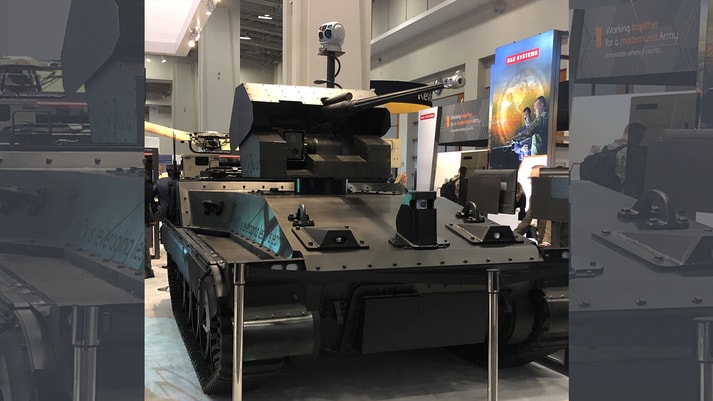
BAE Systems, Britain’s biggest defense company, debuted on Monday it’s Robotic Technology Demonstrator (RTD) representing leap-ahead advancements for unmanned combat vehicles at the Association of the United States Army’s (AUSA) Annual Meeting & Exposition.
The RTD prototype showcases advanced capabilities and is adaptable for future weapon systems, sensors and other payloads. The RTD features autonomous mobility to help keep soldiers out of harm’s way, a Hybrid Electric Drive for fuel efficiency, a 30 mm remote weapons station, a suite of sensors for 360-degree situational awareness and surveillance, composite rubber track system, and a small legged robot for reconnaissance missions among other key new technologies. The demonstrator reflects BAE Systems’ commitment to investing in the future of Army warfighting capabilities and the soldier.
“The Robotic Technology Demonstrator is designed as a ‘rolling lab’ to integrate emerging autonomy and lethality technologies for testing. The electrical infrastructure, advanced optics, and software that have been integrated onto this highly reliable and robust chassis provides the foundation for truly game-changing battlefield capability,” said James Miller, director for business development at BAE Systems Combat Vehicles. “BAE Systems built this demonstrator to help us determine the best way to mitigate risk for our soldiers while increasing their lethality.”
The RTD technologies include sensors with true 360-degree situational awareness to include long-wave infrared imaging, signal processing and video distribution. It also includes a tethered unmanned aerial system to support situational awareness and reconnaissance.
The RTD prototype leverages decades of BAE Systems expertise in the design and development of combat vehicles, as well as advanced electronic systems. BAE Systems is a world leader in tracked and wheeled combat vehicles, including Infantry Fighting Vehicles, self-propelled howitzers, personnel carriers, and amphibious vehicles.