


- AZAK detailed how its unmanned ground platform was tested during 2025 Army evaluations, including xTechOverwatch and a National Training Center rotation.
- The company said U.S. Army and SOF units are exploring the platform for roles such as resupply, CASEVAC, counter-UAS payloads, and drone-launch systems.
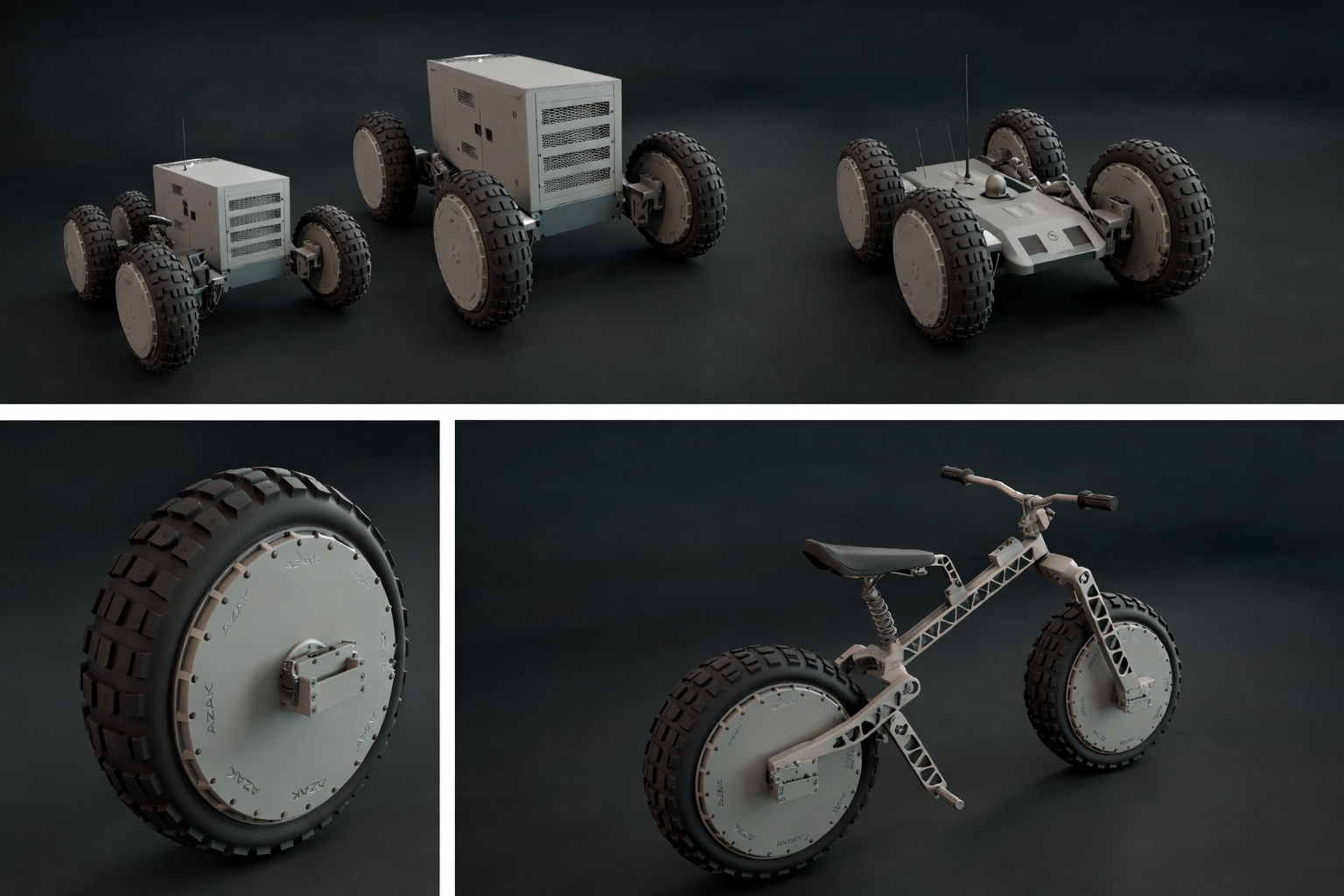
Denver-based AZAK is positioning itself at the center of a shift in unmanned ground mobility with a chassis-free vehicle built around an autonomous wheel system rather than a traditional frame. In place of axles, drivetrains, and a fixed body, the company designed each wheel as a self-contained power unit that houses the motor, battery, and core drive components.
The architecture allows torque to scale by adding wheels, lowers the center of gravity, and enables obstacle climbing instead of avoidance.
This chassis-free unmanned ground vehicle is meant to behave differently from conventional UGVs, offering a higher payload-to-weight ratio, improved stability on uneven terrain, and the ability to assemble platforms in multiple configurations without redesigning the vehicle. The concept has emerged as a central topic in AZAK’s work with the U.S. Army, drawing interest from units seeking mobility solutions for resupply, counter-UAS roles, CASEVAC tasks, and drone-launch systems.
That vision — a wheel-centric, modular, chassis-free ground robot — forms the core of our interview with AZAK CEO Ben Meager. He detailed how units tested the platform throughout 2025, including at xTechOverwatch and during a full National Training Center rotation, and why the company believes this approach represents a new direction in ground autonomy.

Meager said the Army evaluated AZAK at the 2025 xTechOverwatch competition to see whether the platform could reshape how squads planned and executed missions. Soldiers employed the system in multiple field scenarios, using it for load carriage, movement across rough ground, and deployment of smaller drones.
One soldier summarized the platform’s role during the event, saying AZAK “allows for more guns to be in the fight, takes the burden of carrying heavy loads, and can also be used to allow for deployment of smaller drones without needing to place a Soldier at risk.”
According to Meager, the system carried more than 500 pounds across difficult terrain and altered the participating squad’s concepts of operation at each stage of the trials.

“The Soldiers quickly grasped the high-ceiling potential of AZAK, recognizing it as an essential tool to accelerate their mission tempo and, most critically, keep personnel out of harm’s way.”
Meager emphasized that AZAK does not identify as a UGV manufacturer in the traditional sense. Instead, the company builds a mobility technology centered on a self-contained wheel module.
“AZAK’s architecture isn’t just an unusual concept; it is the defining evolution of ground mobility,” he said.
He outlined three main drivers behind the design:
- Low center of gravity: All drive components sit inside and below the wheel’s midpoint, improving stability and climbing performance.
- Higher payload-to-weight ratio: Eliminating axles and chassis reduces system weight.
- Flexible modularity: The wheel can be assembled into any mission-specific platform without a dedicated vehicle body.
“We don’t build a single vehicle; we provide the core engine of ground autonomy in endless configurations.”
When asked how the system manages navigation and obstacle handling, Meager said AZAK is designed to simplify autonomy rather than rely on complex avoidance software.
The platform is “control-agnostic,” meaning any autonomy stack can be integrated, while the system’s mechanics allow it to handle terrain directly.

“For AZAK, obstacle avoidance is often unnecessary. Our platform’s stability, power, and clearance allow it to climb over objects that other vehicles must detect, route around, or simply fail to clear.”
The latest S26 wheel, in a four-wheel configuration, carries up to 1,500 pounds — enabling long-range operations and integration of heavy payloads such as C5ISR systems or kinetic counter-UAS interceptors.
AZAK’s multi-unit capability is central to its concept. Each wheel has an independent drivetrain, which allows torque to scale linearly when wheels or modules are added.
“Our standard 4-wheel configuration delivers 588 lb-ft of constant torque; by simply expanding to a 6-wheel configuration, the system provides a linear increase to 882 lb-ft,” Meager said.
He noted that the company is developing a broader range of new mission profiles and expanded configurations, without tying the work to specific payloads or variants, with planned announcements in 2026.
One senior Air Force officer who observed the system remarked: “With AZAK, the only limitation is imagination.”

A key milestone during 2025 was AZAK’s participation in a full rotation at the National Training Center with the 1st Cavalry Division. Meager said the company aimed to validate performance in terrain where other vehicles struggled or could not operate at all.
“We specifically focused on operating in terrain where other vehicles simply cannot go, traversing untouched ground far from established tracks,” he said. “Our successful integration into a premier training exercise like the TiC NTC rotation confirms that AZAK is adapted not just for the known battlefield, but for the most contested and difficult terrain imaginable.”
Meager said AZAK closed 2025 with strong demand, noting active engagement with Special Operations Forces, Brigade Combat Teams, and Army modernization offices focused on medical and logistics requirements.
Initial interest centered on CASEVAC and tactical resupply, but units are now exploring the platform as a mobility base for emerging systems.
These include:
- drone-launch and swarm platforms,
- kinetic counter-UAS payloads,
- communications relay modules,
- mobile power-generation units,
- and heavy equipment sustainment.
“Whether integrating a CASEVAC module or a cutting-edge kinetic payload, our mission remains the same: provide uncompromised all-terrain mobility when and where it matters most.”