

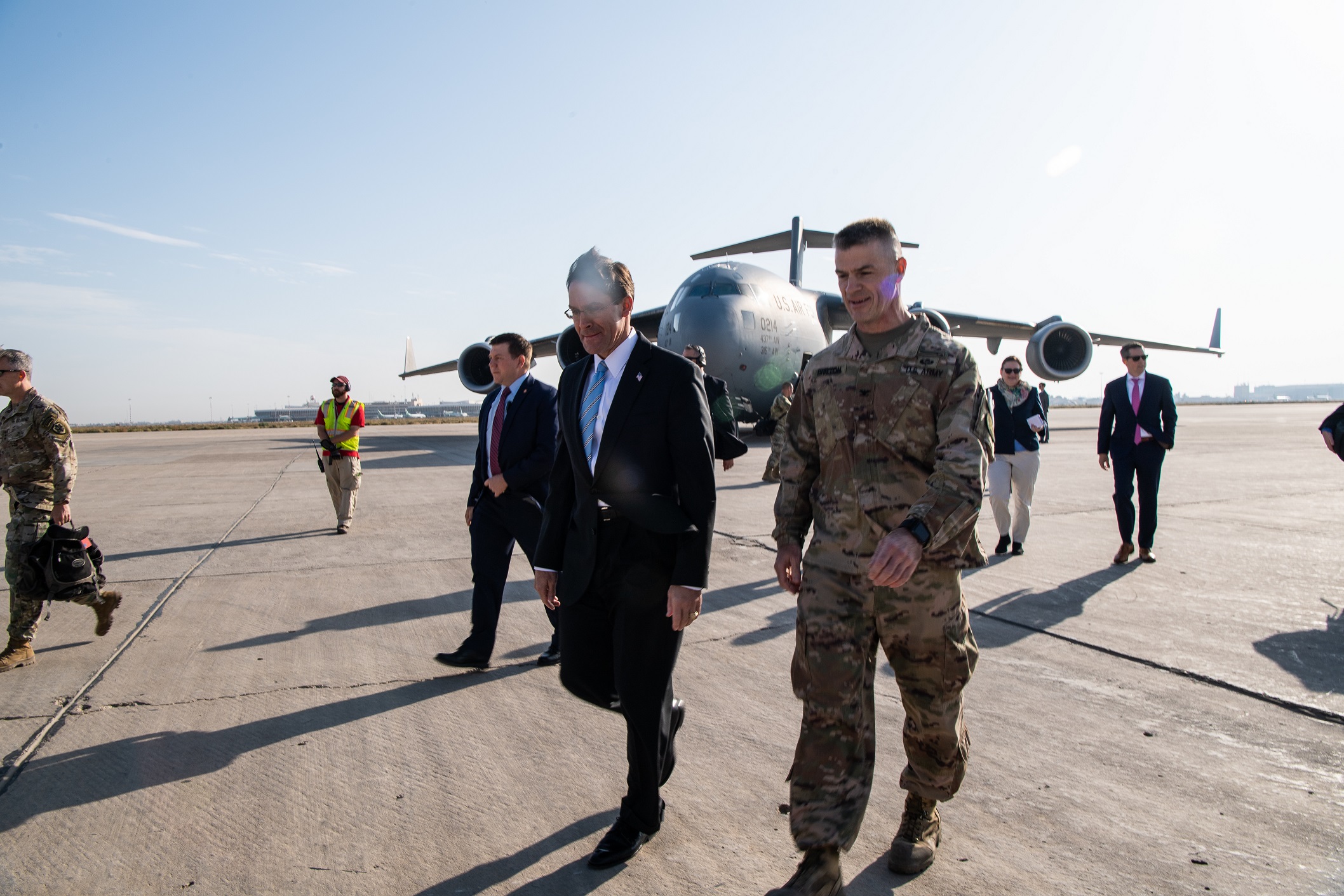
The United States continues to deploy and reposition troops throughout the region of Iraq and Iran to bolster U.S. security and force protection and to be prepared for any contingency, Defense Secretary Dr. Mark T. Esper said.
“Over the last several days, I’ve had many conversations with our partners and allies about the situation in Iraq and the region,” the secretary told reporters at an impromptu Pentagon news conference today.
“It’s been uniform support for our position and our actions, and I continue to convey to them the importance we continue to place on the defeat-ISIS position,” Esper said of the U.S. drone attack that killed Gen. Qassem Soleimani, the head of the Islamic Revolutionary Guard Corps’ elite Quds Force, one of the most powerful figures in the region.
Deterring Iran from its bad behavior and standing up to that behavior has been going on for 40-plus years, the secretary added. “And … we remain prepared for any contingency with regard to Iran,” he said.
The U.S. message is that the ball is in Iran’s court, and the United States encourages Iran to de-escalate the situation, Esper said, adding that the United States is open to discussing issues and having a more normal relationship with Iran. “But if Iran chooses to go the other path, we are prepared to deal with that and will respond forcefully,” he said.
No decision whatsoever has been made for the United States to leave Iraq, the secretary said, reemphasizing the U.S. commitment to Iraq to defeat ISIS and noting the escalation of attacks by Iranian and proxy groups attacking U.S. forces.In recent months, the secretary said, nearly a dozen such attacks took place, escalating in size, scale and types of weapons, including one attack that killed an American.
Esper said the Iranians fired 31 rockets that weren’t meant to harass, but were designed to kill people and destroy things. “Then we had the siege of the embassy,” he added.
He called the strike that killed the Quds Force leader a matter of self-defense carried out to protect Americans.
“When we looked at this operation, we knew there would be consequences; we knew there’d be risks,” said Army Gen. Mark A. Milley, the chairman of the Joint Chiefs of Staff, who joined Esper in briefing reporters. “We didn’t take any of it lightly. We knew we’d have to address [the posture of U.S. Central Command troops] for force protection in the immediate aftermath of this particular strike operation.”
“How do you expect us not to respond when they’ve been killing our people for 20 years?” Esper asked. “Soleimani alone has the blood of hundreds of Americans; he’s wounded thousands of American coalition partners. He is a terrorist, a leader of a terrorist organization who’s been killing and attacking Americans for 20-some years, and the blood is on his hands.”
Soleimani was planning attacks on American forces, Esper said. “This whole narrative that’s being turned around is silly,” he added.
“We knew his history, and importantly, we knew his future,” Milley said, noting that while the evidence cannot be discussed, the evidence was compelling that Soleimani was planning, organizing and synchronizing significant combat operations against U.S. military forces in the region and it was an imminent decision-making event.
“We would have been culpably negligent to the American people had we not made the decision we made,” the general said. But even with Soleimani dead, he said, it doesn’t mean the strike eliminated all threats.
“There’s still significant risk operating throughout the Middle East, and specifically in Iraq,” Milley said.
As to the United States attacking Iran’s cultural sites, U.S. forces will follow the laws of armed conflict, Esper said.
Milley also addressed an unsigned letter from Marine Corps Brig. Gen. William H. Seely, the commanding general of Task Force, Iraq, that was addressed to Iraq’s Defense Ministry. The letter was a draft that was sent out unintentionally, the chairman said.
It addressed plans to withdraw American troops from the region, per the Iraqi parliament vote over the weekend to send U.S. troops home, and it was composed because the U.S. military is moving forces around, Milley said.
“We have increased helicopter movement in Iraq between Baghdad and Taji and other camps and stations, and we are bringing in forces from Kuwait,” he explained. “So there are increased levels of U.S. troops movements in rotary-wing helicopters.”
The draft was sent to the Iraqis to get their feedback, Milley said. “The long and the short of it is [that] it was an honest mistake by people trying to do the right things in highly dynamic situations. It should not have been sent.”