

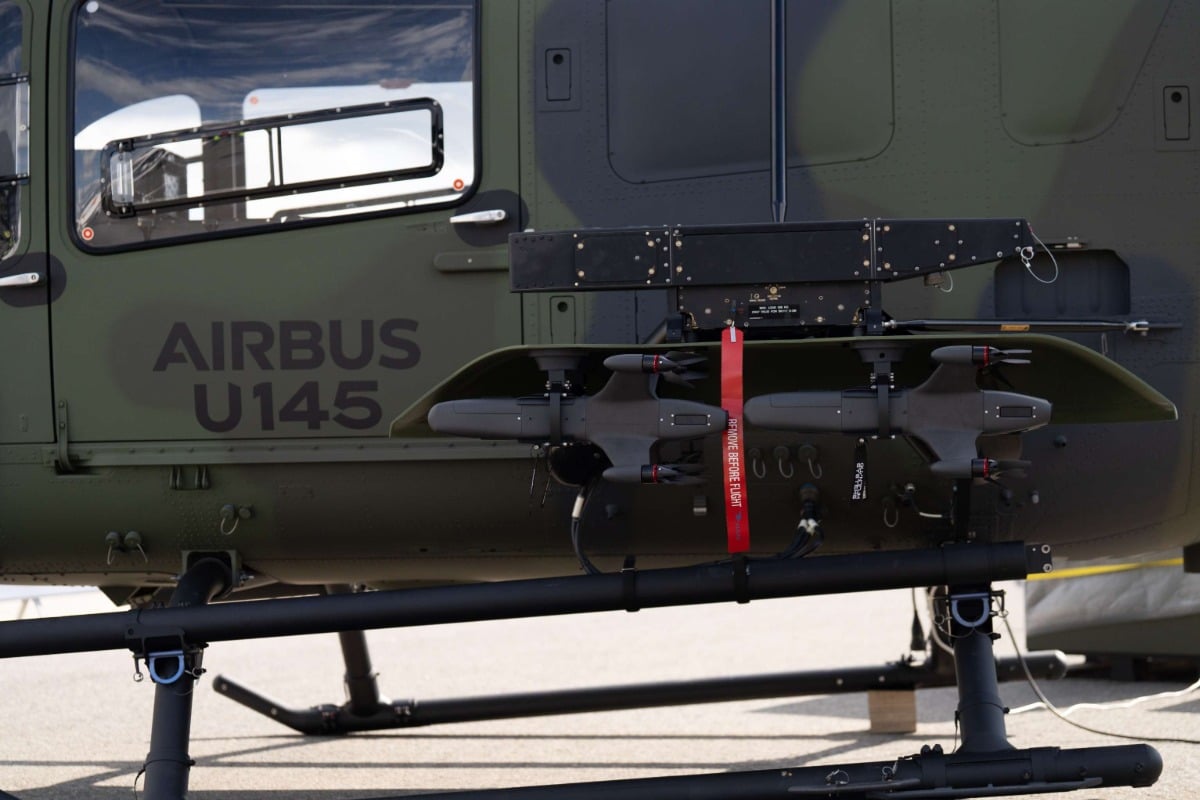
- Airbus Helicopters and Quantum Systems signed a cooperation agreement at ILA Berlin on June 10, 2026, to explore integrating counter-UAS interceptors onto the H145M military helicopter.
- The partnership aims to develop solutions against small unmanned aerial threats; no timeline, technical specifications, or customer commitments have been disclosed.
Airbus Helicopters and German drone technology company Quantum Systems have agreed to explore mounting counter-drone interceptors on military helicopters, starting with the H145M light multirole helicopter, in a partnership announced at ILA Berlin on June 10, 2026.
The cooperation agreement, signed at the ILA Berlin Air Show, tasks the two companies with jointly exploring the integration of Quantum Systems’ counter-UAS interceptor capabilities onto Airbus military helicopter platforms. The H145M serves as the starting point for the collaboration, chosen because of what Airbus describes as its advanced open system architecture and growth potential. Neither company has disclosed a timeline for completing an integrated prototype, conducting flight tests, or seeking military customer qualification, and the agreement at this stage represents a commitment to explore rather than a contract to deliver.
Quantum Systems is a Munich-based defense technology company that has built its reputation in the reconnaissance drone market before expanding into counter-UAS capabilities. The company is best known for the Vector fixed-wing unmanned aircraft used for intelligence, surveillance, and reconnaissance missions, which has been supplied to Ukrainian forces and evaluated by multiple European armed forces. Its counter-UAS interceptor work represents a newer capability line, and the Airbus agreement is the most significant partnership the company has announced for that product area.
The H145M is the military variant of Airbus’s H145 twin-engine light helicopter. The H145M is in service with the German Armed Forces and other military customers for roles including special operations support, medical evacuation, light attack, and reconnaissance. The platform has been supplied to several NATO members as well as export customers in the Middle East and Asia. Its twin-engine configuration, night vision compatibility, and ability to carry external weapon and sensor pods make it a flexible platform for adding new capabilities, which is the architecture characteristic Airbus is highlighting as making it the appropriate starting point for the interceptor integration work.
The tactical problem the partnership is trying to address has become one of the most urgent in modern military aviation. Small unmanned aircraft, ranging from commercial consumer drones modified to carry explosive payloads to purpose-built attack systems like the Iranian Shahed family, have demonstrated the ability to threaten military helicopters during low-altitude operations, particularly during landing and takeoff, which are the phases when helicopters are slowest and most vulnerable. Helicopters operating in support of ground forces in environments where adversaries have access to commercial drones face a threat that existing helicopter self-defense systems, designed around radar-guided missiles and aircraft, were never built to counter. A helicopter-mounted interceptor system that can detect, track, and neutralize small drones before they reach attack range would give helicopter crews a defensive option they currently lack.
The broader concept of mounting counter-drone weapons on crewed aircraft is not new, but practical solutions have proved difficult to develop and qualify. Electronic jamming systems can disrupt communications-dependent drones but are less effective against pre-programmed autonomous systems. Kinetic interceptors, including both miniature missiles and high-energy lasers, add weight and complexity that helicopters with limited payload margins struggle to accommodate. The Airbus and Quantum Systems agreement is exploring whether the specific combination of the H145M’s payload architecture and Quantum Systems’ interceptor design can overcome those constraints, but the scope and technical approach of the integration work remain undisclosed.
“At Airbus Helicopters, we are constantly exploring new frontiers in mission capabilities to bring real, decisive value to our customers,” said Stefan Thomé, Executive Vice President Programmes at Airbus Helicopters. “This agreement with Quantum Systems marks a crucial step forward in further expanding the operational spectrum of our military helicopters, ensuring that crews can effectively control the airspace against uncrewed threats. The H145M, with its advanced open system architecture and exceptional growth potential, serves as the ideal launching pad for this joint initiative.”
Martin Karkour, Chief Revenue Officer at Quantum Systems, framed the partnership in terms of the European defense industrial response to evolving aerial threats. “This cooperation demonstrates how Europe’s defence industry can combine complementary strengths to address emerging operational challenges,” Karkour said. “Current developments show that aerial systems need answers to drone threats.”