

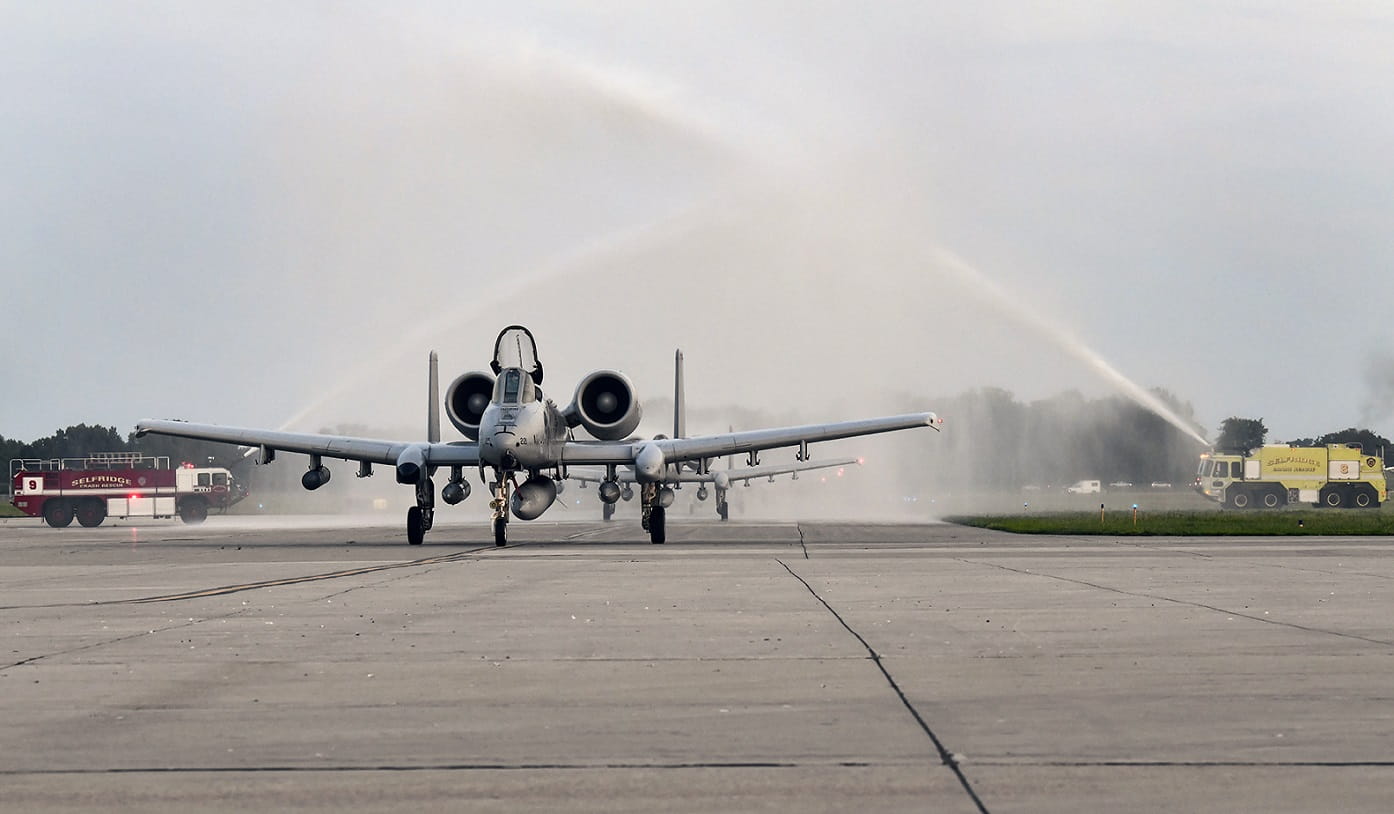
More than 200 Airmen of the 127th Wing with their A-10 Thunderbolt II aircraft returned to home from Afghanistan this week after serving up to six months in the U.S. Central Command area of responsibility in support of Operations Freedom’s Sentinel, Inherent Resolve and Spartan Shield.
“Six pilots of the 107th Fighter Squadron here, taxi their A-10 Thunderbolt II jets through water cannons marking their official return from a combat deployment here on July 26, 2019,” said in 127th Wing Public Affairs statement.
127th Wing Public Affairs has reported that overall, 127th Wing Airmen executed approximately 1,100 sorties in support of Operation Freedom’s Sentinel, Operation Inherent Resolve and Operation Spartan Shield.
“Being ready for the mission downrange is what we constantly train for,” said Brig. Gen. Rolf Mammen, 127th Wing and Selfridge Air National Guard Base commander. We are an operational reserve, and this successful deployment is a testament to our combat capability.”
The A-10 Thunderbolt II has excellent maneuverability at low air speeds and altitude, and is a highly accurate and survivable weapons-delivery platform. The aircraft can loiter near battle areas for extended periods of time and operate in low ceiling and visibility conditions. The wide combat radius and short takeoff and landing capability permit operations in and out of locations near front lines.
The Thunderbolt II can be serviced and operated from austere bases with limited facilities near battle areas. Many of the aircraft’s parts are interchangeable left and right, including the engines, main landing gear and vertical stabilizers.
The Thunderbolt II can employ a wide variety of conventional munitions, including general purpose bombs, cluster bomb units, laser guided bombs, joint direct attack munitions or JDAM, wind corrected munitions dispenser or WCMD, AGM-65 Maverick and AIM-9 Sidewinder missiles, rockets, illumination flares, and the GAU-8/A 30mm cannon, capable of firing 3,900 rounds per minute to defeat a wide variety of targets including tanks.
