

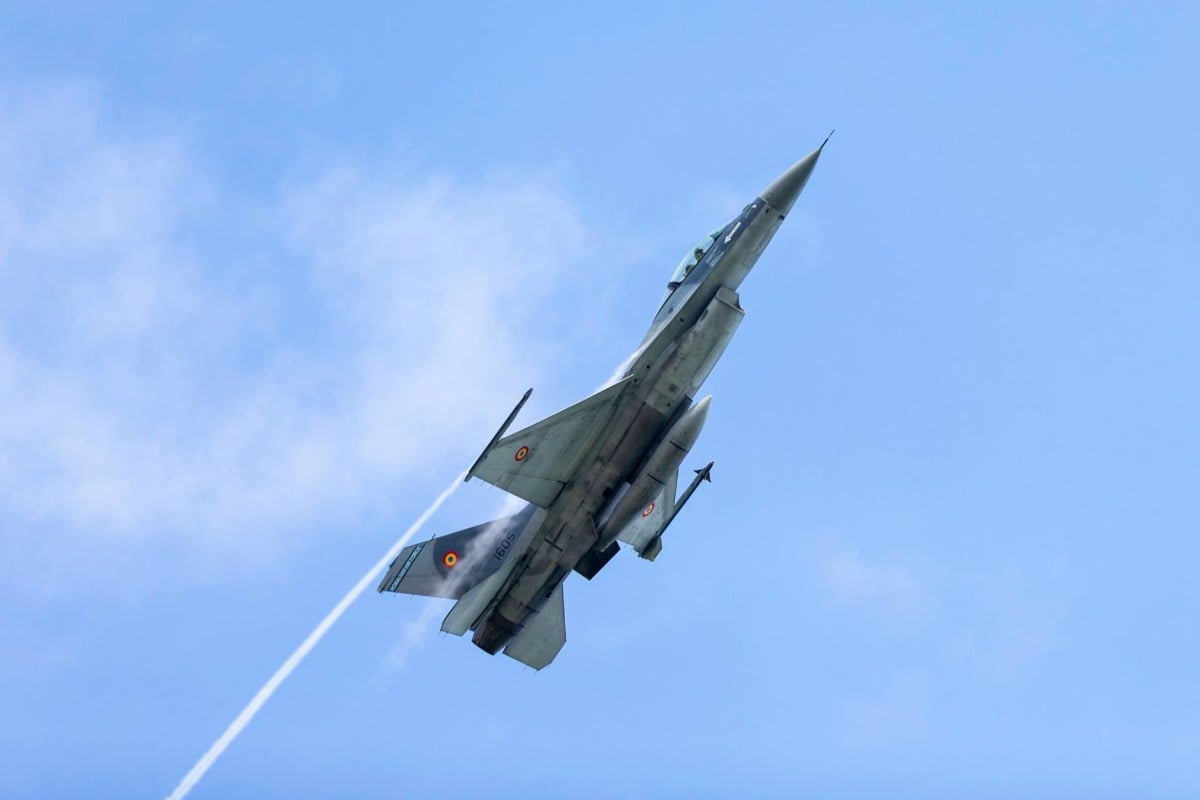
- A Romanian F-16 shot down a drone over the Black Sea near Sulina at 10:13 a.m. Sunday, the third intercept in three consecutive days.
- Friday's downed drone was confirmed as a Russian-used Shahed, and Romania plans a diplomatic protest based on ongoing investigations into all three incidents.
A Romanian F-16 fighter jet shot down a Russian-linked drone over the Black Sea on Sunday morning, marking the third such intercept in just three days, and Romania’s president says the country has had enough.
President Nicusor Dan confirmed that Romanian Air Force pilots downed the drone at 10:13 a.m. local time roughly 12 kilometers (7.5 miles) northeast of the port town of Sulina, in the Sulina-Chilia area along Romania’s Black Sea coast, a stretch of the Danube Delta that has become the epicenter of a rapidly escalating pattern of airspace violations tied to Russia’s war in neighboring Ukraine.
Romania’s Ministry of National Defense said the F-16 engaged and destroyed the drone within about five minutes of detection, neutralizing it safely over open water in Romania’s territorial waters. Authorities issued a warning in Tulcea County, the coastal region bordering the incident site, over the risk of falling drone debris, a precaution that underscores how close these repeated incursions are coming to populated Romanian territory even when the drones themselves end up destroyed over water or empty ground.
Dan publicly thanked the Romanian pilots and ground crews involved, praising what he called their professionalism, courage, and effectiveness in carrying out their missions, and crediting their actions with defending Romania’s national territory and protecting its citizens. That kind of direct presidential statement, issued roughly half an hour after the shootdown itself, reflects how quickly Bucharest is now moving to publicize these intercepts, a sharp contrast to years of quieter reporting on drone fragments and near-misses along the same border.
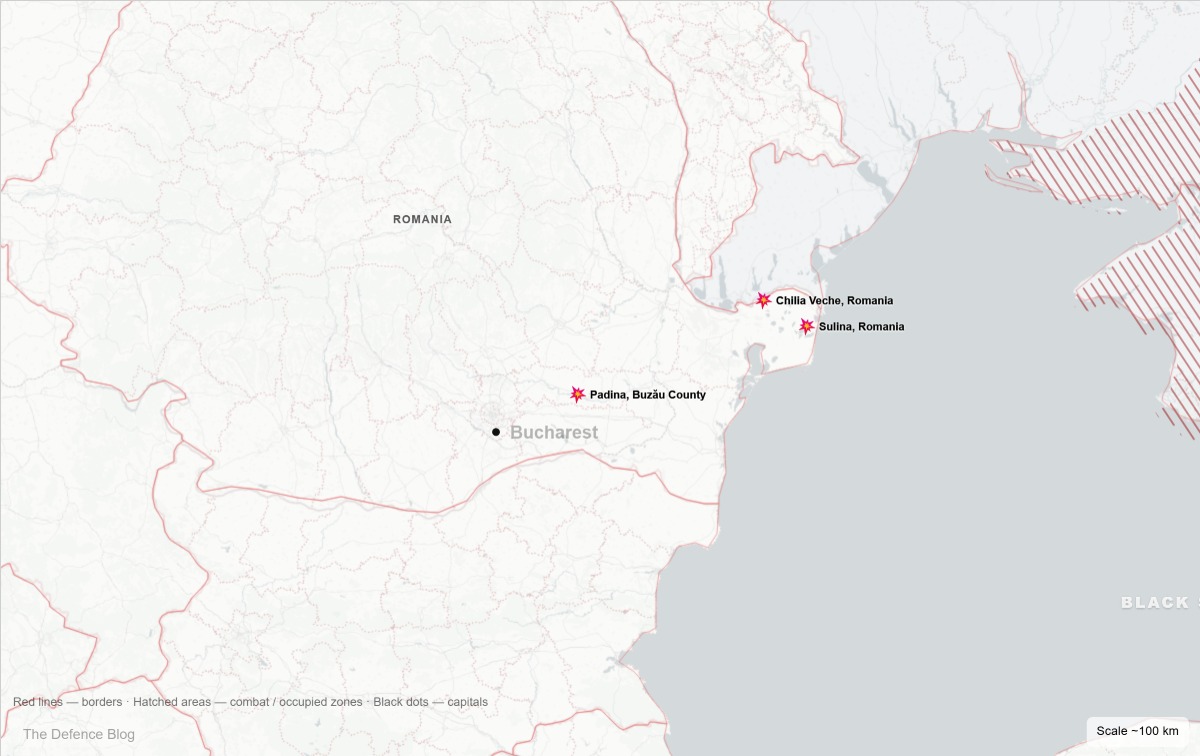
Sunday’s shootdown caps a three-day stretch that has tested Romania’s air defenses like nothing since Russia’s full-scale invasion of Ukraine began. The first came Friday morning, when a Romanian F-16 shot down a drone near the village of Padina in Buzau County, roughly 90 kilometers (56 miles) northeast of Bucharest, marking the first time in the war that Romania had used a fighter jet to destroy an intruding aircraft over its own territory. Romania’s General Prosecutor’s Office has since confirmed that drone was a Shahed, an Iranian-designed, propeller-driven attack drone that Russia has mass-produced by the thousands and fired in growing numbers against Ukrainian cities and infrastructure, often in large swarms meant to overwhelm air defenses through sheer volume.
The second intercept followed just over 21 hours later, on Saturday morning at 8:30 a.m., when the same Romanian pilot who downed Friday’s drone shot down another one roughly 10 kilometers (6.2 miles) west of the village of Sfantu Gheorghe, deeper into the Danube Delta. Romania’s Defense Ministry said radar systems had picked up the drone operating near the Ukrainian border before two F-16s intercepted and destroyed it in an unpopulated area, with Defense Minister Radu Miruta noting that the pattern of the flight was consistent with previously confirmed Russian drone activity in the region.
According to Dan, Romania’s General Prosecutor’s Office is running formal investigations into all of the drones downed over the past several days, and that inquiry has already confirmed Friday’s aircraft as a Shahed used by Russia in its war against Ukraine. Dan said the investigations into Saturday’s and Sunday’s drones remain ongoing, and Romania’s Defense Ministry said it would release further details on Sunday’s incident as they become available.
Dan said Romania’s diplomatic protest against Russia will be built directly on the findings of those investigations, a decision that ties the country’s formal response to documented evidence gathered by prosecutors rather than to preliminary military assessments alone. That approach carries more weight diplomatically within NATO and the European Union than a protest based solely on early battlefield reporting, particularly as Romania seeks to build a clear evidentiary case against Moscow.
“Este inadmisibil și intolerabil ca Federația Rusă să continue încălcarea spațiului aerian al României, care este, în același timp, spațiu aerian al NATO și al Uniunii Europene,” said Nicusor Dan, President of Romania.
That statement, translating to Russia’s continued violation of Romanian airspace being inadmissible and intolerable given that the same airspace belongs simultaneously to NATO and the European Union, places Sunday’s shootdown squarely within the broader alliance-wide anxiety over Russian drone incursions along NATO’s eastern flank. Poland, Estonia, and Lithuania have all reported similar violations in recent years, and Romania’s Defense Ministry noted that four of the five drones shot down so far over NATO and EU territory have been neutralized by Romanian military pilots specifically, a statistic that underscores how central Romania has become to the alliance’s response along this stretch of border.
Dan said such actions are unacceptable and that Romania is treating them with full seriousness alongside its allies, signaling coordination with NATO partners even as he stopped short of detailing what additional alliance-level steps, if any, Romania is pursuing beyond its planned diplomatic protest against Russia.
Romania’s F-16 fleet has become the country’s primary tool for patrolling and defending its airspace along the Black Sea and the Danube Delta, a region that has taken on outsized strategic importance since Russia’s invasion of Ukraine turned the nearby waters into an active conflict zone. Ukrainian port infrastructure along the Danube, used to export grain and other goods after Russia’s blockade of Black Sea shipping lanes, sits close enough to the Romanian border that Russian strikes and stray drones have repeatedly tested the line between Ukrainian and NATO territory, and Sunday’s intercept over open water shows just how narrow that margin has become.
What remains unclear is how many total drone incursions Romania has now recorded along this stretch of coastline, what specific evidence investigators have gathered on Saturday’s and Sunday’s drones beyond confirming Friday’s as a Shahed, and what concrete diplomatic or military measures might follow the formal protest against Russia once those investigations conclude. Those answers will shape how seriously NATO’s broader membership treats this escalating pattern compared to the isolated incidents Romania has weathered in years past.
Three drones down in three days over the same stretch of coastline is no longer an anomaly Romania can explain away as accidental drift from a war next door, and its president just made clear that patience for that explanation has run out.