

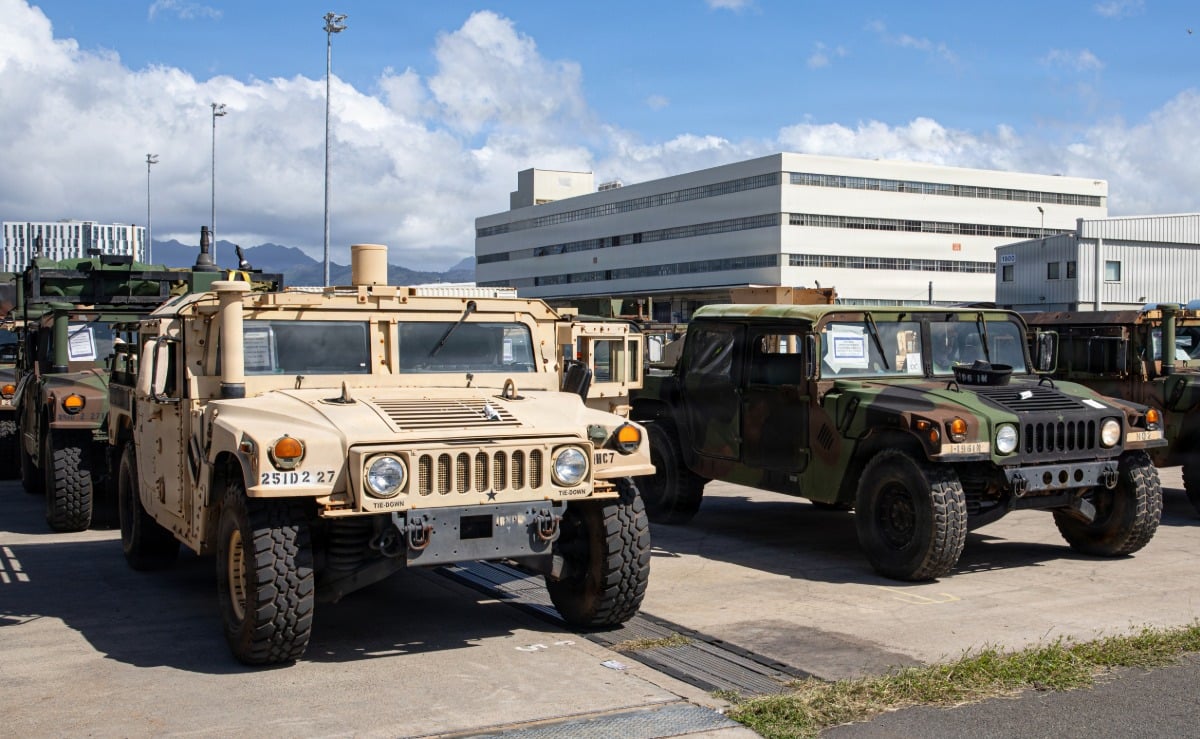
- AM General received a $98.7 million contract modification for HMMWV production, bringing the underlying contract's cumulative value to $3.2 billion.
- The Army Transformation Initiative previously directed the Army to cancel procurement of the HMMWV, though the contract runs through Aug. 28, 2027.
AM General, the South Bend, Indiana manufacturer that has built the Humvee since the 1980s, was awarded a $98.7 million contract modification, according to a Department of War contract announcement, adding to an existing agreement for various models of the High Mobility Multipurpose Wheeled Vehicle, commonly known as the Humvee.
The modification pushes the total cumulative value of that underlying contract to more than $3.2 billion, and Army Contracting Command at Detroit Arsenal, Michigan, awarded it after soliciting a single bid and receiving exactly one, from AM General itself.
AM General has manufactured the Humvee for the U.S. military for more than four decades, and the vehicle has become one of the most recognizable pieces of American military hardware in the world, a boxy, four-wheeled workhorse originally built to replace the Jeep and haul troops, cargo and weapons across rough terrain in virtually every American conflict since the 1991 Gulf War. With no other manufacturer positioned to step in and build a compatible Humvee variant on short notice, sole-source awards like this one are typical for follow-on orders under an existing production contract, and the deal is structured as an indefinite-delivery, indefinite-quantity agreement, meaning the Army sets a ceiling value it can draw against through individual task orders as needs arise, rather than committing to a fixed vehicle count upfront. Work locations and specific funding will be determined order by order, with the broader contract now expected to run through Aug. 28, 2027.
The Army spent much of 2025 signaling it wants out of the Humvee business entirely. Army Chief of Staff Randy George’s Army Transformation Initiative directive, issued last year, explicitly stated the service would cancel procurement of what it called excess ground vehicles like the HMMWV and its intended successor, the Joint Light Tactical Vehicle, as part of a broader push to shift resources toward lighter, faster combat formations and modern technology like drones. That JLTV, built by AM General under a separate contract worth more than $8 billion won in 2023, was designed specifically to replace the Humvee with a heavier, far more survivable vehicle able to better withstand roadside bombs, a lesson the military learned the hard way in Iraq and Afghanistan, where the original Humvee’s light armor left troops exposed to improvised explosive devices.
Despite that plan, the JLTV program has run into serious production trouble, with the Department of War reportedly yet to accept a single production vehicle of the upgraded A2 version as of recent reporting, forcing the Marine Corps to pause its own JLTV orders and start looking for a second manufacturer entirely.
That production gap helps explain why new Humvee money keeps flowing even as the Army says it wants to move on. AM General has continued fulfilling a backlog of Humvee orders it says stretches through 2027, and a significant share of that demand now comes from outside the Army’s own domestic fleet.
The company has separately built new Humvees under multiyear foreign military sales contracts, arrangements where the U.S. government sells American-made equipment to allied nations, and recent Humvee-related awards have gone toward shipments for countries like Lebanon, reflecting steady overseas demand for a vehicle that remains cheaper, simpler to maintain and more widely fielded around the world than the JLTV that’s supposed to replace it stateside. Israel’s own military, which operates more than 2,000 Humvees, signed its first JLTV procurement agreement with the U.S. only this past March, worth roughly $26 million for an initial batch of vehicles, underscoring just how gradual and uneven the global transition away from the Humvee is likely to be even as American forces themselves pull back.