

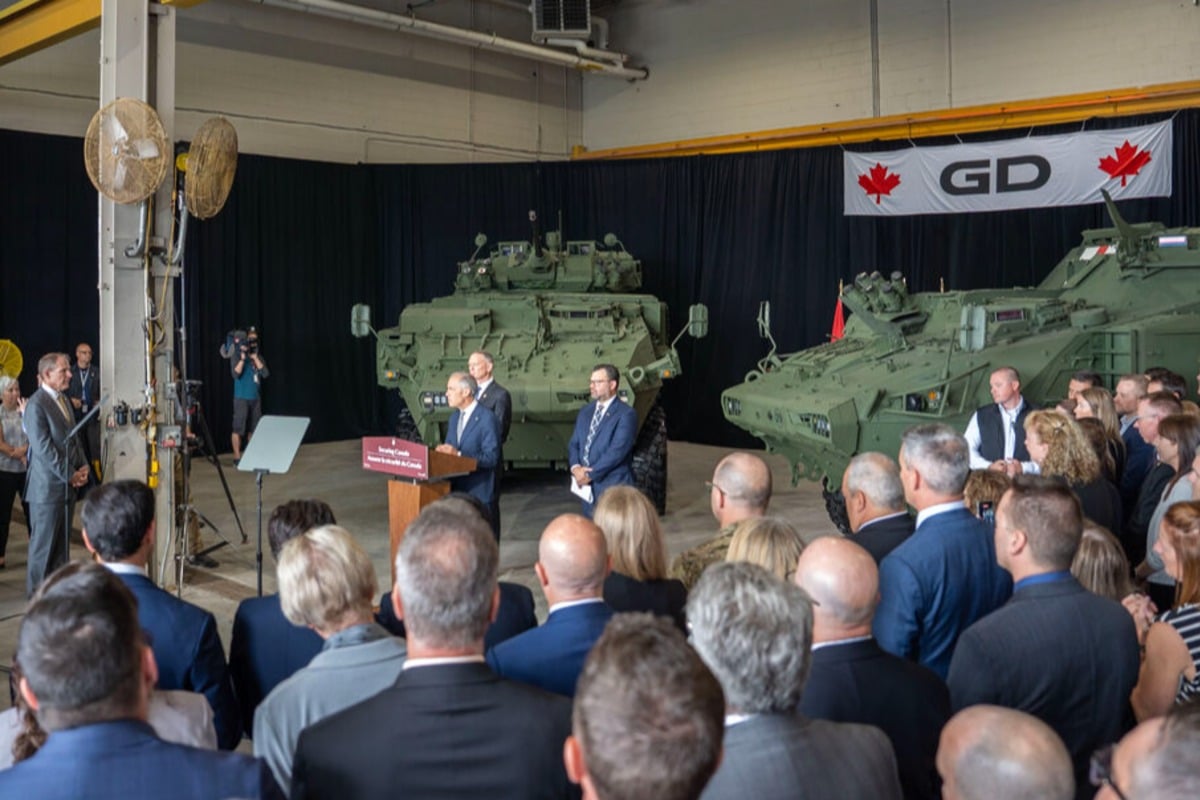
- Canada announced a Strategic Partnership with GDLS-Canada and a contract worth roughly $1.4 billion for 190 additional Armoured Combat Support Vehicles.
- The deal also includes 35 additional ACSVs built specifically for donation to Ukraine.
Canada’s Prime Minister Mark Carney traveled to General Dynamics Land Systems-Canada’s facility in London, Ontario, alongside National Defence Minister David J. McGuinty, to formally announce a new Strategic Partnership between the Canadian government and the company, along with a contract worth roughly $1.4 billion for 190 additional Armoured Combat Support Vehicles for the Canadian military and 35 more of the same vehicles built specifically to be donated to Ukraine.
The Armoured Combat Support Vehicle, known as the ACSV, is an 8×8 wheeled armored vehicle built on the same chassis as the LAV 6.0, the Canadian Army’s primary infantry fighting vehicle platform, giving the support version the same mobility and protection as the frontline fighting vehicles it accompanies rather than trailing behind in a more vulnerable, lightly armored truck. Instead of carrying a turret and cannon like its combat-focused cousin, the ACSV comes in eight different roles designed to keep a brigade functioning in the field, including command post, ambulance, engineering, electronic warfare, and maintenance recovery variants, replacing Canada’s aging fleet of LAV II Bison and M113 tracked vehicles that had been in service for decades.
Canada first ordered the ACSV back in September 2019, when the government awarded General Dynamics Land Systems-Canada a contract worth roughly $1.46 billion at the time for 360 vehicles, initial spare parts, technical manuals, and training, with the first vehicles rolling off the production line by 2021. This week’s announcement builds directly on that original deal, adding 190 more vehicles for Canada’s own military through an amendment to the existing contract, while carving out 35 additional vehicles specifically earmarked for Ukraine, continuing a pattern of Canadian LAV donations that has already put earlier ACSV variants into Ukrainian army service alongside the vehicle’s other longtime users, including the Saudi National Guard.
Dave Haggerty, vice president and general manager of GDLS-Canada, framed the announcement as validation of a relationship the company has spent decades building with the Canadian government.
“Today, our team takes great pride in the opportunity to provide Canadian soldiers with the advanced combat vehicle platforms and support they need to succeed, while continuing to strengthen Canada’s sovereign capabilities, its defence industrial base, and skilled workforce,” Haggerty said. “We are honoured that Prime Minister Mark Carney and the Minister of National Defence David McGuinty visited our London facility to make this announcement. With this strategic partnership agreement, General Dynamics, and our Canadian supply chain, look forward to supplying the Canadian Armed Forces with additional Armoured Combat Support Vehicles that will meet the next generation capability and operational requirements.”
GDLS-Canada represents one of the country’s most significant defense manufacturing operations, and the company has positioned itself as a cornerstone of what Canadian officials call the country’s sovereign defense industrial base, meaning the domestic capability to design, build, and sustain military equipment without depending entirely on foreign suppliers.
The company has operated in London, Ontario since 1977, delivering more than 11,000 Light Armoured Vehicles to Canada and allied nations over nearly five decades, and today employs 1,700 people directly while supporting a network of more than 600 suppliers spread across over 100 communities nationwide, a supply chain the company says sustains more than 13,400 jobs across Canada. More than 85 percent of the company’s revenue comes from exports, according to GDLS-Canada, a figure the company points to as evidence that its defense manufacturing base does more than serve the Canadian Army alone, contributing meaningfully to the country’s broader trade balance while keeping domestic production capacity intact.