

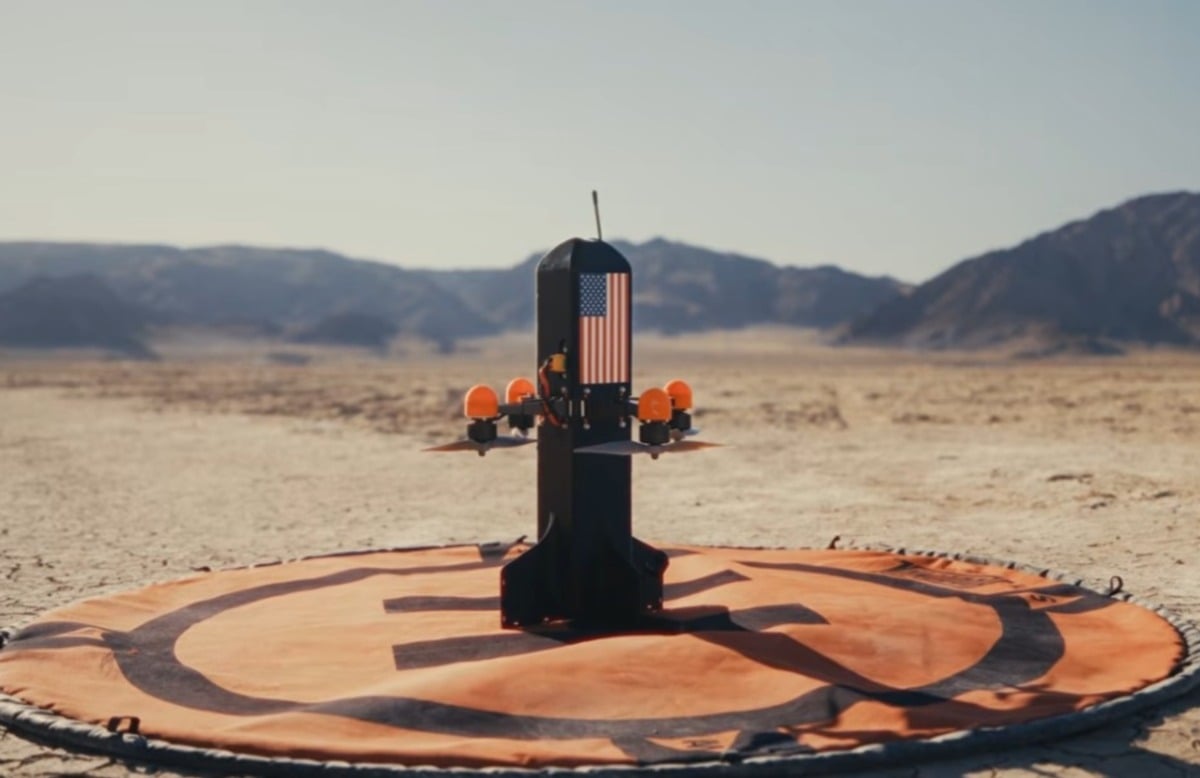
- Neros Technologies announced on July 10, 2026, that it is developing Bandit, a counter-unmanned aircraft system interceptor drone.
- The company said it will document Bandit's development publicly, with full updates posted to its YouTube channel.
The company that helped supply Ukraine’s front lines with cheap, mass-produced attack drones just announced it is racing to build the exact opposite: a drone built specifically to hunt and kill other drones. Neros Technologies posted a video on July 10 showing early testing of what the company calls Bandit, a counter-unmanned aircraft system, or c-UAS, interceptor drone.
“Follow along as we rapidly develop and launch Bandit, our c-UAS interceptor drone,” Neros said in the post, adding that fuller updates would be posted to the company’s YouTube channel.
Understanding why Neros is moving into counter-drone technology now requires understanding what the company has already built its reputation on. Neros, founded in 2023 by former professional drone racers Soren Monroe-Anderson and Olaf Hichwa, built its business around the Archer, an 8-inch first-person-view quadcopter designed to be cheap, expendable, and free of Chinese-made components, a deliberate design choice given how heavily the broader commercial drone industry depends on Chinese suppliers like DJI. The Archer can carry a 4.5 lb (2 kg) payload out to a range exceeding 12 miles (19 km), and Neros has scaled production dramatically since the company’s early days building drones in a garage, with reporting from The Economist indicating output reached roughly 2,000 units per day by December 2025. Roughly two-thirds of that production has gone to Ukraine, where Neros supplied 6,000 drones under a contract with the International Drone Coalition, while the remainder has flowed to U.S. military customers including the Marine Corps, which awarded Neros a $17 million contract for 8,000 Archer Strike drones, the Army, and U.S. Special Operations Command.
Bandit represents a meaningful pivot for a company that has spent its short history almost entirely focused on one-way attack drones rather than defensive interception, though the shift is not without precedent inside Neros’s existing partnerships. The company has already worked with counter-drone technology firm CX2 Industries to integrate an RF-seeking payload called Vadris onto the Archer platform, creating a system designed to locate and track the radio signals of an enemy drone’s pilot rather than intercept the drone itself in flight. Bandit appears to represent a more direct interception approach instead, aiming to physically stop hostile drones in the air rather than simply locating the operator flying them, a capability gap that has become increasingly urgent as adversary drone attacks have grown more frequent and more difficult to counter using traditional air defense systems built for faster, larger aircraft.
The broader U.S. military counter-drone market Neros is entering has already attracted substantial competition and investment. The Marine Corps awarded Anduril $200 million in 2024 to integrate its Anvil drone interceptor into the MADIS Mark 2 counter-UAS system, followed by a separate $642 million base defense contract in March 2025 that also included Anvil systems, while the Army has requested $111 million in its fiscal year 2026 budget to procure 6,000 Coyote Block 2 interceptors and 700 Block 3 variants, alongside hundreds of associated launchers and radar systems. That level of sustained Pentagon investment reflects a strategic reality that has become increasingly stark since Russia’s invasion of Ukraine and, more recently, drone attacks on shipping in the Strait of Hormuz: expensive, traditional air defense systems like Patriot batteries, which fire interceptors costing millions of dollars apiece, are economically unsustainable against swarms of drones that can cost as little as a few thousand dollars each, forcing the Pentagon to develop cheaper, purpose-built interceptors that can match the cost curve of the threats they are meant to defeat.
Neros enters that competition with an advantage few rivals can claim, namely a manufacturing base and cost structure already proven at scale through its Archer production line. Whether Bandit can translate that same low-cost, high-volume manufacturing approach into an effective interceptor remains an open question the company has not yet answered publicly, since building a drone that reliably finds, tracks, and destroys another fast-moving drone in flight presents a fundamentally different engineering challenge than building a one-way attack drone flown deliberately into a stationary or slow-moving target by a human operator. Interceptor drones generally require far more sophisticated onboard sensors and either autonomous guidance or extremely fast human reaction times to successfully close on an evasive, actively piloted target, a technical bar that has proven difficult even for established defense contractors with years of guided munitions experience.