

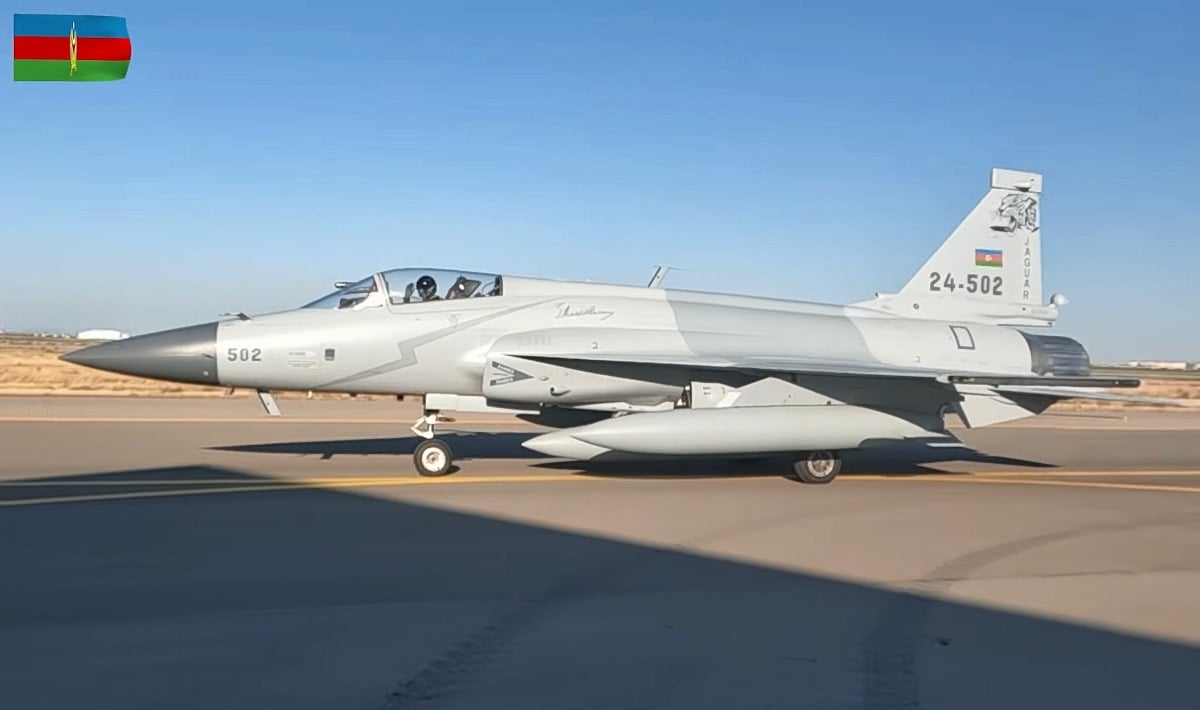
Azerbaijan’s Ministry of Defense confirmed on July 6 that the country’s air force has begun operating JF-17 Thunder fighter jets, releasing a video showing two of the Chinese-Pakistani aircraft taking off and landing on training sorties, the first official acknowledgment that the long-promised fighters have actually entered service.
OSINT analyst Guy Plopsky examined still images from the footage and identified the aircraft as two JF-17C Block III single-seat fighters, tail numbers 24-501 and 24-502, each carrying a trio of external fuel tanks and no visible weapons, footage that Plopsky said appears to have been filmed at Nasosnaya air base near the city of Sumqayit, not far from Baku.
The Azerbaijani Ministry of Defense did not officially name the base in its video, but multiple independent analyses point to Nasosnaya as the most likely location. Defense intelligence firm Janes noted that satellite imagery of the base shows a recent, significant upgrade that included construction of 16 new aircraft shelters, with footage of the pilots walking to their jets showing aircraft 24-501 positioned under the twelfth shelter while 24-502 sat further down the line, with the noses of two additional JF-17s visible protruding from neighboring shelters, suggesting Azerbaijan’s fleet at the base already exceeds the two aircraft shown taking off. Aviation Week separately confirmed the video also showed Azerbaijani Air Force Aero Vodochody L-39 trainers and Sukhoi Su-25 ground attack jets flying alongside the JF-17s, indicating the new fighters are training and operating in coordination with the country’s existing aircraft rather than in isolation.
The JF-17 program represents one of the largest fighter jet export deals in Pakistan’s history, and Azerbaijan’s involvement traces back further than this week’s confirmation suggests. Pakistan’s government confirmed in September 2024 that Baku had agreed to purchase 40 JF-17s, a deal that Aviation Week reported makes Azerbaijan the largest export customer for the lightweight, single-engine fighter, which was jointly developed by the Pakistan Aeronautical Complex and China’s Chengdu Aircraft Corporation. Earlier reporting from Army Recognition traced the deal’s origins to a smaller February 2024 contract worth $1.6 billion covering an initial batch of aircraft, training, and weapons, before Pakistan’s government announced in June 2025 that the arrangement had expanded into a $4.6 billion package covering the full 40-aircraft order, which Army Recognition described as Pakistan’s largest recorded defense export to date.
The JF-17C Block III itself represents a meaningful capability jump for Azerbaijan’s air force, which has relied heavily on aging Soviet-era MiG-29 fighters and Su-25 ground attack jets for decades. The aircraft measures roughly 14.93 meters (49 feet) in length with a 9.45-meter (31-foot) wingspan, powered by a Russian-designed Klimov RD-93 turbofan engine that pushes the jet to speeds of Mach 1.6, or roughly 1,910 km/h (1,187 mph), with a combat range exceeding 3,400 km (2,113 miles) when carrying external fuel tanks like those visible in this week’s footage. The Block III variant carries a KLJ-7A active electronically scanned array radar and compatibility with China’s PL-15E beyond-visual-range air-to-air missile, a combination that analysts at Defence Security Asia say gives Azerbaijani pilots the ability to detect, track, and engage enemy aircraft at ranges exceeding many legacy fighter systems still operated elsewhere in the South Caucasus region. Despite that capability, the JF-17 Block III carries an estimated per-unit cost of roughly $30 million, according to reporting from The National Interest, substantially cheaper than comparable Western fighters like the F-16 Block 70/72, which runs $60 to $70 million per aircraft, or fifth-generation jets like the F-35, which typically exceed $100 million.
Azerbaijan’s choice of the JF-17 over Russian alternatives carries its own backstory. Baku reportedly considered purchasing Russia’s MiG-35 supersonic multirole fighter as far back as 2021 before ultimately selecting the Chinese-Pakistani jet instead, and Russian sources have argued that the MiG-35 technically outperforms the JF-17 in speed, payload, and maneuverability, even as it costs roughly twice as much per aircraft by some estimates. Whatever the technical merits of that comparison, the MiG-35’s own production track record has been rocky enough to raise real questions about whether Russia could have delivered the aircraft at scale even if Azerbaijan had chosen it. Aviation industry reporting has repeatedly described the MiG-35 program as struggling for over a decade, with outlet Simple Flying noting that despite receiving a preliminary production certification from Russian authorities in 2021, only six MiG-35s had been delivered to the Russian Air Force by October 2023, and those aircraft went primarily to Russia’s Strizhi aerobatic display team rather than frontline combat squadrons.