

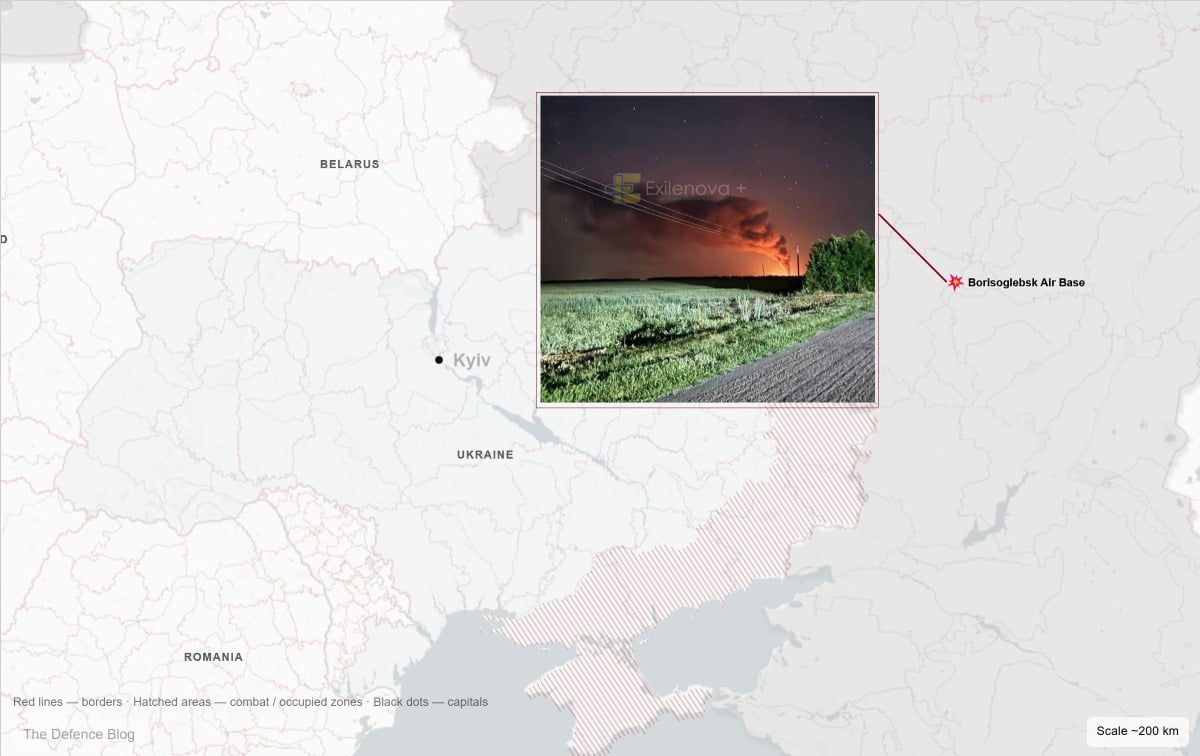
- A fire broke out at the fuel storage area of Borisoglebsk military airfield in Russia's Voronezh region overnight on July 8, 2026.
- Russian authorities have not officially confirmed damage to the airfield, and video of the incident was published by OSINT community Exilenova+.
A fire broke out at the fuel storage area of Borisoglebsk military airfield in Russia’s Voronezh region overnight on July 8, following a drone attack that also struck other targets across the region and left residents reporting numerous explosions, according to video footage shared by the OSINT community Exilenova+.
The footage appears to show flames in the section of the base that supplies fuel to the military aircraft stationed there, though as of publication, Russian authorities had issued no official confirmation of any damage to the airfield, and Russian officials have not commented on the reported strike at all.
Borisoglebsk is not an unfamiliar target for Ukrainian long-range drone strikes. Open source reporting indicates the airfield hosts Su-34, Su-35S, and Su-30SM combat aircraft belonging to Russia’s Aerospace Forces, while also functioning as a training base for the Assault and Bomber Aviation Faculty tied to the Krasnodar Higher Military Aviation School, according to prior open-source reporting on the base’s role. The facility runs a dedicated aviation training center built around Yak-130 advanced jet trainers, aircraft used to prepare Russian pilots for combat jets before they transition to frontline fighter and strike aircraft, according to Ukrainian outlet Militarnyi. That dual role, part active combat aircraft base and part pilot training pipeline, makes Borisoglebsk a recurring target for Ukraine’s campaign against Russian military aviation infrastructure, since damage there can disrupt both current combat sorties and the training pipeline feeding new pilots into Russia’s air campaign against Ukraine.
The July 8 incident fits a pattern stretching back at least two years. Ukrainian strike drones previously hit the same airfield in August 2024, according to Militarnyi’s reporting on the base’s strike history, and satellite imagery reviewed by Radio Free Europe/Radio Liberty following an October 2024 strike showed visible fire damage near the runway along with the apparent disappearance of aircraft from parking areas, suggesting Russian forces had relocated at least some of the base’s combat aircraft in response to the earlier attack. A separate large-scale strike in July 2025 hit Borisoglebsk alongside other Russian targets, with Newsweek reporting at the time that residents in the area heard as many as ten explosions and that Kyiv specifically named the airfield as a target in that overnight campaign.
What makes the July 8 strike notable is not that it happened, but where it appears to have landed within the base. The Exilenova+ footage and subsequent OSINT analysis by the independent Russian-language outlet ASTRA both point specifically to the fuel storage and supply area of the airfield, rather than the aircraft parking ramps or runway that have drawn more attention in prior strikes. A successful hit on fuel infrastructure carries different operational consequences than damage to a runway or parked aircraft, since destroying stored fuel can ground sorties for days or weeks depending on how quickly Russian logistics can truck in replacement supplies, whereas runway damage is often repairable within hours using standard military engineering equipment that most active air bases keep on hand.
According to reporting from Ukrainska Pravda and RBC-Ukraine, the same overnight drone campaign also struck the Saratov oil refinery in a separate Russian region, with residents there reporting explosions beginning around 2:40 a.m. local time after Saratov’s regional governor, Roman Busargin, had already warned hours earlier that Russia’s Ministry of Defense had flagged a threat of incoming drone attacks. That refinery, commonly known by its local name Kreking, had previously been struck by Ukrainian drones on the night of May 30 to 31, 2026, making the July 8 attack at least the second confirmed strike on the same facility within roughly six weeks, according to RBC-Ukraine’s account of the earlier incident.
Determining exactly what burned at Borisoglebsk, and how badly, remains genuinely uncertain given the limits of what open-source video can actually confirm. RBC-Ukraine’s reporting on the incident noted that OSINT accounts circulating footage from the strike offered conflicting characterizations of the target, with some describing the fire as hitting an oil depot specifically while others attributed it more broadly to the airfield itself, a distinction that matters for understanding the scale of the damage but one that cannot be fully resolved without either satellite imagery analysis or an official statement from either government. Neither Ukraine’s military nor Russia’s Ministry of Defense had issued a formal statement specifically addressing Borisoglebsk by the time of this report, though Ukraine’s General Staff did confirm strikes that same night against other targets, including defense industry facilities in the Bryansk region, an oil depot at the Belgorod airfield, and bridges in occupied Crimea, according to General Staff statements relayed through open-source monitoring accounts.
Analysts tracking Ukraine’s long-range strike campaign have consistently pointed to fuel and logistics infrastructure as a deliberate, recurring target category, distinct from the more visually dramatic strikes on parked aircraft or runways that tend to generate more attention online. A Russian military blogger known as Fighterbomber, who has documented close ties to Russia’s Aerospace Forces, wrote following an earlier 2024 strike on Borisoglebsk that such strategically important sites were often defended by only one or two short-range Pantsir air defense systems, a level of protection that leaves fuel depots and other rear-area targets considerably more exposed than frontline positions closer to the war’s active combat zones. If that assessment still holds roughly two years later, it would help explain why Borisoglebsk keeps reappearing as a target despite repeated strikes, since air defense gaps identified once tend to persist unless a base receives a substantial and costly overhaul of its protective systems.