

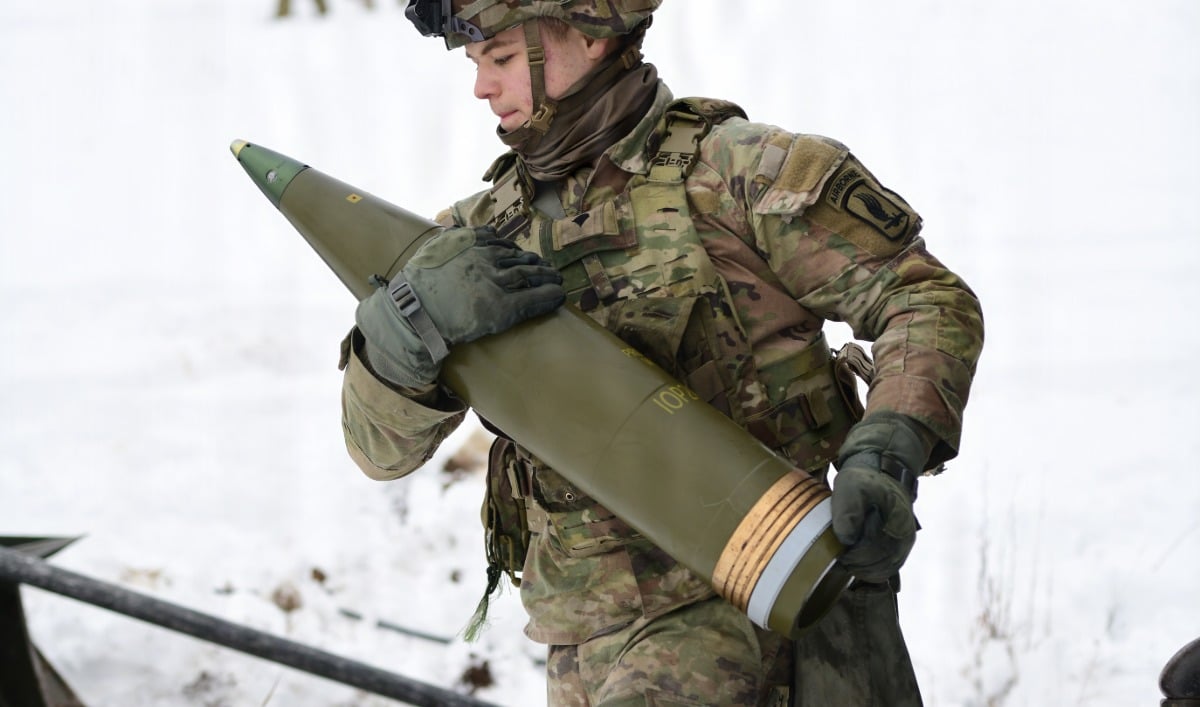
- A NATO member state ordered several thousand 155mm artillery shells and propellant charges from Rheinmetall for Ukraine, valued in the mid double-digit millions of euros.
- Production has already begun, with Rheinmetall targeting completion of the order before April 2027.
A fellow NATO member state has placed a new order for thousands of German-made artillery shells that will end up in Ukrainian hands, German defense manufacturer Rheinmetall announced today, the latest sign that European allies are still funneling significant firepower to Kyiv even as global attention shifts toward other flashpoints.
The contract, recognized in Rheinmetall’s books during the second quarter of 2026, covers several thousand 155mm artillery shells along with the propellant charges needed to fire them, and it carries a value in the mid double-digit millions of euros, though Rheinmetall did not name which NATO country placed the order or disclose the exact number of rounds involved.
The ammunition itself represents a well-established combination that has already seen extensive use on Ukrainian battlefields. The projectiles are the ER02A1 B/B variant, a 155mm high-explosive shell that comes in two configurations, a standard boat-tail design with a range of roughly 30 km (19 miles) and a base-bleed version that extends that reach to about 40 km (25 miles) by reducing aerodynamic drag as the shell flies. Rheinmetall manufactures the ER02A1 at its Expal Munitions facility in Spain, a plant the company acquired in 2023 specifically to expand its large-caliber ammunition production beyond its home base in Germany, and the shells have already been supplied to Ukraine in previous batches, where they have been fired from a range of Western-supplied howitzers including the Swedish Archer, French Caesar, German PzH 2000, and German RCH 155 self-propelled guns.
The DM72 modular propellant charges, supplied by Swiss-German manufacturer Nitrochemie, use a bag-based system that lets gun crews adjust how much propellant they load depending on the target’s distance, rather than relying on a single fixed charge for every shot. Nitrochemie says its DM72 and related high-zone charge modules are already fielded by more than ten NATO and partner countries, with more than 1.5 million individual charge modules produced and deployed to date, giving the system a track record of reliability across a wide range of 155mm gun platforms built to different national specifications.
Rheinmetall’s statement frames this specific order as part of a broader pattern rather than an isolated transaction, describing it as “military aid from a NATO member state” being channeled through the company’s existing production lines rather than a direct government-to-government transfer of stockpiled ammunition. That distinction matters because it reflects how European artillery support for Ukraine increasingly works in 2026: rather than draining national reserves that allied militaries also need for their own readiness, individual NATO governments are placing fresh production orders with manufacturers like Rheinmetall and then donating the finished shells once they roll off the line, a model that keeps national stockpiles intact while still getting ammunition to Ukraine’s front lines.
Production on this particular order has already begun, according to Rheinmetall, with the company targeting completion before April 2027, a timeline that gives some indication of how far ahead European ammunition manufacturers are now planning given the sustained, multi-year nature of the conflict. That production window also reflects the reality that even a company investing as heavily as Rheinmetall has cannot simply flip a switch and produce thousands of precision-manufactured artillery shells overnight, since both the shell bodies and the propellant charges require specialized manufacturing processes, quality testing, and supply chains for raw materials like explosive fillers and nitrocellulose-based propellant that cannot be scaled instantly.
The company has been expanding its 155mm production capacity continuously since 2022, and it opened Europe’s largest artillery ammunition plant in Unterluess, Germany, in August 2025, a nearly $585 million facility built in just fifteen months that is ramping toward 350,000 shells annually by 2027 at that site alone. Beyond Unterluess, Rheinmetall has ammunition plants either operating or under construction in Lithuania, Bulgaria, and Romania, part of a company-wide push toward a stated goal of producing around 1.5 million 155mm artillery shells per year by 2030, a target that would represent roughly a twentyfold increase from the company’s pre-war production levels of under 70,000 shells annually.
That production surge exists because demand has not slowed down. Ukraine’s artillery batteries have continued to burn through 155mm ammunition at a pace that has strained Western stockpiles since the earliest months of Russia’s full-scale invasion, and European NATO members have simultaneously needed to rebuild their own reserves to levels considered adequate for collective defense commitments, creating two competing demand streams that manufacturers like Rheinmetall have had to satisfy simultaneously. Every contract like this one, funded by an allied government but fulfilled through commercial production rather than stockpile drawdown, represents one small piece of how that dual demand gets met without leaving any single NATO country’s own defenses thinner than before.