

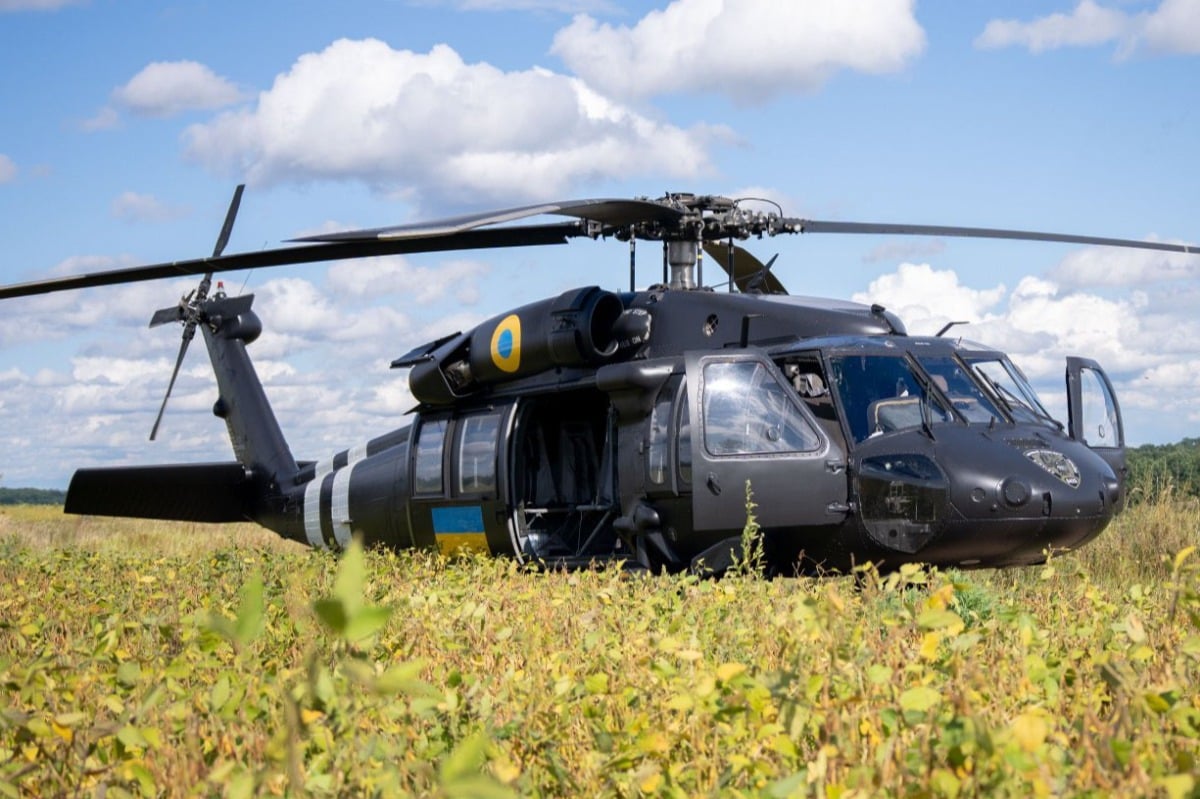
- Brigadier General Pavlo Bardakov, commander of Ukraine's Army Aviation, told LIGA.net the branch plans to replace Soviet-designed helicopters with American UH-60 Black Hawks.
- Bardakov said the change is unavoidable because Ukraine's current helicopter fleet depends on spare parts mostly manufactured in Russia.
Ukraine’s Army Aviation command plans to retire its Soviet-designed helicopter fleet in favor of American-made UH-60 Black Hawks, Brigadier General Pavlo Bardakov, commander of Army Aviation under Ukraine’s Ground Forces Command, told LIGA.net in an interview published last week. Bardakov said the shift away from Ukraine’s existing Mi-8 and Mi-24 helicopters has become unavoidable, because nearly every aircraft in the current fleet depends on spare parts that are manufactured almost exclusively in Russia, a supply chain that war has permanently severed.
“Aviation is always an expensive pleasure,” Bardakov said. “Everything costs money: helicopters, training, maintenance, spare parts, logistics support, aviation weapons, preparation.”
The math behind that statement is straightforward and unforgiving. Ukraine’s Mi-8 transport helicopters and Mi-24 attack helicopters on its bases, both legacy Soviet designs still flown by dozens of former Soviet states, were built around a parts and components ecosystem centered in Russia. Bardakov said his branch has already modernized its existing helicopters with Western weapons, navigation systems, and defensive equipment to keep them combat relevant, but that workaround only goes so far when the airframes themselves, along with their engines, transmissions, and rotor components, eventually run out of spare parts with no domestic or allied production line able to replace them.
“New equipment for army aviation is unavoidable,” Bardakov said. “Our entire helicopter fleet is tied to spare parts, assemblies, and components, most of which are manufactured in Russia.”
He added that the parts shortage will not become critical within the next year or two, but that Ukraine’s Army Aviation needs new aircraft on a medium-term horizon regardless. Whatever comes next may not necessarily be brand new production, he said, but could instead be refurbished or modernized airframes, a distinction that matters given how tightly global Black Hawk supply is already stretched by demand from Ukraine and other buyers. “Perhaps not new, but restored or modernized. Work on this is ongoing constantly. We have a number of projects to acquire,” Bardakov said, before naming the UH-60 Black Hawk as the aircraft his branch is counting on.
“The main combat vehicle we see is the UH-60 Black Hawk. This is a universal machine for combat and airborne-transport missions, tested through many military operations,” Bardakov said.
The UH-60 Black Hawk, built by Sikorsky, a Lockheed Martin subsidiary, has served as the backbone of U.S. Army utility aviation since entering service in 1979 and has logged more than 9 million fleet flight hours across nearly every major American combat operation since, including Grenada, Panama, Iraq, Somalia, the Balkans, and Afghanistan. Its combination of air assault, general transport, medical evacuation, and command-and-control capability, all from a single airframe design, has made it one of the most widely exported military helicopters in the world and a natural fit for a Ukrainian aviation branch trying to consolidate multiple mission sets onto one reliable platform rather than maintaining several specialized types.
Ukraine already operates a small number of Black Hawks, though not through Army Aviation. Ukraine’s Main Intelligence Directorate, known as the GUR, confirmed receiving its first UH-60A in February 2023, an aircraft that had previously been restored from U.S. Army surplus stock by the American firm Ace Aeronautics. In August 2025, a second Black Hawk reached Ukraine’s military intelligence service through an entirely different channel: a nationwide Czech crowdfunding campaign called Dárek pro Putina, or “A Gift for Putin,” which raised more than $3.2 million from over 20,600 donors to purchase, disassemble, ship, and reassemble the aircraft in Ukraine. Bardakov’s comments mark the clearest signal yet that Army Aviation, the branch responsible for Ukraine’s frontline helicopter operations rather than intelligence or special forces missions, wants Black Hawks in meaningful numbers rather than as isolated donations.
Bardakov was notably more skeptical about other Western attack helicopters that might otherwise seem like obvious replacements for the Mi-24. “There are questions about them,” he said of alternative attack platforms, without naming specific types. He argued that many helicopters fielded by other countries were not designed for the operating conditions Ukraine’s war demands, citing gaps in avionics, weapons integration, and battlefield durability, and describing some available options as too fragile or too expensive to maintain for sustained combat use. “Not all the machines in service with many countries meet the conditions of our war. Not all meet our requirements for operating conditions, avionics, weapons. There are very fragile and expensive-to-maintain machines. We still need to approach our fleet more rationally and practically,” Bardakov said.
Ukraine’s push toward Black Hawks arrives as American industry is separately investing heavily in extending the platform’s relevance for decades to come. Sikorsky announced in April 2026 a new line of Armed Black Hawk kits that let operators reconfigure a single UH-60 airframe between assault, close air support, precision strike, medical evacuation, and reconnaissance roles in roughly three hours, with installation available through Lockheed Martin in the United States or PZL Mielec in Poland. The U.S. Army itself has requested industry proposals to modernize between 12 and 24 UH-60M aircraft annually, and Army officials have said publicly they expect the type to remain in frontline service beyond 2050. That combination of an expanding kit ecosystem and a sustained U.S. production and modernization pipeline gives Ukraine a wider set of options for how any future Black Hawk acquisition might be configured, whether refurbished from existing stock, built new, or adapted from kits designed for other operators.
What remains unclear from Bardakov’s interview is how many Black Hawks Ukraine’s Army Aviation branch is seeking, on what timeline, and through which funding or donor mechanism such an acquisition would move forward. Bardakov gave no figures and described the effort as a set of ongoing projects rather than a signed program, leaving open whether Army Aviation’s ambitions will be shaped by direct U.S. government transfer, commercial purchase, or the kind of allied crowdfunding that has already delivered one Black Hawk to Ukraine’s intelligence service.