

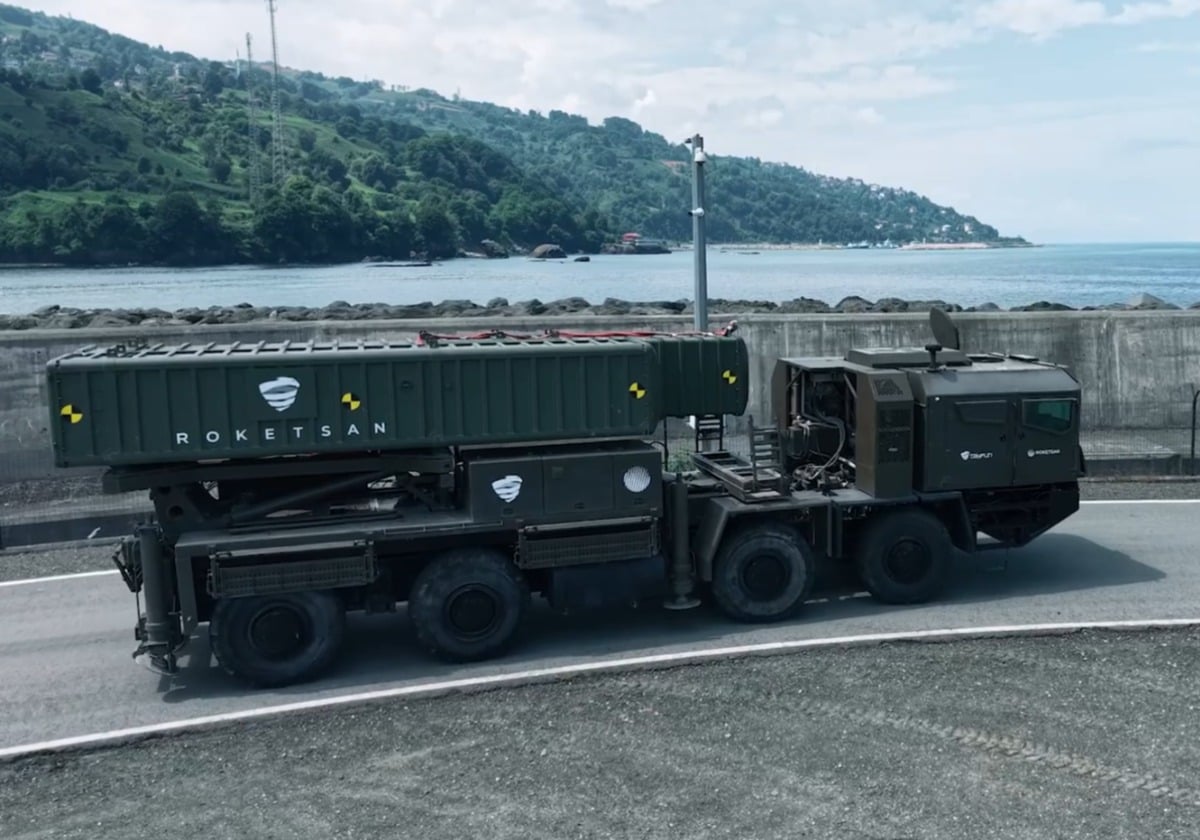
- Roketsan test-fired the TAYFUN Block-3 ballistic missile against a moving unmanned surface vessel with a seeker-guided warhead.
- Turkey says this marks its first domestic ballistic missile integration of a seeker head for moving sea targets.
Turkish defense manufacturer Roketsan conducted a live-fire test of its TAYFUN Block-3 ballistic missile, striking a free-moving, unmanned surface vessel roughly 7 meters (23 feet) long, built to represent a small fishing boat, with a live warhead traveling at hypersonic terminal speed.
The company described the hit as achieved with surgical precision, and Turkish officials say the test marks the first time a domestically developed seeker head has been successfully integrated onto a ballistic missile to guide it onto a moving sea target during the final phase of flight, effectively qualifying TAYFUN Block-3 as an Anti-Ship Ballistic Missile, or ASBM, a category of weapon that fires a warhead on a traditional ballistic arc but adds sensors and steering capable of correcting onto a moving vessel during the missile’s final descent.
That distinction matters more than it might sound, since a conventional ballistic missile is built to strike a fixed point on a map, arcing high into the atmosphere before descending onto coordinates that do not move while the missile is in flight. Turning that same weapon into an effective ship killer requires solving a much harder problem, since a vessel can change course and speed in the minutes it takes a ballistic missile to complete its trajectory, meaning the missile needs a seeker, a sensor package in its nose that can detect, track, and steer toward a target that has physically relocated since the missile launched. Very few nations have successfully fielded this combination, with China’s DF-21D representing the most prominent existing ASBM in the world, and Turkey’s success places it among that small group of countries capable of turning a land-attack ballistic missile into a genuine naval strike weapon.
Roketsan and Turkey’s Presidency of Defense Industries developed the missile out of the earlier Bora missile system, and its existence became known to the world almost by accident when its first test launch on October 20, 2022, was observed and reported before Turkish officials had planned to reveal it. That accidental unveiling briefly strained relations with Greece, after Turkish President Recep Tayyip Erdogan suggested the missile’s reach could threaten Athens, prompting a sharp rebuke from Greek officials. TAYFUN completed a second test in May 2023 and entered mass production that same month, followed by a third test in February 2025 near Rize on Turkey’s Black Sea coast, where it struck a maritime target hundreds of kilometers away with an accuracy of roughly 5 meters (16 feet), figures that already demonstrated the missile’s precision even before this latest seeker-guided variant added the ability to track a moving target.
The Block-3 tested in this latest launch sits partway through TAYFUN’s ongoing evolution into ever larger and more capable variants. The baseline TAYFUN measures 6.5 meters (21 feet) long, weighs roughly 2,300 kilograms (5,070 pounds), and uses a guidance approach Roketsan calls GOLIS, short for go-onto-location-in-space, combined with additional guidance corrections during flight to achieve a published circular error probability under 10 meters, meaning half of all missiles fired are expected to land within that radius of the aim point. Roketsan has continued expanding the family well beyond that original design, unveiling the substantially larger TAYFUN Block-4 at Turkey’s IDEF defense exhibition in July 2025, a variant measuring 10 meters (33 feet) long and weighing roughly 7,200 kilograms (15,870 pounds), nearly a third longer and more than triple the mass of the original missile, with Roketsan targeting hypersonic speeds exceeding Mach 5 and mass production beginning sometime in 2026 following successful trials.
Turkey’s defense industry has leaned heavily into the strategic messaging around these capabilities, framing each successful test as evidence of growing self-reliance rather than dependence on foreign suppliers for critical strike weapons. Roketsan CEO Murat İkinci told Turkish media in February 2026 that the company’s exports exceeded $750 million in 2025 alone, with total company revenue surpassing $2 billion and roughly $1 billion in new export contracts signed that year, growth he said the company aims to extend by another 50 percent in 2026 across exports, revenue, and order backlog. That commercial momentum runs alongside continued domestic deliveries, with Turkey’s Special Forces Command confirming in late June 2026 that it had completed acceptance procedures for another batch of TAYFUN Block-2 missiles, though neither Roketsan nor Turkish officials disclosed how many missiles were included in that delivery.
Roketsan has also begun teasing an even larger ballistic missile project separate from the TAYFUN family entirely, a system called CENK that appeared publicly for the first time mounted on a trailer towed by an 8×8 truck, too large to fit the single-vehicle launch configuration TAYFUN uses. Early images of CENK have shown what appear to be fins near the missile’s nose, a detail that has led some observers to speculate the system may incorporate a maneuverable reentry vehicle, a warhead capable of adjusting its flight path during descent specifically to complicate an adversary’s efforts to intercept it, though Roketsan has not officially confirmed those design details.
Turkey’s push to field an anti-ship capable ballistic missile arrives against a backdrop of ongoing regional friction that gives the capability obvious strategic weight beyond pure technical achievement. Ankara maintains a military presence in Syria, continues monitoring a long-running though diminished threat from Kurdish militant groups following calls for the PKK to disarm in 2024, faces persistently strained relations with Israel, and remains locked in a decades-old dispute with Greece and Cyprus over territorial waters and energy exploration rights in the eastern Mediterranean, a dispute where a missile capable of striking a moving warship from land represents a direct and unambiguous escalation of Turkey’s coercive options.