

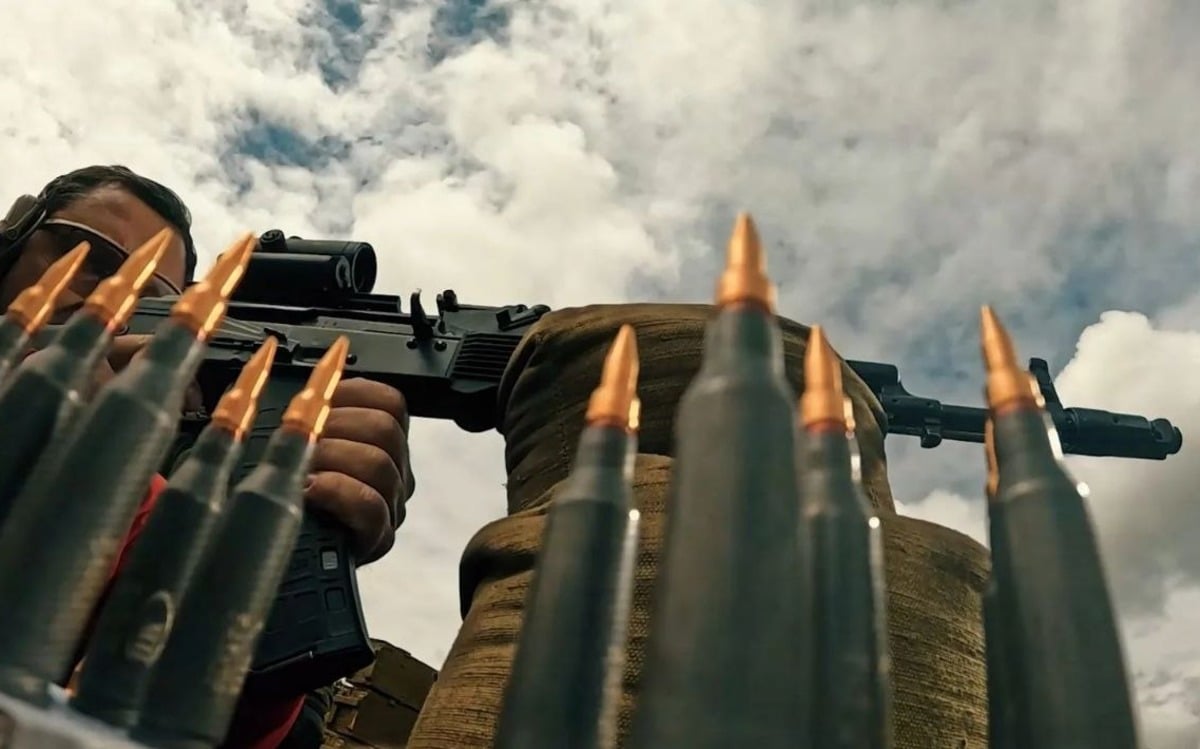
- Rostec announced on July 3, 2026, that it began delivering Mnogotochie anti-drone cartridges to Russian troops.
- The cartridges come in 5.45x39mm and 7.62x54mm calibers, each using a three-element bullet that separates in flight.
Rostec, Russia’s state-owned defense conglomerate, announced on July 3, 2026, that its subsidiary High Precision Systems has begun delivering the first production batches of an anti-drone cartridge called Mnogotochie, a name that translates roughly to “ellipsis,” to troops in the field. The company says full-scale serial production is now underway, with an initial experimental batch already reaching frontline units.
Mnogotochie comes in two calibers built to fit weapons Russian troops already carry rather than requiring new rifles or specialized attachments. The 5.45x39mm version, designated SC 226, and the 7.62x54mm version, designated SC 228, each use a bullet made of three stacked elements crafted from a bronze-like alloy that separate evenly after leaving the muzzle, spreading into a small cloud of projectiles rather than traveling as a single solid slug. Each element spins as it flies, giving it enough stability to remain accurate even when fired through a rifle’s muzzle brake, a key difference from shotgun buckshot, which tumbles randomly and cannot achieve the same precision at range.
According to the manufacturer, the cartridges use standard cases and standard propellant powder, a design choice meant to let existing ammunition factories produce Mnogotochie without retooling their production lines, and the rounds fit any standard AK-pattern rifle chambered in a matching caliber, including rifles fitted with a suppressor, eliminating any need for soldiers to carry a separate shotgun purely for shooting down drones.
An engineer involved in developing the cartridge described the state of production when Rostec announced the deliveries.
“Production has already begun. Serial production is underway. The first experimental batch is already in the military,” the developer said.
Rostec has previously stated that the multi-element design increases a soldier’s chance of hitting a small, fast-moving drone by roughly 2.5 times compared to a standard cartridge at ranges up to 300 meters (985 feet), with the 5.45mm version rated effective out to somewhere between 100 and 150 meters (330 to 490 feet) depending on conditions and the larger 7.62mm round extending that envelope further. Company testing has demonstrated real penetrating power behind those range claims, with the 5.45mm cartridge punching completely through a 25-millimeter (1-inch) sheet of raw pine at 50 meters (164 feet) and the 7.62mm version achieving the same result at 100 meters (328 feet), tests that also included a steel sheet roughly 0.8 millimeters (0.03 inches) thick layered onto the wood to better approximate a drone’s thin metal and plastic airframe.
That same multi-element design was engineered with an eye toward safety in populated areas, since a rifle round fired at a drone overhead that misses its target still has to come down somewhere. Rostec addressed that concern directly in its own statement about the cartridge’s behavior at extended range.
“At distances greater than 500 meters, the elements of the bullet, due to their low mass and controlled dispersion, quickly lose energy and their damaging properties. Thanks to this, the potential harm from their use in urban conditions is minimized both for people and for objects,” Rostec said.
That built-in safety margin stands in sharp contrast to a standard 7.62mm round, which the company notes can retain dangerous energy at distances up to two to three kilometers (1.2 to 1.9 miles) depending on the specific cartridge, meaning a missed shot at a drone using ordinary ammunition carries a far greater risk of causing harm well beyond the intended target, a genuine concern for any force firing rifles skyward from within or near a city.
Russia is not alone in reaching for this particular solution to the drone problem. The U.S. Army has been independently testing a comparable multi-projectile anti-drone cartridge, developed for both 5.56mm and 7.62x51mm NATO rifles, that disperses into a shotgun-like pattern in flight specifically to increase the odds of hitting a small, low-flying drone, with soldiers from the XVIII Airborne Corps training with the round in April 2026 without needing to modify their existing M4 carbines or add any specialized equipment. The near-simultaneous emergence of similar ammunition on both sides of the war in Ukraine reflects how thoroughly cheap, mass-produced first-person-view drones have reshaped infantry combat, forcing militaries that otherwise have little in common to independently arrive at nearly identical countermeasures, since a rifle round that scatters into multiple pieces addresses the same basic problem regardless of which army’s soldiers are pulling the trigger.