

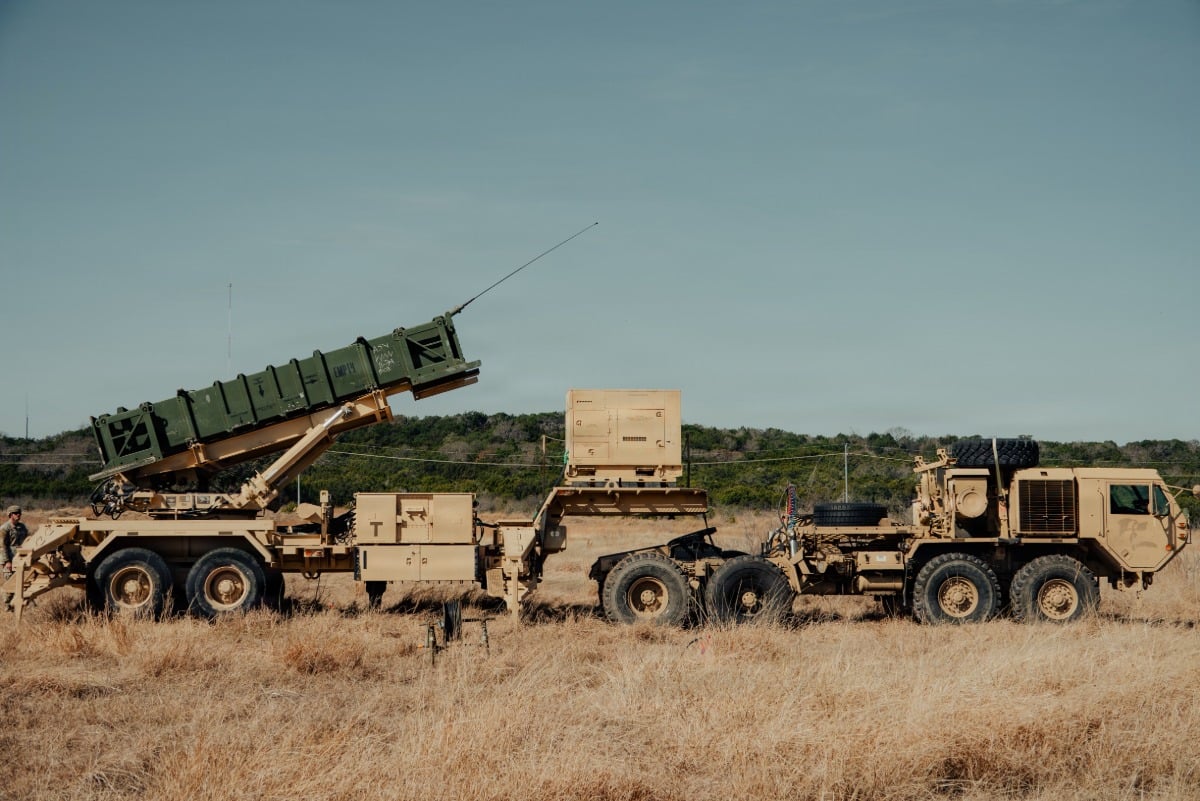
- The Army awarded Lockheed Martin Missiles and Fire Control a $347.5 million contract for prototype air and missile defense system improvements.
- Army Contracting Command at Redstone Arsenal, Alabama issued the award, with an estimated completion date of December 31, 2028.
Lockheed Martin’s Missile and Fire Control division, based in Grand Prairie, Texas, won a new contract worth $ 347.5 million for the development, fabrication, and testing of improvements to prototype air and missile defense systems, according to the Pentagon’s contract announcement.
The notice itself leaves several important questions unanswered, since it does not name a specific missile system, interceptor, or radar the prototype work will improve, stating only that work locations and funding will be determined with each individual order placed under the contract, with an estimated completion date of December 31, 2028. That kind of open-ended structure is common for Army prototyping vehicles that cover a family of related technologies rather than a single weapon, letting the service issue task orders for specific projects as needs and funding become clear rather than locking in every detail up front.
Contracts structured this way often fall under what the Pentagon calls middle-tier acquisition, a rapid prototyping authority created by Congress in 2016 that lets programs move new technology from concept to a working demonstration within roughly five years, bypassing the slower, more bureaucratic traditional acquisition process that can take a decade or more to field a new weapon system. The notice also states that bids were solicited over the internet and only one was received, meaning Lockheed faced no competing offer for this particular award, an outcome that is not unusual in missile defense work given how few companies in the world can match the combination of specialized facilities, security clearances, and decades of institutional knowledge required to prototype these systems.
Army Contracting Command at Redstone Arsenal in Huntsville, Alabama, issued the award, and the location matters because Redstone functions as the Army’s primary hub for missile procurement, home to the Program Executive Office for Missiles and Space and the office that has signed off on some of the largest weapons contracts in Army history. Redstone closed fiscal year 2025 having overseen $34 billion in contract awards, including the definitization of a $9.8 billion multi-year deal with Lockheed Martin Missiles and Fire Control for 1,970 Patriot Advanced Capability-3 Missile Segment Enhancement interceptors, known as PAC-3 MSE, a short-range system designed to destroy incoming missiles through sheer kinetic force rather than an explosive warhead. That contracting relationship deepened further this year when the Pentagon awarded Lockheed a $35.5 billion contract for long-term production of its Terminal High Altitude Area Defense system, commonly called THAAD, which intercepts ballistic missiles at higher altitudes than PAC-3 and is considered one of the few defenses the United States has against long-range threats.
Those enormous production contracts sit alongside a separate and much newer wave of missile defense spending tied to Golden Dome, the Trump administration’s plan for a layered, nationwide shield against ballistic, hypersonic, and cruise missile threats that Congress funded with $13.4 billion in the fiscal 2026 defense appropriations bill on top of billions allocated the year before. The Missile Defense Agency has structured much of that spending through a contracting vehicle called SHIELD, which had cleared more than 2,440 companies, including Lockheed Martin, to compete for task orders as of January 2026, and the Space Force separately selected Lockheed as one of twelve companies sharing up to $3.2 billion in prototype agreements to design space-based interceptors capable of striking missiles traveling faster than Mach 20. Whether this new $347.5 million prototype contract at Redstone connects directly to Golden Dome, feeds into an entirely separate air defense modernization effort, or supports something else within Lockheed’s existing PAC-3 and THAAD lines is not something the Army’s brief announcement makes clear, and nothing in the public record yet answers that question definitively.
What the contract does confirm, regardless of which specific program eventually claims the money, is that the Army continues treating missile defense prototyping as a priority worth hundreds of millions of dollars even as it simultaneously commits tens of billions to production of systems already in the field. Lockheed Martin has told investors and the public that Golden Dome represents a mission on the scale of the Manhattan Project, a comparison that signals how seriously the company and the Pentagon are treating the technical challenge of stopping a modern missile attack before it reaches its target, whether that missile is a short-range rocket fired across a battlefield or an intercontinental weapon crossing an ocean.