

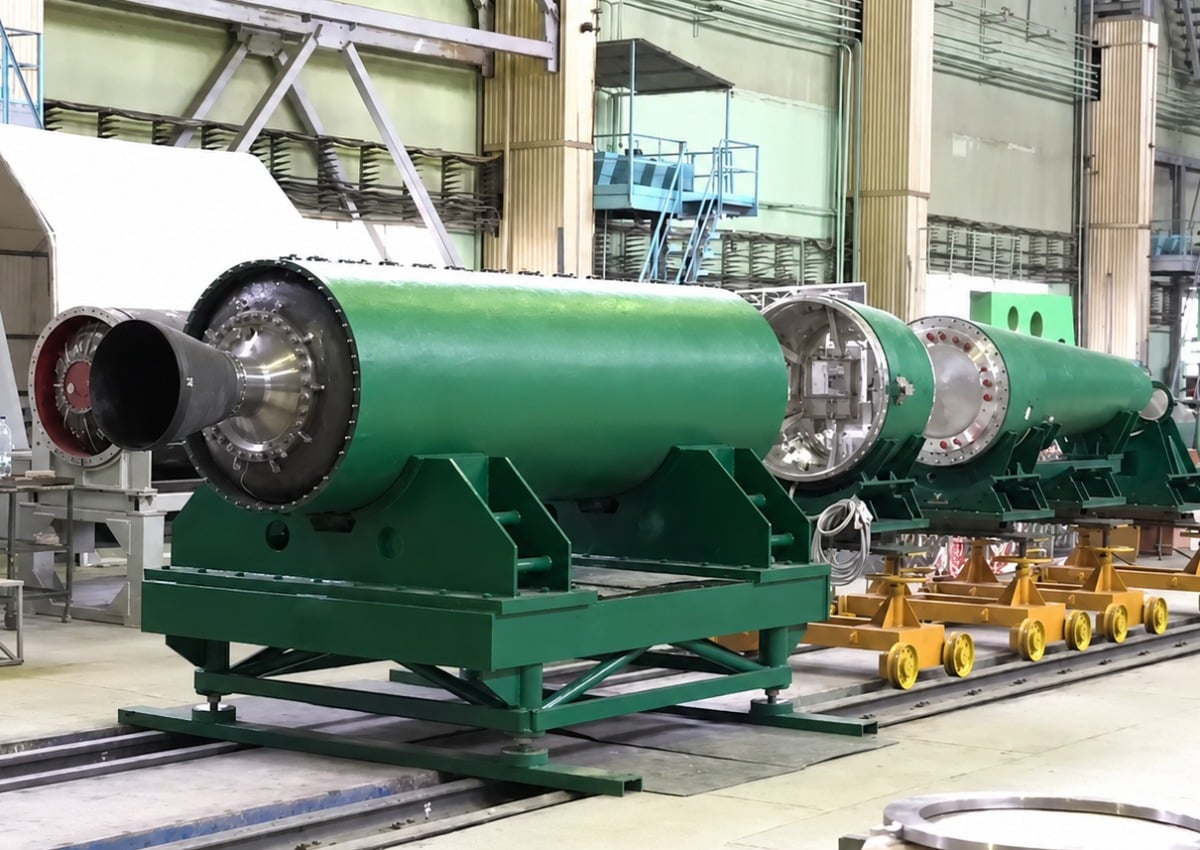
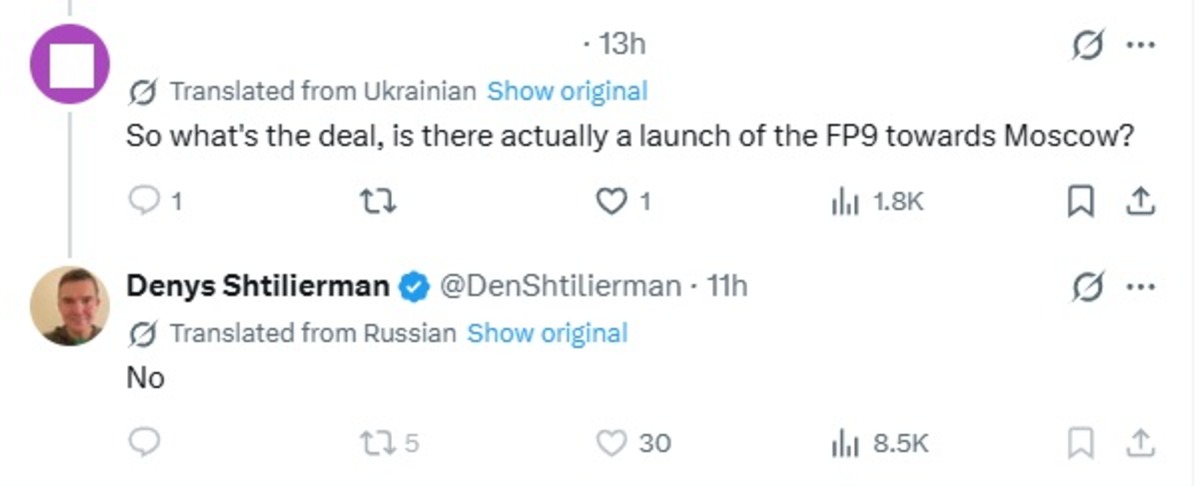
- Fire Point's CEO denied that the June 30 missile intercepted near Moscow was FP-9 ballistic missile.
- Russia’s Ministry of Defense said on July 1 that air defenses intercepted a long-range operational-tactical missile.
Fire Point chief designer and co-owner Denys Shtilierman has denied that the mysterious missile intercepted near Moscow on June 30 was the company’s FP-9 heavy ballistic missile, leaving open the central question raised by Russian and Ukrainian OSINT accounts: what exactly did Russian air defenses engage over Moscow Oblast?
The denial matters because Fire Point is the only Ukrainian developer that has publicly linked its ballistic missile work to a range capable of reaching the Russian capital. Other Ukrainian companies are also working on ballistic missile projects, but their identities and programs remain under strict secrecy, leaving analysts with little public evidence to compare against the object reportedly intercepted near the village of Yudanovka along the Warsaw Highway corridor southwest of Moscow.
Russia’s Ministry of Defense said on July 1 that its air defenses had intercepted a “long-range operational-tactical missile,” but did not identify the missile, name the intercept location, or provide wreckage imagery. Russian state and local media carried the ministry’s wording, including Interfax, which reported that Russian air defenses also shot down guided bombs and hundreds of Ukrainian fixed-wing drones during the same reporting period.
That official Russian wording gave the incident a new level of importance, but it did not resolve the core uncertainty. The ministry did not call the missile ballistic, did not say whether the intercept happened over Moscow Oblast, and did not connect its statement to the crater later geolocated by Ukrainian OSINT accounts. The available picture still depends on fragments: Russian air defense claims, open-source geolocation, imagery of a crater, and analyst interpretation of the reported engagement profile.
The most prominent early observation came from Voyennyy Osvedomitel, a pro-Russian military Telegram channel, which said S-300 or S-400 air defense systems had operated at high altitude during a missile alert in Moscow Oblast. The channel described the profile as unusual for a drone or cruise missile and pointed to a large crater at the impact site, while cautioning that the available evidence was indirect and insufficient for a definitive conclusion.
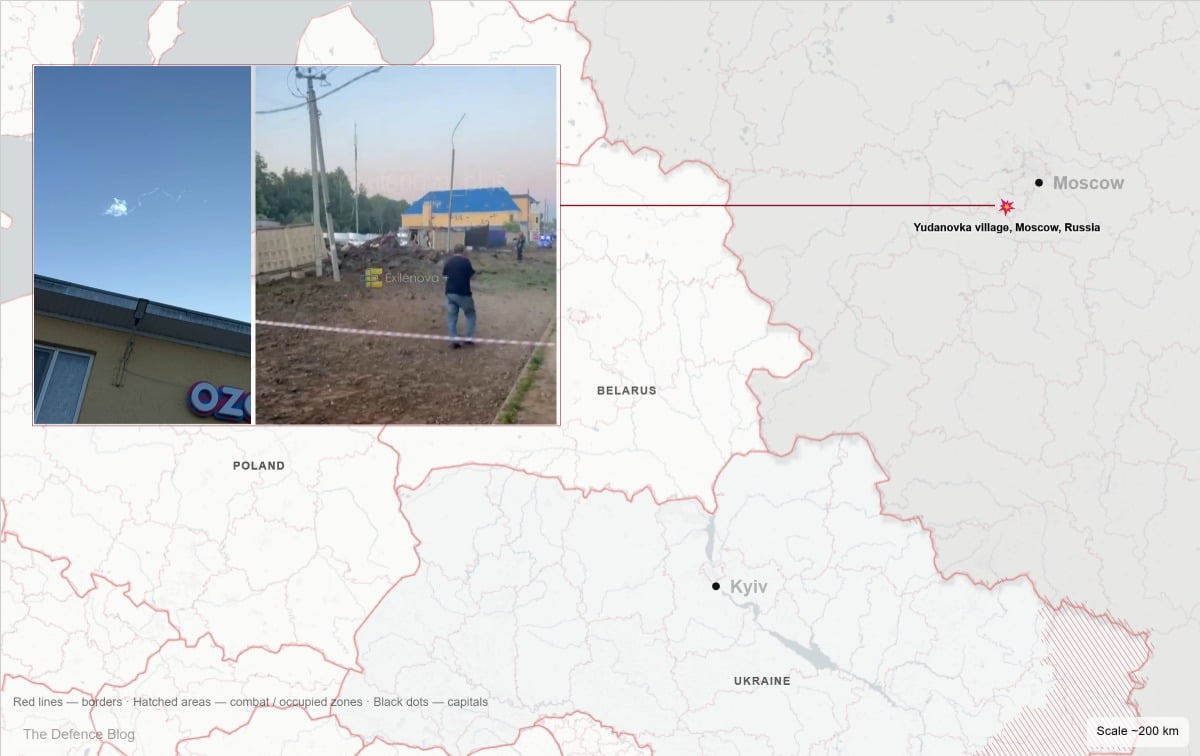
Ukrainian OSINT group CyberBoroshno later geolocated the crater near Yudanovka, a village in Moscow Oblast on the southwest approach to the Russian capital. That location became central to the debate because it sits far beyond the reach of Ukraine’s known Soviet-era tactical ballistic missiles and beyond the publicly documented range of the U.S.-supplied ATACMS missiles that Ukraine has used since 2023.
The distance problem is what makes the unidentified missile so difficult to explain. ATACMS, the U.S.-made Army Tactical Missile System fired from HIMARS and M270 launchers, has a maximum range of 300 km (186 miles), according to Lockheed Martin’s published specifications. Ukraine’s older Soviet-designed Tochka-U tactical ballistic missiles have a much shorter known reach, commonly cited at up to 120 km (75 miles), which makes them unsuitable for a strike profile reaching the Moscow region from Ukrainian-held territory.
Those limits do not prove the missile was a new Ukrainian ballistic weapon, but they narrow the field of known candidates. A missile reaching Moscow Oblast from Ukraine would need substantially more range than ATACMS or Tochka-U can provide. That is why OSINT discussion quickly turned toward Ukraine’s emerging domestic long-range missile programs, even before Shtilierman moved to distance Fire Point’s FP-9 from the incident.
Fire Point has drawn attention because it has publicly discussed the FP-9 in unusually direct terms. The missile is described in Ukrainian defense reporting as a heavy ballistic missile with a claimed range of about 855 km (531 miles), a length of roughly 9.5 m (31 ft), a diameter of about 1.1 m (3.6 ft), and a claimed warhead of 800 kg (1,764 lb). Published descriptions have also cited speeds of around 2,200 m/s (7,218 ft/s), placing it in a class far beyond one-way attack drones or cruise missiles.
Reuters reported in June that Fire Point expected to begin flight tests of the FP-9 in the summer and battlefield trials by autumn, while also developing the FP-7X interceptor missile for a European air defense concept with Germany’s Hensoldt radar technology. Separate Ukrainian defense reporting has said Shtilierman described the FP-9 engine as the remaining major development hurdle, which made any unusual long-range ballistic incident near Moscow especially sensitive for the company.
Shtilierman’s denial therefore pushes the story away from the simplest public explanation. If the missile was not FP-9, and if Russia’s claim of intercepting a long-range operational-tactical missile is accurate, then the object may point to another Ukrainian ballistic program, a different long-range missile type, or a Russian misclassification. None of those possibilities can be treated as confirmed without imagery of debris, a Ukrainian acknowledgment, or more precise Russian data.
Ukraine has clear reasons to keep any new ballistic missile capability opaque. Long-range strike programs depend on surprise, survivable production, and uncertainty about launch locations. Russia also has reasons to obscure details, because acknowledging a new Ukrainian missile capable of reaching Moscow Oblast would raise uncomfortable questions about air defense coverage around the capital.
That leaves the public record in an unusual place. Russia says it intercepted a long-range operational-tactical missile. OSINT groups say a crater near Yudanovka matches the geography of the Moscow Oblast incident. Fire Point’s chief designer says the missile was not the FP-9. The known Ukrainian ballistic missiles supplied by partners or inherited from the Soviet period do not have the range to explain such a flight path from Ukrainian territory.