

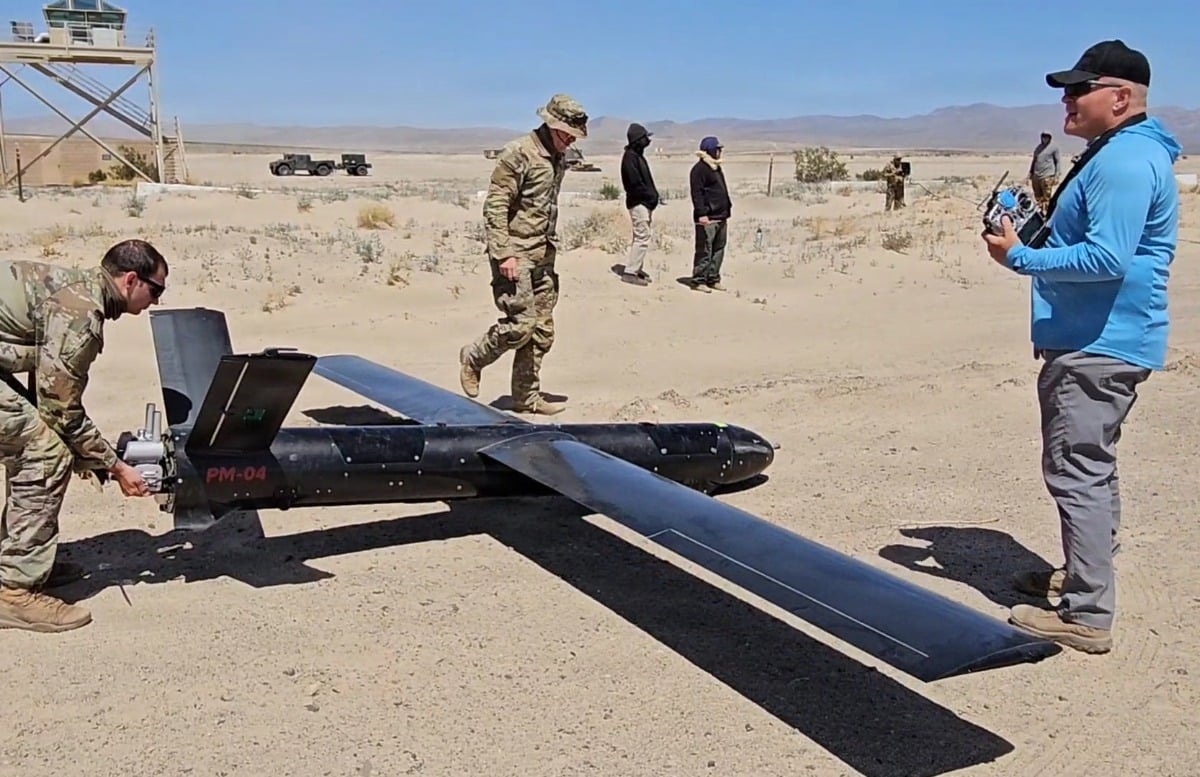
- AEVEX Corp. secured a $50 million U.S. Air Force contract on June 30, 2026, with $27 million in initial funding to expand unmanned mission-support capabilities.
- The contract advances production of AEVEX's long-range precision strike platform, engineered for extended-range missions in GPS-denied environments.
AEVEX Corp. secured a $50 million contract from the United States Air Force on June 30, 2026, to continue expanding unmanned mission-support capabilities for current operations, with $27 million in initial funding committed at award.
The Solana Beach, California-based company, publicly traded on the New York Stock Exchange under the ticker AVEX, will use the contract to advance production of what it describes as a long-range precision strike platform, a modular, expeditionary aircraft engineered specifically for extended-range missions in contested and GPS-denied environments, the kind of electronically jammed battlespace that defense planners increasingly expect any future conflict with a capable adversary to feature.
GPS-denied operation has become one of the defining engineering requirements across the entire unmanned aircraft industry, and understanding why requires understanding what GPS jamming and spoofing actually do to a drone in flight. Most commercial and early-generation military drones rely on satellite navigation signals to know where they are and where they are going, a system that works flawlessly until an adversary deploys electronic warfare equipment specifically designed to flood the area with false or overwhelming radio signals on the same frequencies GPS satellites use. When that happens, a drone dependent solely on satellite navigation either loses its position entirely or, worse, accepts spoofed coordinates that lead it somewhere the operator never intended. Russia has deployed GPS jamming and spoofing extensively in Ukraine and along NATO’s eastern flank, and the technique has proven effective enough that American defense planners now treat GPS denial as a baseline assumption for any near-peer conflict scenario rather than an edge case worth occasionally testing against.
AEVEX’s broader unmanned aircraft portfolio addresses that requirement through what the company calls alternative positioning, navigation, and timing technologies, layered navigation systems that combine vision-based navigation, where onboard cameras and processing identify and track terrain features to calculate position without any satellite input, alongside inertial navigation and other sensor fusion techniques that allow an aircraft to maintain accurate course and targeting even when GPS signals are jammed, spoofed, or simply unavailable. AEVEX’s existing Atlas system, a Group II autonomous precision strike aircraft weighing between 21 and 55 lb (9.5 to 25 kg), already employs exactly this approach, and the U.S. Army selected Atlas in 2025 as the first system fielded under its Launched Effects-Short Range program, with soldiers from the 101st Airborne Division operating the platform during training at the Joint Readiness Training Center at Fort Polk, Louisiana, in April 2026, as previously reported by The Defence Blog.
The press release announcing this new Air Force contract does not name the specific aircraft involved, but the description, a modular, expeditionary, long-range platform delivering high-payload capacity, rapid reconfiguration, and seamless payload integration, points toward AEVEX’s larger Group III aircraft family rather than the smaller Atlas. That family includes the Disruptor, capable of remaining airborne for more than 14 hours and reaching distances up to 1,400 km (870 miles) while carrying mission payloads up to 22.6 kg (50 lb), and the Dominator, rated for 18 hours of endurance, a range of roughly 1,852 km (1,151 miles), and a 16.7 kg (37 lb) payload capacity, both built around an open-architecture design that allows rapid integration of intelligence, surveillance, reconnaissance, electronic warfare, and strike payloads depending on what a specific mission requires. AEVEX manufactures both aircraft through a process the company calls ForgeX, an additive manufacturing system relying heavily on 3D printing and digital engineering specifically intended to accelerate production and simplify the scaling of complex airframes.
Roger Wells, Chief Executive Officer of AEVEX, framed the contract as evidence of operational confidence the Air Force has placed in the company’s broader product line.
“Our teams continue to demonstrate the ability to deliver reliable, adaptable unmanned solutions at operationally meaningful scale,” Wells said. “This award underscores the confidence our customers place in AEVEX to provide affordable, rapidly deployable capabilities that enhance current mission readiness.”
The category of unmanned aircraft AEVEX builds sits in a strategically significant middle ground that the Pentagon has been racing to fill. Conventional long-range cruise missiles like the JASSM-ER cost millions of dollars per unit and take years to produce at meaningful scale, while small first-person-view drones assembled from commercial components have transformed front-line combat by giving individual soldiers precision attack capability at extremely low cost but extremely limited range. AEVEX’s Group III platforms occupy the space between those extremes, offering hours of endurance, hundreds of kilometers of range, and payloads measured in tens of pounds, at a unit cost and production timeline that allows the kind of mass deployment that traditional missile programs cannot sustain. Large numbers of autonomous strike drones operating in that middle category can force an adversary to expend costly interceptor missiles, saturate radar coverage, and complicate air defense planning even before manned aircraft enter contested airspace, a tactical logic the Pentagon has studied closely after watching exactly that pattern play out repeatedly in Ukraine and across the Middle East.
This contract continues a pattern of expanding Air Force engagement with AEVEX’s autonomous aircraft portfolio that has accelerated through 2026. The company supports an existing Air Force contract covering its additive-manufactured Group III unmanned aircraft systems, a category that includes the Onyx, Disruptor, Raker, and Dominator platforms, with that agreement also covering engineering and field support services delivered directly by AEVEX personnel. AEVEX maintains roughly 100,000 sq ft (9,290 sq m) of unmanned systems manufacturing facilities and employs more than 150 engineering personnel spread across California, Virginia, Ohio, Florida, and Alabama, giving the company a distributed domestic production footprint that allows performance across multiple AEVEX engineering, integration, and production facilities, exactly the arrangement specified for executing this newest $50 million award.
The strategic logic underpinning the Air Force’s continued investment in companies like AEVEX reflects a broader doctrinal shift the Pentagon has been pursuing since the early lessons of the war in Ukraine became impossible to ignore. One-way attack drones and autonomous strike aircraft are no longer treated as expendable battlefield curiosities; they are increasingly viewed as a method for delivering precision mass at ranges once dominated exclusively by expensive stand-off weapons, with the specific advantage of being producible in numbers that traditional acquisition programs cannot match. A platform built to operate effectively when an adversary’s electronic warfare systems have already degraded or eliminated GPS access is not a luxury feature in that environment. It is the baseline requirement for any unmanned aircraft expected to survive long enough to complete its mission, and it is exactly the capability AEVEX’s $50 million contract is built to expand.