

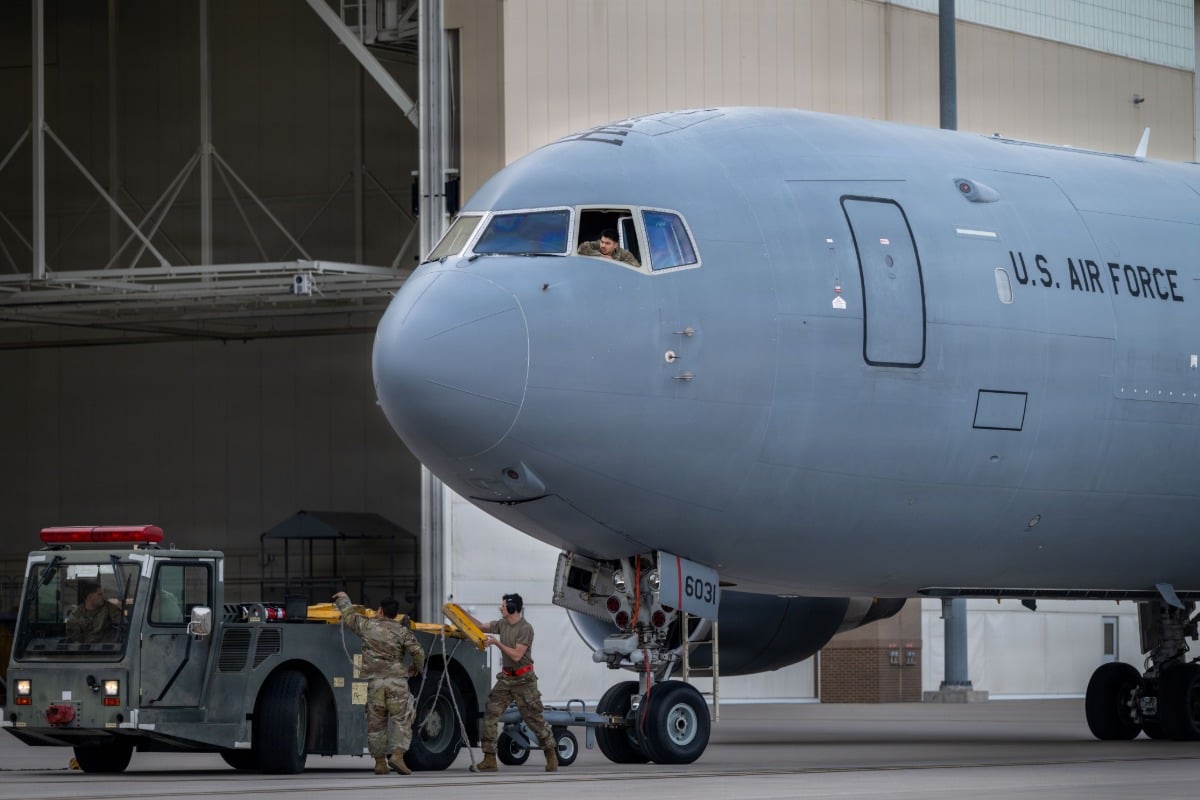
- The U.S. Air Force awarded a combined $471 million across 28 companies on June 24, 2026, for KC-46 tanker parts exchange and repair services.
- The contracts, managed by the Air Force Sustainment Center at Tinker Air Force Base, run through May 28, 2031, following a competitive process with 28 offers received.
The U.S. Air Force awarded a combined $471 million in contracts to 28 different companies on a single day, spreading the work of exchanging and repairing aircraft parts for the KC-46 Pegasus tanker across facilities in more than a dozen states and Israel, in a move that targets one of the most persistent and least visible problems plaguing America’s premier aerial refueling fleet.
The Air Force Sustainment Center at Tinker Air Force Base in Oklahoma made the award through 28 separate indefinite-delivery, indefinite-quantity contracts, each capped within the combined $471 million ceiling, after a competitive process that drew 28 offers. The contracts cover commercial and non-commercial aircraft parts exchange and repair, and the work runs through May 2031.
The KC-46 Pegasus is a militarized version of the Boeing 767 airliner, built to carry up to 96,160 kg (212,000 lb) of fuel and transfer it to other aircraft mid-flight through either a boom system or a hose-and-drogue system, while also serving as a cargo hauler capable of carrying 65,000 lb (29,484 kg) across 18 pallet positions and an aeromedical evacuation platform that can move up to 58 patients at once. The Air Force has already taken delivery of more than 105 of a planned 263 aircraft, with the fleet now operating from seven bases across the country and additional locations slated to come online through 2031. Every long-range bomber mission, every fighter deployment to a distant theater, every cargo flight that needs to stretch beyond a single tank of fuel depends on tankers like the KC-46 being available and ready to fly, which is precisely where the program has struggled most.
A Government Accountability Office report released in 2026 found the KC-46 had a mission capable rate of just 62 percent in fiscal year 2024, below even the aging KC-135 Stratotanker fleet it is meant to replace, which posted a 68 percent rate the same year against an Air Force target the GAO described as persistently unmet across the entire tanker fleet. The Pentagon’s Director of Operational Test and Evaluation flagged two specific unresolved technical issues in a March 2026 report, the Remote Vision System that boom operators use to guide the refueling connection and the Boom Telescope Actuator that extends the boom itself, both of which remain limiting factors on the aircraft’s full combat certification even as the tanker continues flying restricted operational missions. The GAO also identified a maintenance personnel problem compounding the technical issues, finding that roughly 75 percent of maintainers at some bases operating both the KC-135 and KC-46 lack the experience needed to keep the newer, more complex aircraft properly serviced.
Parts availability sits at the center of that readiness gap in a way that is easy to overlook amid headlines about software glitches and camera systems. A fleet of aircraft can be technically airworthy and still grounded simply because a specific component, a hydraulic actuator, a landing gear assembly, an avionics module, is not available when it fails, forcing the aircraft to sit in a hangar awaiting parts rather than flying its assigned mission. The 28 contracts awarded June 24 address exactly that vulnerability, establishing a broad network of commercial repair vendors who can exchange or repair KC-46 parts faster and more flexibly than relying on a single source or waiting for new manufacture, spreading risk across multiple suppliers so that a problem at any one vendor does not stall the entire repair pipeline.
The roster of companies receiving awards spans the breadth of the American aerospace supply chain, from Boeing itself in Tukwila, Washington, the original manufacturer with the deepest technical knowledge of the airframe, to specialized component repair shops like Crane Aerospace and Electronics in Lynnwood, Washington, and Eaton Corporation, which received five separate awards across different business units and locations in Ohio, California, Michigan, and Mississippi covering different categories of aircraft systems. Honeywell International in Tempe, Arizona and Hamilton Sundstrand, doing business as Collins Aerospace in Windsor Locks, Connecticut, both major avionics and systems suppliers, also received contracts, alongside smaller specialized firms like Davenport Aviation in Blackstone, Virginia and S&K Aerospace in Saint Ignatius, Montana. One award went to TAT Technologies in Kiryat Gat, Israel, reflecting the international dimension of the aerospace parts supply chain that keeps American military aircraft flying.
This parts contract arrives as part of a broader, deliberate readiness campaign the Air Force launched in partnership with Boeing on May 12, 2026, specifically targeting KC-46 availability. That initiative combines an accelerated installation schedule for the Remote Vision System 2.0 upgrade, the repurposing of five early-production aircraft whose engines, landing gear, and other high-value components will be redistributed into the operational fleet rather than waiting for those aircraft to complete refurbishment in 2031, and a five-year performance-based logistics agreement under which Boeing assumes responsibility for improving the supportability of the aerial refueling subsystem and other components the Air Force identified as the most significant drags on availability. Air Force officials project that combined effort will deliver an immediate availability increase of roughly 6 percent, with overall fleet readiness climbing more than 20 percent by 2030.
Secretary of the Air Force Troy Meink described the KC-46 in May 2026 as a “cornerstone of U.S. power projection,” language that reflects how central aerial refueling has become to American military strategy, particularly in the Indo-Pacific theater where the distances involved make sustained air operations impossible without tankers extending the range of fighters and bombers operating from dispersed bases. China’s anti-access strategy in the region specifically targets the assumption that American airpower can rely on forward bases close to potential conflict zones, making the KC-46’s ability to extend range from more distant, less vulnerable locations a central pillar of how the Air Force plans to fight if deterrence fails.
The KC-46 has already proven its operational value under real combat conditions. Tankers from the fleet deployed to Israel on February 28, 2026, providing aerial refueling support during Operation Epic Fury, a large-scale joint U.S.-Israeli military operation against Iran, demonstrating the platform’s combat utility even amid the unresolved technical issues that continue limiting its full certification. The Air Force is simultaneously planning to expand the fleet further, with fiscal year 2027 budget materials seeking funding for 15 additional aircraft and reports indicating annual procurement could rise to 18 aircraft per year between 2028 and 2031, growing the eventual fleet toward 263 tankers.