

- L3Harris Technologies received a $614 million contract from U.S. Special Operations Command on June 29, 2026, for logistics support of the AN/ALQ-211 electronic warfare system.
- The non-competitive contract includes $40.7 million in fiscal 2025 and 2026 funding obligated at award, managed through MacDill Air Force Base, Florida.
When a U.S. Special Operations helicopter or tiltrotor flies into hostile territory and an enemy radar locks onto it, the crew has seconds to break that lock before a missile finds them. The system that buys them those seconds just secured its long-term maintenance pipeline. L3Harris Technologies received a $614 million contract from U.S. Special Operations Command on June 29, 2026, to provide ongoing logistics support for the AN/ALQ-211 Suite of Integrated Radio Frequency Countermeasures, the electronic warfare system that protects America’s most sensitive aircraft from radar-guided weapons.
The award, structured as an indefinite-delivery, indefinite-quantity contract that lets the government order varying amounts of support work over time rather than committing to a fixed scope upfront, combines firm-fixed-price and cost-reimbursement components, with $40.7 million in fiscal year 2025 and 2026 funding obligated immediately. U.S. Special Operations Command, headquartered at MacDill Air Force Base in Florida, awarded the contract non-competitively under federal acquisition rules that permit sole-source awards when only one qualified supplier can reasonably provide the capability, a designation that reflects L3Harris’s position as the system’s sole developer and integrator.
The AN/ALQ-211, known throughout the defense community by its program acronym SIRFC, functions as an aircraft’s electronic bodyguard, constantly scanning the radio frequency spectrum for the signature emissions of enemy radar systems and automatically determining whether the aircraft has entered the lethal engagement range of a radar-guided surface-to-air missile or anti-aircraft gun. When that threshold is crossed, the system can break the missile’s lock through a combination of radio frequency jamming and electro-optical countermeasures, cueing the release of chaff and flares at precisely the moment needed to confuse the incoming weapon’s guidance. The system serves as what L3Harris describes as the aircraft’s overall electronic warfare manager, fusing data from onboard and off-board sensors to give the pilot a real-time picture of every radar threat in the surrounding airspace rather than forcing the crew to interpret raw warning signals during the highest-stress moments of a mission.
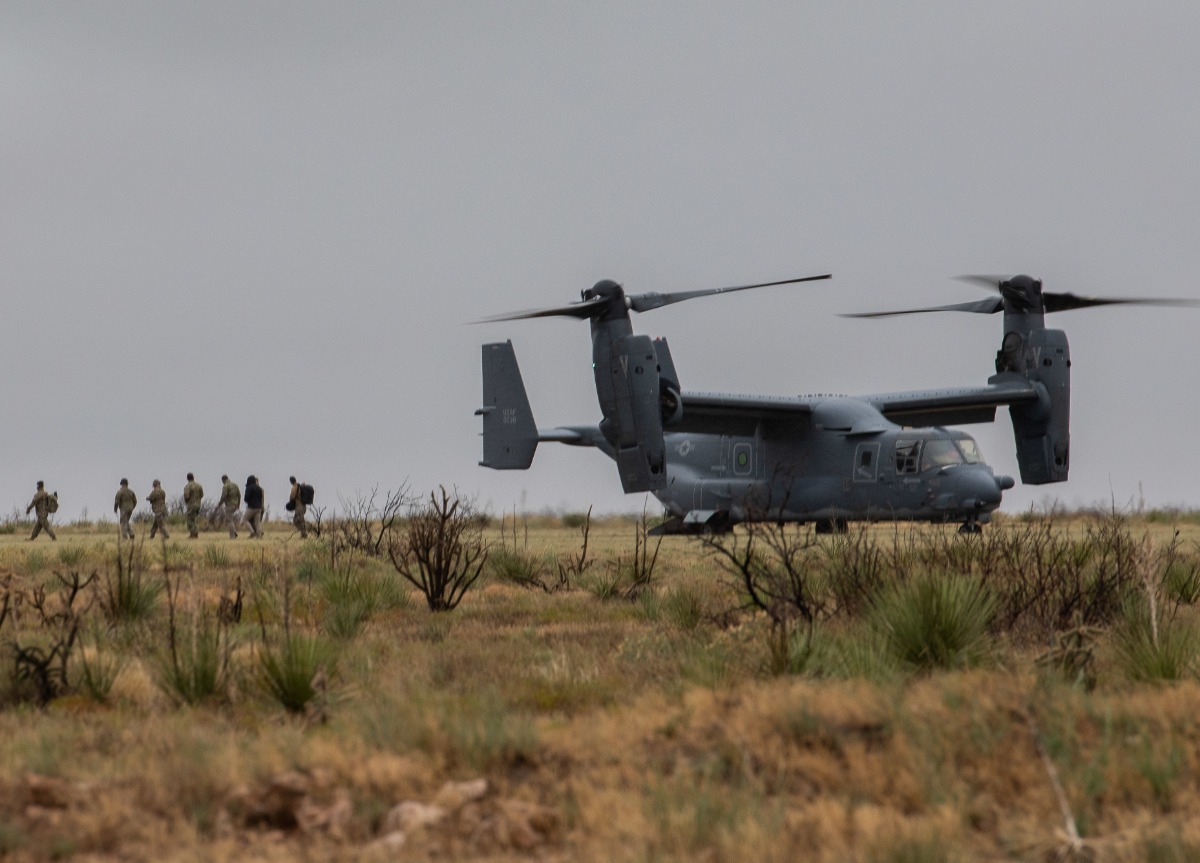
The system is integrated into the CV-22 Osprey, the tiltrotor aircraft that takes off and lands like a helicopter but flies like a fixed-wing turboprop, giving Air Force Special Operations Command the speed and range to insert and extract operators deep into contested territory. It also equips Army Special Operations MH-47G Chinook and MH-60M Black Hawk helicopters, the workhorse platforms that have carried special operations forces on virtually every major raid and infiltration mission of the past two decades. Beyond U.S. forces, the system has been exported to F-16 fighter fleets operated by Chile, Poland, Pakistan, Turkey, and Oman, and equips Norway’s NH90 multi-mission helicopter, reflecting the broad allied demand for a proven electronic warfare capability that can be integrated across both rotary-wing and fixed-wing platforms.
The technical sophistication of SIRFC lies in its ability to counter a remarkably broad spectrum of radar threats simultaneously. The system is designed to detect, identify, and jam pulse radar, pulse-Doppler radar, continuous wave radar, and the harder-to-defeat monopulse radar that modern surface-to-air missile systems increasingly rely on for precision guidance, operating across the dense and overlapping radio frequency environment that characterizes contested airspace where multiple radar systems may be tracking an aircraft simultaneously. That multi-threat capability matters enormously in the operational environments where Special Operations aircraft actually fly, frequently into regions where air defense systems combine older Soviet-era radar technology with newer Western and Chinese-sourced systems, creating exactly the kind of unpredictable, mixed-signal environment that simpler electronic warfare systems struggle to interpret correctly.
SIRFC’s development history traces back to the early 1990s, when the Army began work on an integrated replacement for the separate radar warning receiver and jamming systems that previous generations of helicopters carried as distinct, unintegrated boxes. The program experienced significant technical challenges during its developmental testing in the late 1990s and early 2000s, including software integration problems discovered during testing at Edwards Air Force Base that required the Army to restructure the program’s testing schedule, a difficult but ultimately successful maturation process that produced the integrated system now flying on Special Operations aircraft. The Army eventually reduced its broader fleet-wide ambitions for SIRFC, narrowing the program’s focus primarily to Special Operations applications where the system’s advanced capabilities against sophisticated threats justified its cost and complexity relative to the legacy systems it replaced.
This latest contract continues a long-standing relationship between L3Harris, the company that absorbed the original ITT Industries and Exelis defense electronics businesses that developed SIRFC, and U.S. Special Operations Command, which has consistently funded incremental support and sustainment contracts for the system over the past several years. A prior order in 2024 brought $48.7 million for SIRFC components and services, a figure dwarfed by the new $614 million ceiling, indicating that Special Operations Command intends to fund a substantially larger volume of sustainment activity over the life of this multi-year award. The contractor logistics support covered under the new agreement typically includes spare parts provisioning, system repair and overhaul, technical engineering support, and the kind of continuous software and threat library updates that keep an electronic warfare system effective against adversary radar technology that itself continues to evolve.
That last point deserves emphasis, because electronic warfare is fundamentally an arms race conducted in the radio frequency spectrum rather than a one-time engineering achievement. The radar systems SIRFC was designed to defeat in the 1990s are not the radar systems Special Operations aircraft encounter today, and adversaries from Russia to China to Iran continue fielding increasingly sophisticated air defense networks with improved frequency agility, lower probability of intercept waveforms, and counter-countermeasure techniques specifically designed to defeat systems like SIRFC. Sustaining the system’s effectiveness requires continuous software updates incorporating newly identified threat signatures, a process that depends entirely on the kind of long-term logistics support contract Special Operations Command just awarded.
For the operators who fly into hostile airspace aboard CV-22s and MH-47Gs, SIRFC is not an abstraction discussed in budget documents. It is the difference between a mission that proceeds as planned and one that ends with a missile finding its mark. The $614 million Special Operations Command just committed ensures that the system standing between America’s most elite aviators and the radar-guided weapons hunting them stays current, stays maintained, and stays ready for whatever threat environment the next mission brings.