

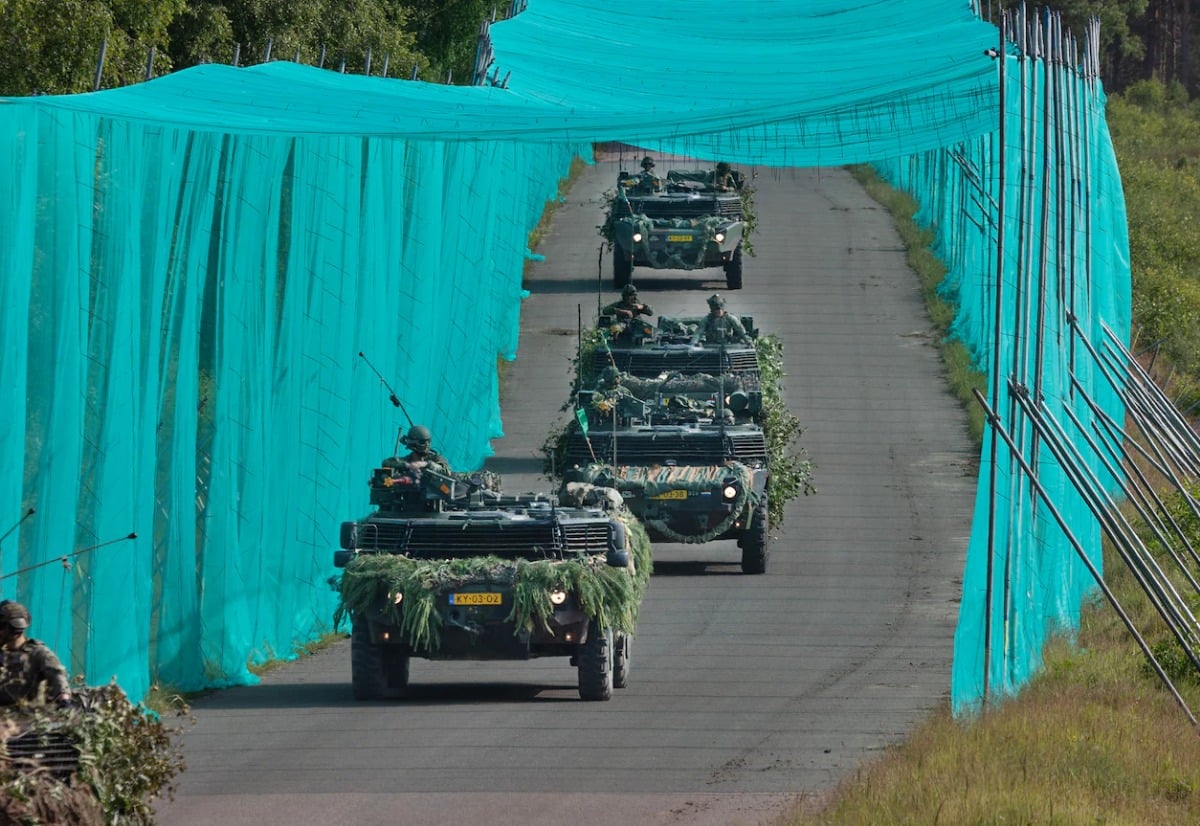
- Exercise Fighter Lion involves nearly 7,000 Dutch troops training near Bergen-Hohne, Germany, through early July 2026, the Netherlands' largest army exercise in twenty years.
- Dutch forces integrated Ukrainian-derived anti-drone tunnels and drone warfare teams into the exercise scenario for the first time, training under constant simulated drone and electronic warfare threats.
Dutch soldiers are training with anti-drone tunnels, the netted covered routes first developed by Ukrainian forces to shield vehicles from kamikaze drone strikes, after the Netherlands became one of the first NATO armies to integrate Ukrainian battlefield lessons directly into its largest military exercise in twenty years, Eindhovens Dagblad reported from the field in northern Germany, where nearly 7,000 Dutch troops are conducting Exercise Fighter Lion through early July 2026.
The exercise, which the Dutch Ministry of Defence describes as the largest army exercise of 2026 and the biggest in two decades, is taking place on training areas around Bergen-Hohne, a vast military training ground roughly 60 kilometers (37 miles) south of Hamburg in the forested lowlands of Lower Saxony. The scenario is fictional but unmistakably based on Russia: a hostile nation called Murinus invades NATO territory, pushing from east to west across the European continent after crossing the Oder River, the waterway that forms the border between Germany and Poland, and driving toward the German regions of Bergen and Münster. The Dutch army’s job in the exercise is to stop that advance, using the same defensive maneuvers NATO planners believe they would need in a real large-scale conventional conflict.
The 13th Light Brigade from Oirschot, a city in the Dutch province of North Brabant, took the first assignment: stop the fictional enemy’s advance before it could consolidate. The brigade’s commander assessed the outcome clearly after completing that phase of the exercise.
“It went great. We stopped the attackers,” the commander said, as quoted by Eindhovens Dagblad.
The 43rd Mechanized Brigade from Havelte, in the province of Drenthe, then took over the fight with heavier armored assets to finish the engagement. The handoff between the two brigades while combat operations were still ongoing, a military maneuver known as a Forward Passage of Lines that requires extraordinarily precise coordination, is new to Fighter Lion this year, and reflects the kind of complex combined-arms sequencing that NATO planners consider essential for large-scale conventional warfare. In past editions of the exercise, units practiced their own phases in sequence. In 2026, they practiced transferring a live fight to the next unit without stopping, which is what actual war demands.
The most tactically distinctive element of Fighter Lion is not the scale, but what is being trained within it. Soldiers trained under constant threats from drones and electronic interference throughout the exercise, a combat environment that would have been absent from a comparable NATO exercise ten years ago and that now defines every operational planning assumption the Dutch army makes. Drone teams from a new Dutch army unit designated “Tech Dev,” established on April 1, 2026, as one of the first dedicated drone warfare units in NATO, are flying surveillance and attack drones as part of the exercise’s opposing force, giving Dutch ground units realistic experience against the kind of threat Ukrainian soldiers face every hour of the day.
The anti-drone tunnels that have attracted attention from the exercise are a direct import from Ukrainian battlefields. In Ukraine, soldiers discovered that vehicles moving along roads and trails are extremely vulnerable to first-person-view kamikaze drones, which can identify and strike a moving vehicle within seconds of it entering an open area. The Ukrainian solution was to construct covered routes using fishing nets, camouflage netting, and improvised frames that create a low overhead barrier along frequently used paths, reducing the angle of attack available to incoming drones and forcing them to approach from directions where countermeasures are more effective. The tunnels became famous across social media and defense journalism worldwide in 2024 and 2025, and the Dutch army has now built equivalent structures on the Bergen-Hohne training area to give its soldiers experience operating within and defending them.
Lieutenant General Jan Swillens, commander of the Dutch land forces, said the Dutch army leads within NATO on drones, drawing directly on Ukraine war lessons to understand both what drones can do and what can be done against them. The Omroep Brabant regional broadcaster, which embedded with the 13th Brigade during the exercise, reported that soldiers carried both commercial umbrella-type anti-drone screens and fishing nets as personal protective equipment, improvised countermeasures that Dutch troops are training with before more formal equipment solutions reach the field. Dutch soldiers operating armored vehicles at the exercise’s command center also trained using simulators, controlling tracked vehicles and tanks through screens rather than physical presence, a method the exercise director Brigadier General Jos Dirkx described as essential for training at scale without the physical damage and public disruption that moving hundreds of armored vehicles through civilian areas would cause.
The exercise scenario places the fight within a broader multi-domain context, with the Dutch defence publication Defensie Dichtbij noting that the war in Ukraine has demonstrated how airspace, cyber, and the electromagnetic spectrum all directly affect ground combat, and that Fighter Lion is designed to train those dimensions simultaneously rather than in isolation. Electronic warfare units are conducting jamming operations during the exercise, units are training to remain invisible in the electromagnetic spectrum to avoid being detected and targeted, and the Bushmaster armored personnel carrier, the Dutch-Australian wheeled infantry vehicle that has served extensively in Afghanistan and that Australia has supplied to Ukraine in significant numbers, is being used in the exercise with systems that map the electromagnetic environment around it.
The Fighter Lion scenario draws on a fictional geography that mirrors the actual NATO defensive challenge in Northern Europe with considerable precision. The Oder River crossing that the fictional Murinus force uses to launch its westward advance mirrors the genuine defensive concern about Russian forces potentially using the same terrain in a war against NATO, and the German training grounds between Bergen and Münster sit in territory that NATO’s northeastern defensive plans have identified as critical ground for any large-scale conventional defense. Dutch forces train on that ground as part of the German 1st Armored Division’s structure, an integration that reflects the real command relationships that would apply in an actual NATO defensive operation.