

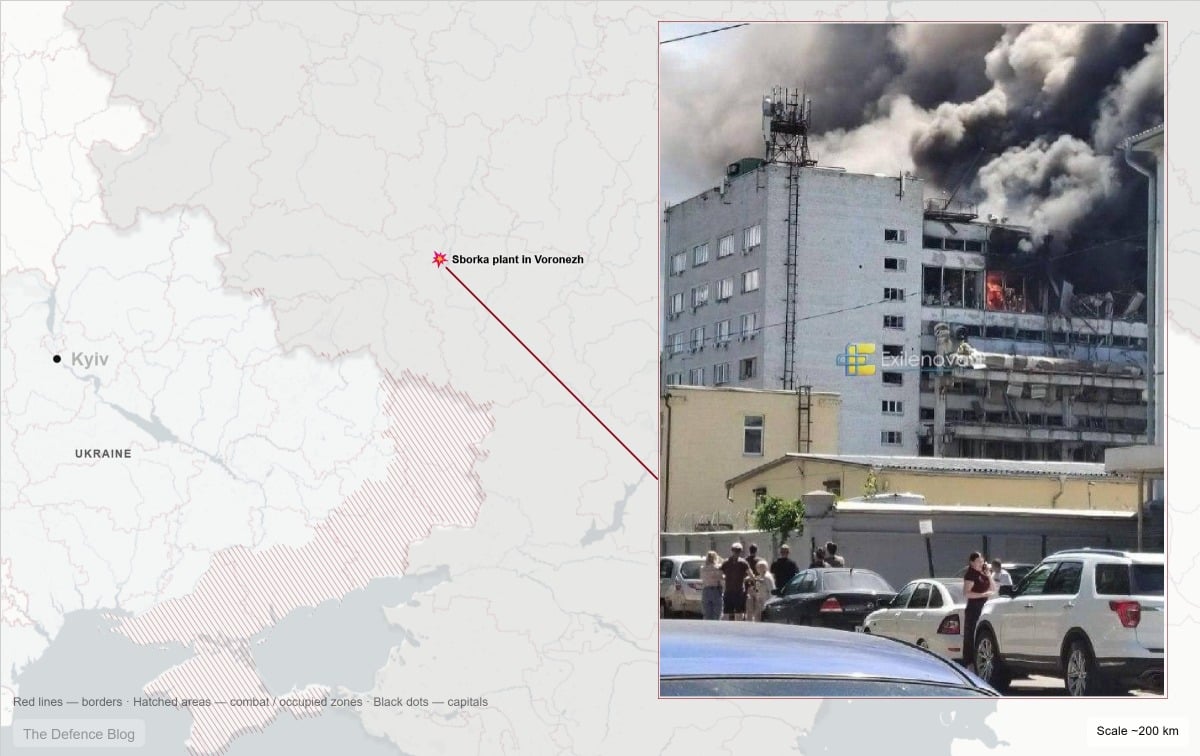
- Ukraine reportedly struck the Sborka semiconductor plant in Voronezh with cruise missiles, causing significant damage; the date and munition type remain unconfirmed.
- Ukraine's military intelligence database confirms the Sborka plant supplies specialized components to the Kh-101 cruise missile, Iskander-K missile complex, and Pantsir-S1 air defense system.
Ukraine appears to have struck one of the more obscure but consequential nodes in Russia’s weapons manufacturing chain, hitting the Sborka plant in Voronezh, a facility that Ukrainian military intelligence identifies as a supplier of specialized semiconductor components to three of Russia’s most operationally significant weapons programs: the Kh-101 cruise missile, the Iskander-K ballistic missile complex, and the Pantsir-S1 air defense system.
The strike, reportedly carried out with cruise missiles, caused significant damage to the facility, according to the source reporting.
The Sborka plant’s full official name is the Voronezh Factory of Semiconductor Devices, and its role in Russia’s defense industrial supply chain is documented in detail by Ukraine’s Main Intelligence Directorate, known as the GUR, which maintains a public database of sanctioned Russian defense enterprises. According to that database, the plant is Russia’s leading designer and manufacturer of discrete semiconductor devices, integrated circuits, and power modules, and it participates in the production of at least three weapons programs through precisely specified component contracts.
The Kh-101 connection is the most strategically significant. The Kh-101 is a long-range air-launched cruise missile capable of striking targets at ranges up to 5,500 kilometers (3,418 miles) from its launch point, making it one of the longest-range conventional cruise missiles in any air force’s inventory. Russia has used the Kh-101 extensively throughout the war in Ukraine, launching it from Tu-95MS strategic bombers flying over Russian territory, often deep in the Caspian Sea region or over the Volga River basin, far beyond the reach of Ukrainian air defenses. The missile navigates using a combination of inertial guidance, terrain-following radar, and optical terminal homing, with altitude controlled in part by what Russian technical documentation refers to as the UVK-208 block, a coded altimeter unit.
According to Ukraine’s sanctions documentation, the Sborka plant produced two specific components for that block: transistor assemblies designated 1NT251 4 NPN and transistor matrices designated 2TS622A. These are not generic parts that can be purchased off a commercial electronics catalog; they are specialized military-grade semiconductor components manufactured to Russian defense specifications, and their supply chain is narrow.
The Iskander-K connection is equally specific. The Iskander-K is a cruise missile variant of Russia’s Iskander short-range ballistic missile complex, designated the 9M727, which carries a conventional warhead and navigates to targets using the Zarya-61M onboard digital computer, a mission computer that processes guidance data throughout the missile’s flight. The Sborka plant, according to the HUR database, manufactures and supplies semiconductor matrices designated 1NT.251.2311 for a specific circuit board within the Zarya-61M’s architecture. Disrupting the supply of that component does not stop the 9M727 overnight, because any functioning weapons program maintains some stockpile of critical parts. But it compresses the program’s production timeline and forces Russian procurement officials to either find an alternative supplier, an increasingly difficult task under Western sanctions that have restricted Russia’s access to advanced semiconductors since 2022, or draw down reserves faster than they are replenished.
The third supply relationship the database documents involves the Pantsir-S1, Russia’s short-range air defense and anti-aircraft system, which combines radar-guided guns with surface-to-air missiles on a single vehicle and has been widely deployed to protect Russian assets in both Ukraine and Syria. The Sborka plant supplies diodes and transistor assemblies to the system’s television sighting channel, designated TKV-2, which provides optical targeting capability alongside the radar. Disabling the optical channel does not render the Pantsir-S1 inoperable, but it degrades the system’s ability to engage targets in radar-jammed or electronically contested environments, precisely the conditions under which Ukrainian forces have worked hardest to operate.
Voronezh, where the plant is located, sits approximately 500 kilometers (310 miles) northeast of the Ukrainian border, a distance that places it within range of Ukraine’s long-range strike assets. The city has been targeted by Ukrainian strikes before, including attacks on the Baltimor military airbase, home to Russian Su-34 fighter-bombers, and on fuel storage infrastructure in the region. Russia maintains significant military-industrial infrastructure across Voronezh Oblast, making it a recurring target in Ukraine’s campaign to degrade Russia’s capacity to sustain weapons production. The Sborka plant’s location within that industrial ecosystem, producing components for weapons actively used against Ukrainian cities and armed forces, made it a logical target within that targeting logic.
In March 2026, Ukraine used Storm Shadow cruise missiles, jointly produced by Britain and France, to strike the Kremniy El plant in Bryansk, which the Ukrainian General Staff described as one of Russia’s largest military microelectronics producers and which supplied components to Iskander ballistic missiles, Pantsir air defense systems, and the S-300 and S-400 surface-to-air missile families. In May 2026, Ukraine struck the VNIIR-Progress plant in Cheboksary using FP-5 Flamingo cruise missiles, hitting workshops that produced GNSS navigation receivers and jam-resistant antennas for Shahed drones, Iskander-M missiles, and Kalibr cruise missiles. The Sborka strike, if confirmed, continues that pattern: a targeted, intelligence-driven attack on a specific node in Russia’s weapons production network rather than a strike on a symbolic or prestige target.
What distinguishes this strand of Ukraine’s campaign from conventional deep strikes on airbases or fuel depots is the precision of the targeting intelligence behind it. Knowing that a specific plant in Voronezh supplies transistor assemblies with specific part numbers to a specific circuit board in a specific missile guidance computer requires a level of technical intelligence about Russian defense production that was not publicly known to exist at the beginning of the war. Whether that intelligence came from defectors, signals collection, open-source analysis of Russian procurement documents, or some combination of all three, the practical result is a targeting list that appears designed to dismantle Russia’s weapons production capacity component by component, in a war where Russia’s industrial scale has been one of its most important military advantages.