

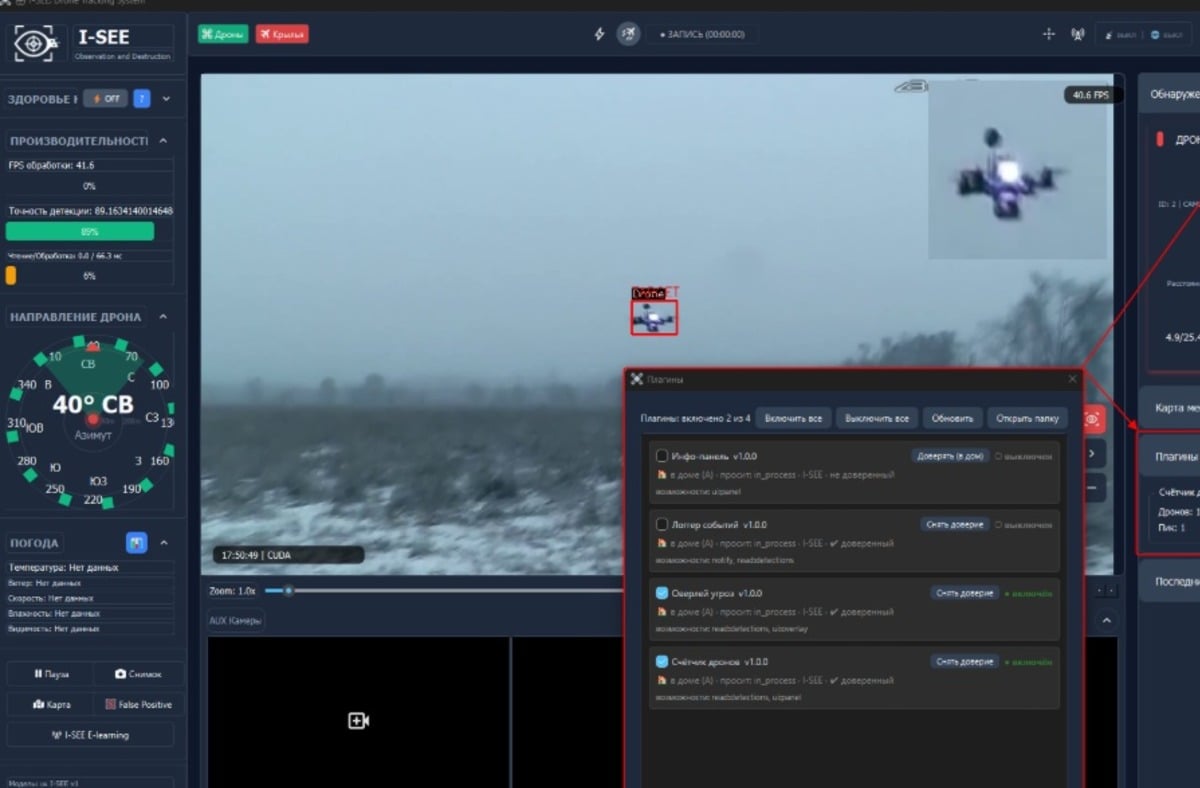
- Ukrainian company I-SEE announced an open platform architecture for its counter-drone system, adding an API, SDK, and plugin system for third-party integration.
- The I-SEE platform currently operates with net guns and is in laboratory testing for turret and electronic warfare effector integration.
A Ukrainian drone defense company has made a decision that could reshape how anti-drone systems get built and deployed on the battlefield, opening its I-SEE detection and engagement platform to outside developers through a full software ecosystem that includes an open application programming interface, a developer toolkit, and a plugin architecture that lets third-party engineers add new hardware and software directly into the system’s core without waiting for the original vendor to release an update.
Drone threats evolve faster than procurement cycles. A system that arrived at a forward position six months ago may already face threats its original designers did not anticipate, and in a closed architecture, the only fix is to wait for the vendor. I-SEE is betting that the better answer is to let the unit, the integrator, or a contracted engineer write the fix themselves, the same week the problem appears.
The I-SEE platform, developed by a Ukrainian defense technology company of the same name, detects, tracks, and engages unmanned aerial systems using a core processing engine that handles target acquisition, tracking calculations, target selection, and engagement decisions. The system currently operates with net guns, a counter-drone effector that fires a weighted net to physically capture or disable an incoming drone by entangling its rotors, and is in active laboratory testing for integration with gun turrets and electronic warfare jamming systems. Autonomous interceptor drones are described as a near-term addition. Until now, all of those capabilities operated as a single closed software environment, meaning every new hardware integration or feature addition required the development team to do the work themselves. The new architecture changes that completely.
The three integration layers the company announced work at different levels of depth. The outermost layer is the API, or application programming interface, a standardized data channel that lets any external software system pull real-time information from I-SEE: target positions, tracking parameters, threat classifications, and live video feed. The connection is secured and runs over current network standards, which means an operator can pipe I-SEE’s situational picture directly into a command post display, a digital tactical map, an event log, or any adjacent system without reverse-engineering the platform or building custom data bridges. A unit that already runs its own command software does not need to replace it. It connects I-SEE as a data source and reads the picture in whatever interface the operators already know.
The second layer is the SDK, or software development kit, a prebuilt toolkit designed to make that integration fast enough that a competent developer can have it running in a single evening rather than across weeks of integration work. The toolkit includes a client library that handles all the underlying network complexity and delivers data to the developer in clean, pre-parsed objects with ready-made fields and methods, and a browser-based testing interface that displays live video and real-time target tracking so an integrator can verify the connection is working before deploying to a real position. The company’s stated design principle here is deliberate: lower the entry threshold far enough that connecting to I-SEE is not a specialized skill requiring deep platform knowledge, but a routine integration task that any experienced software engineer can complete.
The third layer is the most operationally significant. The plugin system allows a third-party developer to write a self-contained software module, drop it into the platform, and have the system automatically detect, verify, load, and surface it in the operator interface without touching the platform’s source code. That module could add a new display panel, overlay data on the video feed, open a settings tab, or act as a hardware driver for a new effector: a different turret model, a new net gun variant, a jamming unit that was not in the original product lineup. The system finds the plugin at startup, checks it, loads it, and makes it available. The operator sees it appear. If the plugin fails or crashes, it shuts down in isolation without affecting anything else. The core keeps running.
That last point is not a minor technical detail. It is the architectural decision that makes the whole ecosystem viable for a military system rather than just a commercial software platform. In a combat environment, a plugin that misbehaves cannot be allowed to take down the system protecting a position. I-SEE’s answer is a sandboxed execution model where each plugin operates within a permission boundary defined by the core. A hardware driver can send commands to the effector it controls. It cannot reach into the engagement logic, override a targeting decision, or interact with other modules outside its defined scope. The engagement decision always stays with the core and the operator. No plugin can fire a weapon autonomously or bypass the system’s protective mechanisms.
Open architecture without control boundaries creates fragility. A system that lets any module do anything is a system that can be broken by any module doing the wrong thing. The I-SEE team’s formulation of the principle is direct: the core is the brain, the extensions live at the edges. Detection, tracking, calculations, target selection, engagement decisions, and safety logic stay inside the core. Visualization, analytics, integrations, and hardware connections go into the modules.
The practical consequence for a unit or systems integrator is that I-SEE now offers three capabilities that closed systems cannot. First, the platform’s data flows outward to whatever command infrastructure a unit already operates, without requiring that unit to abandon its existing software. Second, new hardware, a camera with better thermal performance, a net gun with a longer effective range, an electronic warfare module optimized for a specific drone frequency, connects to the platform as a replaceable module without requiring a vendor integration project. Third, a capability the unit needs that the vendor has not built yet can be written by a contracted engineer and plugged in, on a timeline measured in days rather than months.