

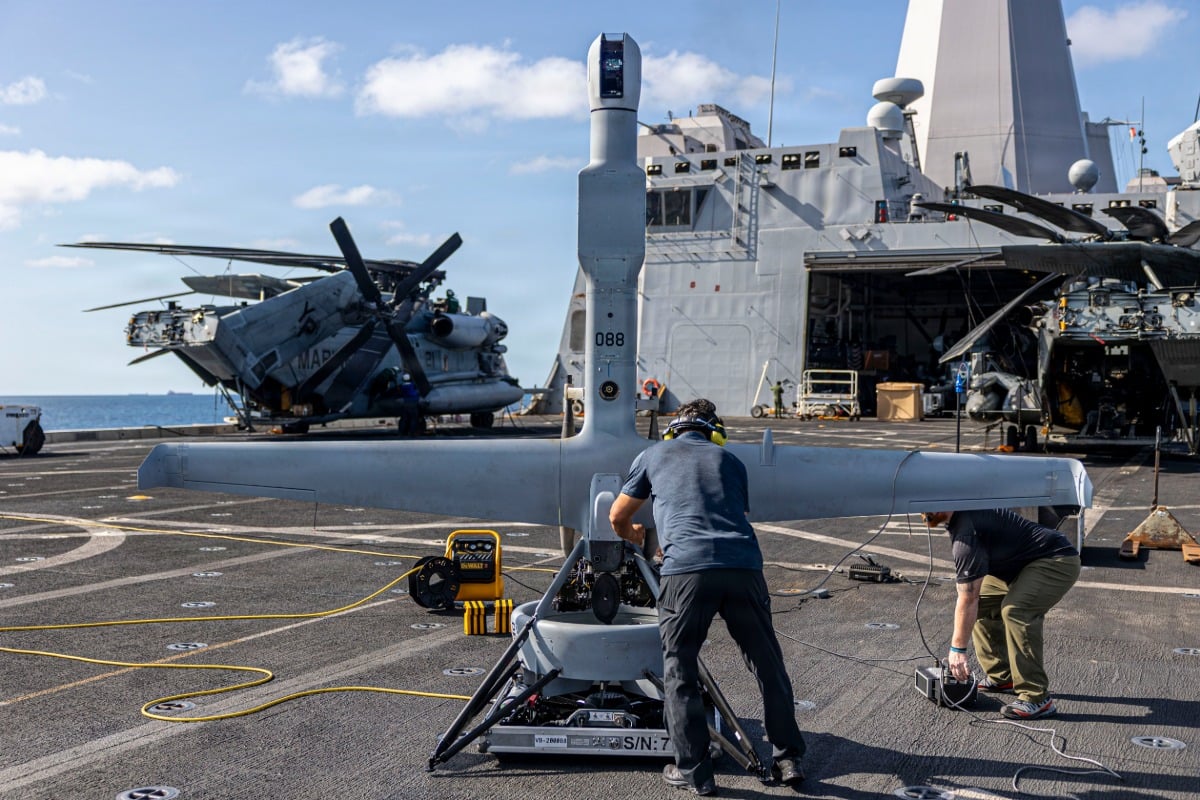
- Department of War contractors with the 11th MEU launched a V-BAT drone from USS Portland in the South China Sea on June 17, 2026.
- The V-BAT MQ-35A weighs 56.5 kg, achieves over 10 hours of flight endurance, and requires a launch area as small as 6 by 6 meters.
A surveillance drone that needs no runway, no catapult, and no dedicated launch infrastructure lifted off from the deck of a U.S. Navy warship in the South China Sea on June 17, 2026, and in doing so illustrated exactly the kind of warfare that keeps Chinese military planners up at night. Marines and Department of War contractors supporting the 11th Marine Expeditionary Unit prepared a V-BAT unmanned aerial system for takeoff aboard USS Portland, a San Antonio-class amphibious transport dock ship operating with the Boxer Amphibious Ready Group, pushing the warship’s organic eyes well beyond the horizon without displacing a single manned aircraft or burning a drop of aviation fuel from the ship’s combat reserve.
The V-BAT, officially designated the MQ-35A and built by California-based defense technology company Shield AI, is not a flashy piece of hardware by the standards of modern aviation. It weighs roughly 56.5 kilograms (124 pounds) with payload, spans a modest 3.8 meters (12.5 feet) across its wings, and launches vertically from a deck space as small as 6 meters by 6 meters (20 feet by 20 feet) using a single ducted-fan engine that drives a shrouded propeller.
What it lacks in visual drama it makes up for in persistence: the system can remain airborne for more than 10 hours on a single fuel load, loitering over a search area far longer than most rotary-wing drones, scanning the sea surface with electro-optical and infrared cameras while transmitting real-time intelligence to commanders aboard ship. A two-person team can have it in the air in under 30 minutes, requiring no specialized deck infrastructure and no dedicated launch crew beyond the operators themselves.
The V-BAT’s single-engine ducted fan enables it to take off and land vertically in confined spaces and to shift from hover to horizontal flight, a transition it completes in under 15 seconds. That dual-mode design solves a problem that has frustrated naval aviation planners for decades: how to field a long-endurance fixed-wing aircraft from a ship without either a runway or a catapult system.
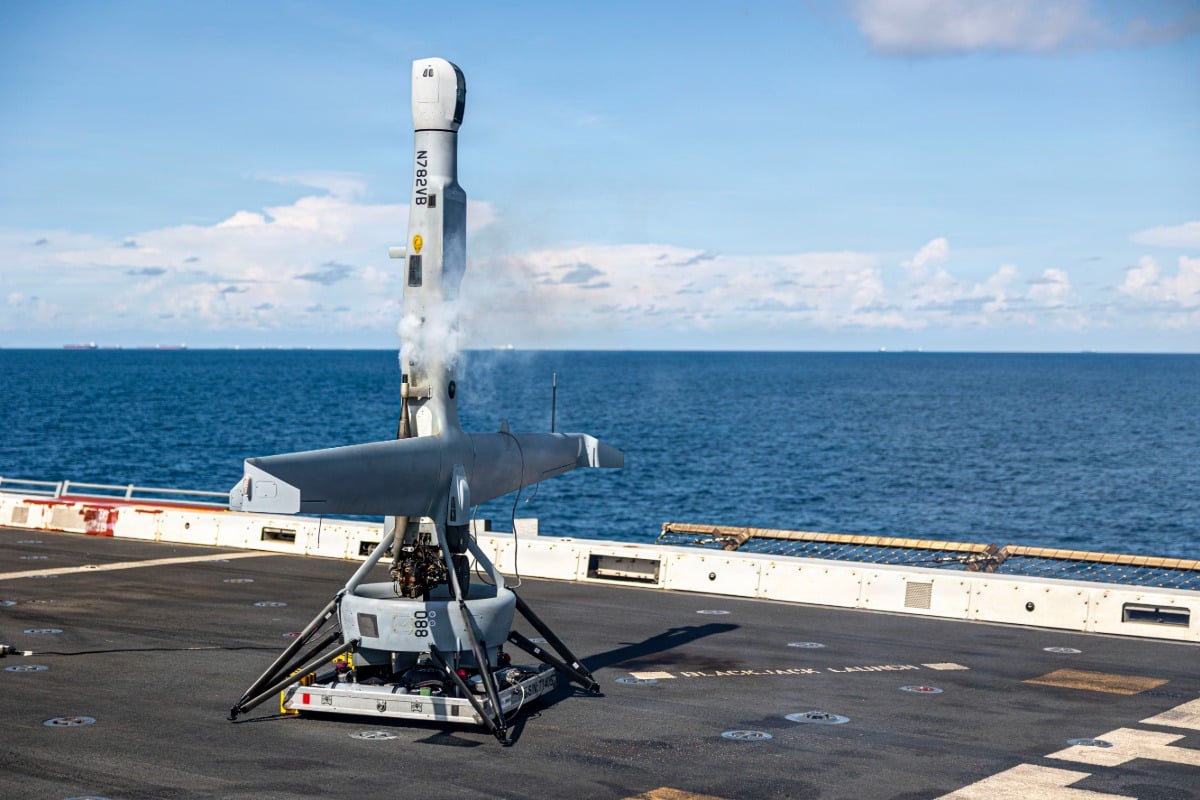
The MQ-35A does it by taking off like a helicopter and flying like a plane, then reversing the sequence on recovery. Its embedded autonomy software, which Shield AI brands as Hivemind, allows it to navigate and complete missions in environments where GPS signals are jammed or communications are blocked, a capability that proved its value in Ukraine, where the V-BAT demonstrated resilience against electronic warfare and completed the first successful long-endurance ISR and targeting mission while GPS and communications were jammed.
The 11th Marine Expeditionary Unit, the roughly 2,200-strong Marine force that departed San Diego in March 2026 and has been operating across the Indo-Pacific since, embarks aboard three ships of the Boxer Amphibious Ready Group: USS Boxer, a Wasp-class amphibious assault ship that serves as the group’s flagship and aviation centerpiece; USS Comstock, a dock landing ship; and USS Portland, the San Antonio-class transport dock from whose deck the V-BAT launched on June 17. The 11th MEU includes Battalion Landing Team 3/5, Combat Logistics Battalion 11, Marine Fighter Attack Squadron 122, and Marine Medium Tiltrotor Squadron 163 (Reinforced), giving the group infantry, logistics, strike aviation, and assault support capacity that operates independently of any fixed base ashore. The V-BAT extends that self-contained capability further by giving shipboard commanders a persistent eye in the sky without tasking the group’s manned aircraft or competing with other flight deck operations.
The South China Sea, where USS Portland operated on June 17, is among the most contested maritime spaces on earth. China claims sovereign rights over most of the sea’s approximately 3.5 million square kilometers (1.35 million square miles) under a legal theory rejected by an international arbitral tribunal in 2016, and has constructed and militarized a series of artificial islands in the Spratly and Paracel island chains to back those claims with hardware. American naval forces transit and operate in the sea routinely under the legal doctrine of freedom of navigation, and the presence of an amphibious ready group with embarked Marines sends a message that cannot be communicated by a carrier strike group alone: not just that the United States can project air power into the region, but that it can land forces, hold ground, and sustain operations from ships that need no fixed basing whatsoever.
The V-BAT provides persistent surveillance and targeting support from amphibious ships operating far from shore, extending a commander’s situational awareness well beyond the visual and sensor range of the ship itself. In the geography of the South China Sea, where island chains, contested reefs, and congested shipping lanes create a complex three-dimensional picture that changes by the hour, that kind of persistent overhead coverage matters enormously. A warship that can only see as far as its radar horizon is a warship operating partly blind. A warship that can push a 10-plus-hour drone over the horizon 130 kilometers (81 miles) in any direction, scanning for surface contacts, coastal activity, or potential threats, is a fundamentally different tactical proposition.