

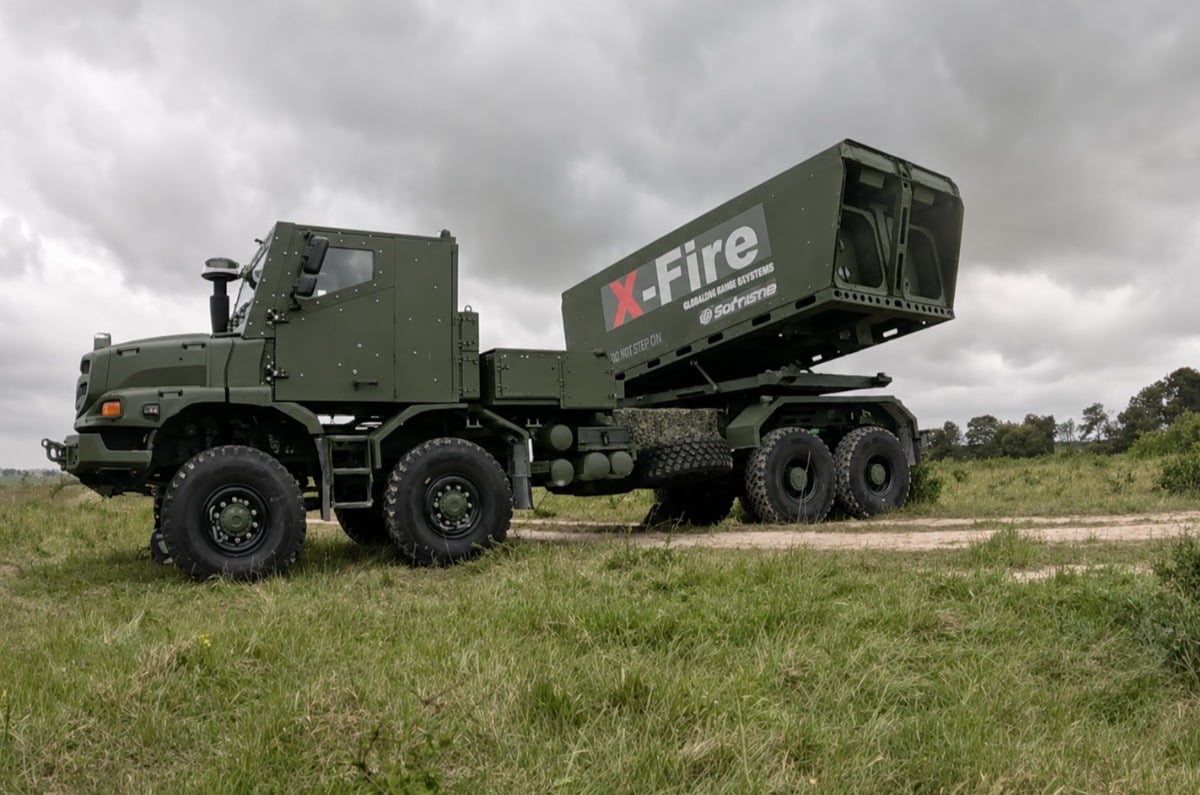
- Hanwha Aerospace and Thales signed an MOU on June 17, 2026, at Eurosatory in Paris to integrate Chunmoo guided missiles with Thales X-Fire launchers.
- The agreement covers three missile types ranging from 80 km (50 miles) to 290 km (180 miles), targeting the European long-range precision strike market.
Hanwha Aerospace, the South Korean defense giant behind one of the most combat-credible rocket artillery systems currently in service, signed a Memorandum of Understanding with French defense technology company Thales on June 17, 2026, at Eurosatory 2026, the biennial land warfare exhibition held at Paris Nord Villepinte. The agreement commits the two companies to integrating Hanwha’s Chunmoo guided missile family with Thales’ X-Fire launcher platform, creating a combined system capable of delivering precision strikes at ranges spanning from 80 kilometers (50 miles) to 290 kilometers (180 miles), distances that cover the depth of a modern operational theater and extend well beyond what most European armies can currently engage with ground-based fires.
The Chunmoo is South Korea’s domestically developed multiple launch rocket system, a direct competitor in capability terms to the American M270 Multiple Launch Rocket System and the M142 HIMARS, both of which have become widely known through their operational use in Ukraine. Where the American systems have dominated export headlines in recent years, Hanwha has been quietly building its own customer base in Europe and beyond, signing deals with Poland, Romania, and other NATO members who want capability equivalent to American systems without the political and logistical dependency that comes with them. The Chunmoo’s appeal lies partly in its range of munitions and partly in South Korea’s demonstrated willingness to move faster on export approvals and industrial cooperation than the United States has historically managed.
The three missile types that Hanwha will integrate with Thales’ X-Fire launchers cover distinctly different segments of the precision strike mission. The CGR-080 is a 239 mm guided rocket with a range of approximately 80 kilometers (50 miles), placing it in the same operational bracket as the Guided Multiple Launch Rocket System munitions used by HIMARS and M270. The CTM-MR sits in the medium-range class at roughly 160 kilometers (99 miles), extending the engagement envelope beyond what most Western rocket artillery systems currently field as a standard munition. The CTM-290, a tactical ballistic missile with a range of up to 290 kilometers (180 miles), is the most significant of the three from a strategic standpoint, as it can reach targets at distances that previously required either air strikes or cruise missiles, both of which carry substantially higher costs per strike and far greater logistical demands.
The X-Fire system that Thales brings to this partnership is a wheeled launcher platform designed for high mobility and rapid deployment, fitting the operational doctrine that NATO armies have refined through years of observing how fixed or slow-moving artillery gets destroyed in modern high-intensity conflict. Pairing that mobility with the extended-range precision of Hanwha’s missile family creates a system that can displace quickly after firing, complicating the enemy’s counter-battery targeting, while still threatening targets at distances that give the launching unit considerable stand-off protection.
Julien Assoun, Vice-President for Vehicles and Tactical Systems at Thales, described the intent directly at the signing ceremony.
“This MoU strengthens our partnership and enhances long-range precision strike capabilities to reinforce collaboration on the international market. Together, we will deliver flexible and interoperable solutions to meet the current operational needs in deep strike.”
The phrase “deep strike” carries specific military meaning that the general context of European defense in 2026 amplifies considerably. Deep strike refers to the ability to engage enemy forces, command nodes, logistics hubs, and infrastructure well behind the forward line of contact, disrupting the flow of reinforcements and supplies before they reach the battlefield. NATO has identified long-range precision fires as a critical gap in European military capability, a shortfall that the conflict in Ukraine has made impossible to ignore. Ukrainian forces using HIMARS demonstrated repeatedly that precision rocket artillery at operational depth could neutralize ammunition depots, command posts, and bridge crossings in ways that fundamentally altered the ground situation, and every European army with serious defense planning on its agenda has drawn the same lesson from those engagements.
Kyoung-hoon Kang, Head of the European Business Team at Hanwha Aerospace, framed the agreement as the opening move in a longer campaign to embed the company within European industrial networks rather than simply selling hardware into the continent.
“This MOU is a first step toward integrating Hanwha Aerospace’s guided missiles with Thales’s launchers. We are committed to expanding our cooperation with French and European defense companies and to building long-term relationships with local industry.”
That framing matters because European defense procurement has increasingly shifted toward prioritizing industrial participation, meaning that foreign companies which embed themselves in local supply chains and manufacturing tend to win contracts that pure exporters do not. Hanwha’s approach mirrors what it has done in Poland, where the Chunmoo deal included significant technology transfer and domestic production components, making South Korean artillery systems politically viable in a way that a straight import deal would not have been. Applying the same model to France and the broader European market, with Thales as the industrial anchor, gives Hanwha a pathway that runs through one of Europe’s most influential defense companies.
The MOU is not a contract, and no production commitment or financial terms were disclosed. What it establishes is a formal engineering cooperation framework that allows the technical integration work to begin, with the commercial outcomes that follow depending on how that work progresses and which European customers ultimately express interest in the combined capability. Given the pace at which European governments are rebuilding defense budgets and acquiring long-range fires, the market the two companies are positioning for is growing faster than at any point since the Cold War ended.