

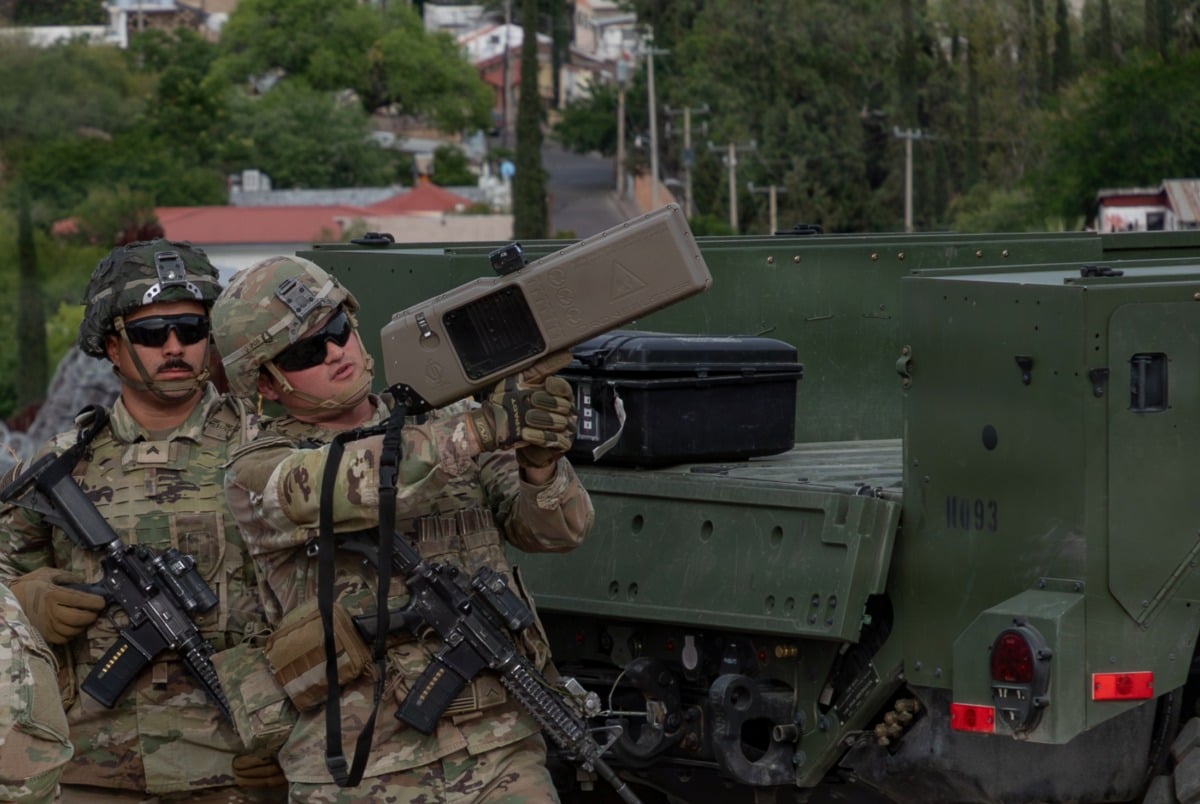
- The U.S. Air Force's 5th Contracting Squadron issued a solicitation on June 18, 2026, to procure DZYNE Technologies Dronebuster Block 4 handheld counter-drone systems for the 91st Security Forces Group at Minot AFB.
- The Dronebuster Block 4 is the only handheld electronic attack system authorized for use by the U.S. Department of War, according to Air Force justification documents.
Drone threats to military bases have become so routine that the U.S. Air Force is now buying specialized handheld guns capable of knocking them out of the sky, and the unit guarding America’s nuclear missiles just put in an order for one of the most widely used systems on the market.
The U.S. Air Force’s 5th Contracting Squadron at Minot Air Force Base in North Dakota published a solicitation on June 18, 2026, seeking to procure DZYNE Technologies’ Dronebuster Block 4, a man-portable handheld counter-drone system, for the 91st Security Forces Group, the unit responsible for protecting one of the most sensitive military installations in the United States. Quotes from vendors are due no later than June 26, 2026, giving the defense industry less than two weeks to respond to a requirement the Air Force has formally described as an operational necessity.
Situated in the flat plains of western North Dakota, it hosts the 91st Missile Wing, which operates 150 Minuteman III intercontinental ballistic missiles, nuclear-tipped weapons capable of reaching targets anywhere on Earth, buried in launch silos spread across roughly 8,500 square miles (22,000 square kilometers) of the northern Great Plains. The 91st Security Forces Group is the organization that physically guards those missiles, their launch facilities, and the base itself, making its ability to detect and defeat drone threats a matter of nuclear security, not routine force protection.
The Dronebuster Block 4, built by San Diego-based DZYNE Technologies, is a rifle-shaped electronic warfare device that a single soldier can carry and operate without additional support equipment, meaning it requires no vehicle, no power generator, and no fixed installation. The system works by emitting radio frequency jamming signals and disrupting the Global Navigation Satellite System connections, commonly known as GNSS, that commercial drones rely on for positioning and autonomous flight, effectively forcing a targeted drone to land or return to its operator rather than continuing its mission. The justification document filed by the Air Force describes the system as capable of “detecting, disrupting, and defeating commercial-off-the-shelf drone threats,” a phrase that acknowledges the core challenge facing military base defenders today: the enemy’s tools are available on Amazon.
The Air Force’s contracting documents reveal something notable about how seriously the military takes standardization around this particular device. The justification for purchasing the Dronebuster by brand name rather than opening full competition to any counter-drone vendor states explicitly that it is “the only handheld electronic attack system officially authorized for use by the U.S. Department of War,” the current name for what was formerly the Department of Defense. That single-source justification, certified by Staff Sergeant Marta E. Lange of the 5th Contracting Squadron and corroborated by Technical Sergeant Elise M. Kelege of the 91st Mission Support Squadron, is the legal mechanism that allows the Air Force to specify a brand name rather than generic performance specifications, bypassing the usual requirement to solicit competing products. The practical effect is that only authorized DZYNE distributors can compete for this contract, though the Air Force notes that competition will still occur at the distributor level to ensure fair pricing.
The Dronebuster has accumulated a significant operational footprint across U.S. military branches since DZYNE Technologies began producing it. Its prevalence at sensitive installations reflects a broader pattern in how the American military has responded to the proliferating threat from small unmanned aircraft, a category that has expanded from recreational nuisances into a genuine security concern at nuclear facilities, forward operating bases, and critical infrastructure sites. The conflict in Ukraine has demonstrated in vivid operational terms how cheap commercial drones can be weaponized, and that lesson has accelerated procurement timelines for counter-drone systems throughout NATO militaries, including the United States.
The solicitation falls under Air Force Global Strike Command, the major command responsible for America’s nuclear bomber and missile forces, which underscores that this is not a peripheral acquisition buried somewhere in the logistics chain. Global Strike Command controls the B-52 and B-2 bomber fleets alongside the Minuteman III missile force, and protecting those assets from the low-cost drone threat is increasingly treated as a first-order priority rather than an afterthought. The fact that the 91st Security Forces Group is procuring additional Dronebuster units for base defense, security force mobility, and what the documents describe as dismounted operations — meaning soldiers operating on foot away from vehicles — suggests the unit is expanding its counter-drone coverage beyond fixed perimeter positions.