

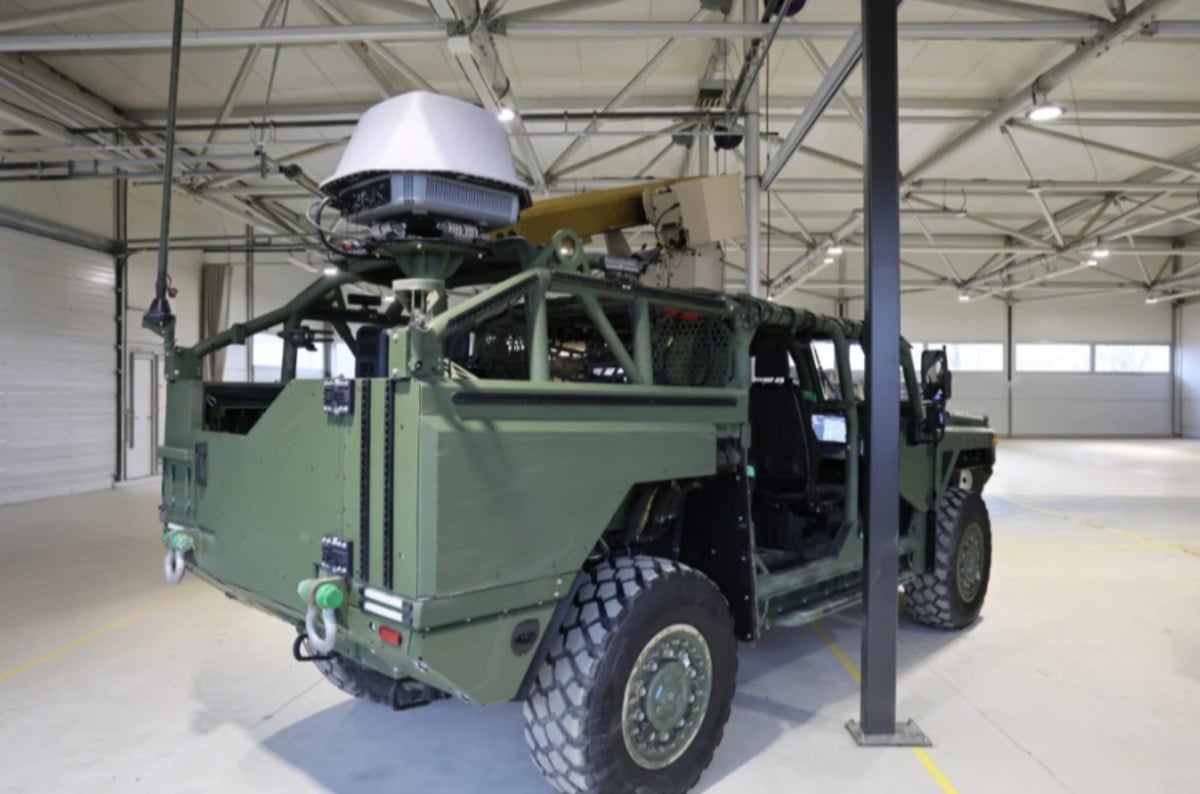
- DroneShield and Defenture signed a memorandum of understanding at Eurosatory 2026 to pursue joint mobile counter-drone capability.
- The partnership combines DroneShield's counter-UAS systems with Defenture's GRF and Mammoth vehicle platforms.
DroneShield and Defenture have signed a memorandum of understanding to combine the Australian company’s counter-drone hardware, software, command-and-control, and operational support with Defenture’s tactical vehicle platforms, including the GRF and Mammoth, betting that the pairing will give NATO armies the kind of mobile drone defense they have been scrambling to buy as cheap unmanned aircraft reshape how ground forces operate.
The two companies signed the MoU at Eurosatory 2026, the biennial defense and security trade show held outside Paris that draws weapons makers, generals, and procurement officials from across the globe, and the agreement sets up a framework for joint commercial opportunities and a coordinated market-deployment roadmap rather than a finished, contracted product.
DroneShield has spent the better part of a decade building a reputation as one of the more credible names in counter-unmanned aircraft systems, the technical term for hardware designed to spot and stop hostile drones before they can do damage. The Australian company’s portfolio includes the RfPatrol, a wearable detector that passively listens for the radio signals drones emit rather than broadcasting its own signal and giving away its position, and the DroneGun, a rifle-shaped jammer that disrupts a drone’s control link from the ground. DroneShield has sold this equipment to militaries and law enforcement agencies across multiple continents, and earlier this year the company disclosed a $9.7 million deal to supply handheld and vehicle-mounted systems to a Latin American defense customer, its third such order from the same regional distributor since late 2024.
Defenture, based in the Netherlands, builds a different kind of hardware entirely. The company has spent more than a decade designing light tactical vehicles for European special operations forces, and its GRF platform, known inside the Dutch military as the Vector, has become something close to a standard issue ride for commando units that need a truck light enough to sling under a helicopter and tough enough to survive off-road punishment. Defenture says the GRF has been supplied to several European military customers, and the Dutch special forces alone have fielded 75 of the vehicles. The company’s larger Mammoth platform, developed jointly with Germany’s elite Kommando Spezialkräfte and capable of hauling roughly 4,000 kilograms (8,800 pounds) of cargo and equipment, extends that same design philosophy to heavier missions that demand more payload without sacrificing the off-road mobility that made the GRF popular in the first place.
The partnership announced this week aims to fuse those two product lines rather than simply selling them side by side. Under the memorandum, DroneShield will offer its current and next-generation detection and jamming systems as integrated options across Defenture’s vehicle platforms, while the companies jointly pursue what they describe as layered on-the-move counter-drone concepts, systems designed to protect a moving convoy or patrol rather than a fixed checkpoint or base perimeter. The companies say they intend to coordinate go-to-market planning, customer engagement, testing, and interoperability work, the kind of unglamorous groundwork that determines whether two companies’ hardware actually talks to each other in the field rather than just on a brochure.
Louis Gamarra, DroneShield’s chief commercial officer, framed the deal as a response to a shift he is seeing across the industry’s customer base. “Many military customers are looking for scalable and mobile counter-UAS solutions, that can be deployed quickly and operate effectively in dynamic environments,” Gamarra said.
Roderick Toutenhoofd, a Defenture board member, pointed to the same shift from the vehicle side of the equation. “By combining Defenture’s mobile platform capability with DroneShield’s proven counter-UAS technologies, we are better placed to support customers seeking agile, layered protection against evolving drone threats,” Toutenhoofd said.
The strategic logic behind pairing a mobility company with a counter-drone company traces back to a problem that has become difficult for any modern military to ignore. Cheap first-person-view drones, often costing a few hundred dollars and built largely from commercial parts, have proven capable of destroying armored vehicles and supply trucks worth orders of magnitude more, and that asymmetry has forced militaries across Europe and beyond to treat drone defense as a feature every vehicle needs rather than a specialized capability bolted onto a handful of dedicated platforms.
The U.S. Army has already begun retrofitting its own armored vehicles with counter-drone equipment in response to the same threat, and Germany’s parliament voted in favor of an order for 49 AGF-2 mobile platforms from Defenture in December 2025, a sign of how thoroughly the alliance’s most capable militaries have bought into vehicle-centric procurement even before counter-drone packages became standard equipment on the trucks themselves.