

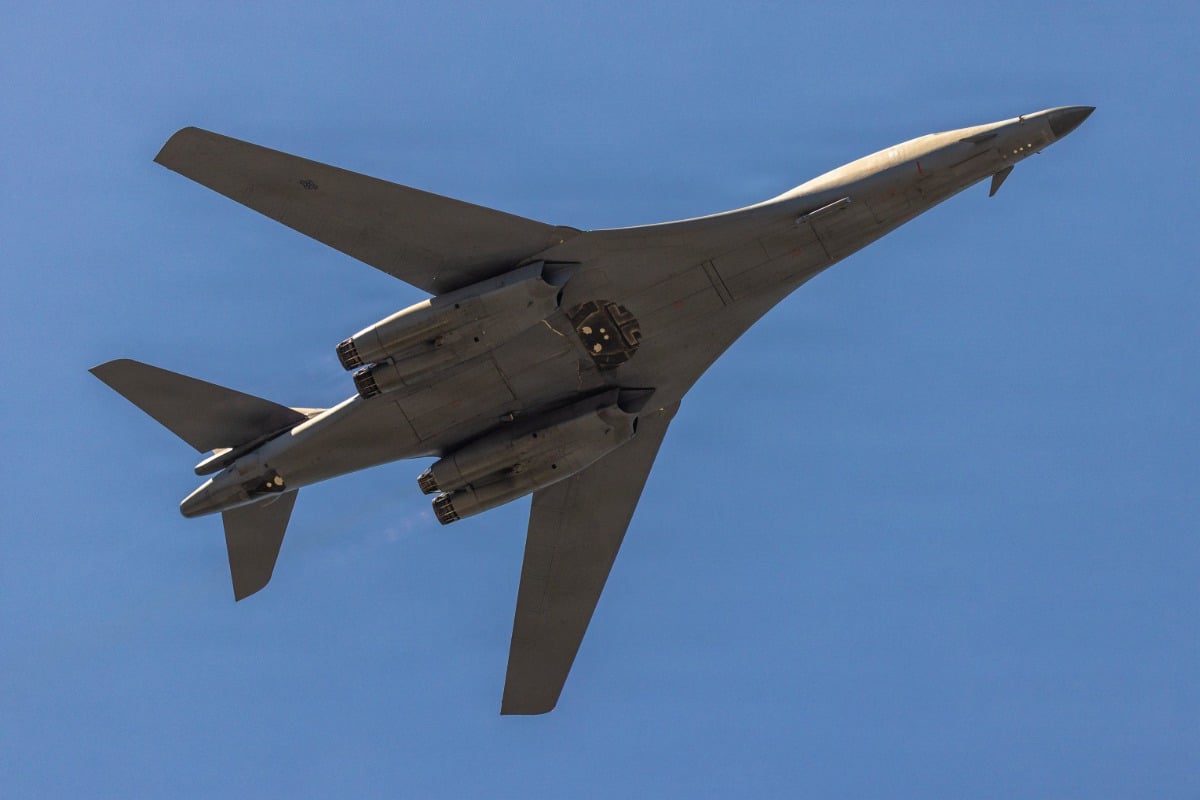
- The Defense Logistics Agency awarded Top Flight Aerostructures two contracts worth up to $53.1 million and $23.4 million for B-1 bomber wing parts.
- Both contracts run through June 2029 and support the Air Force's fleet of 45 B-1B bombers, the youngest of which is roughly 38 years old.
Top Flight Aerostructures, a Georgia parts manufacturer, won two indefinite-delivery contracts from the Defense Logistics Agency to build wing components for the B-1 bomber fleet. One contract has a maximum value of $53.1 million for trailing edges, the other up to $23.4 million for wing tips, with completion dates in mid-June 2029. Both awards came through competitive bidding with two companies responding, and both are three-year base contracts with no option periods.
Trailing edges and tips sound like minor hardware until you understand what kind of wing they’re attached to. The B-1B Lancer flies on a variable-sweep wing, a design that lets the crew physically change the wing’s angle in flight, from 15 degrees fully extended for takeoff and landing out to 67.5 degrees swept back for high-speed dashes at low altitude. That’s the same basic concept the old F-14 Tomcat used, and it comes with the same downside: more moving mechanical parts means more components under constant stress every time the wing sweeps, and more things that eventually crack, corrode, or wear out. The trailing edge is the rear portion of the wing, and the wing tips sit at the outer edges, both of them structural surfaces that bear real aerodynamic load every time the wing sweeps, on an aircraft with a maximum takeoff weight of 477,000 lb (216,000 kg).
The airframe itself is old enough to explain why these parts wear out. Boeing, which inherited the B-1 program when it bought Rockwell International’s defense business in 1996, delivered the very last B-1B in May 1988, making the youngest aircraft in the fleet roughly 38 years old today. The B-1 program produced four B-1A prototypes and 100 B-1B aircraft; about 45 B-1Bs remain in the fleet today after a 2021 retirement round pulled 17 of the least serviceable jets out of the lineup. Those survivors have spent decades flying high-stress combat missions over Iraq, Afghanistan, Libya, and Syria that put far more wear on the airframes than the Cold War nuclear-alert missions the B-1B was originally designed around. The Air Force has publicly acknowledged that years of punishing deployments accelerated structural fatigue across the fleet, with wing-pivot points and other load-bearing components degrading to the point where some damaged aircraft have actually cost more to repair than it cost to pull a mothballed jet out of storage and return it to service instead.
That history explains why two contracts for replacement wing parts make sense right now. Keeping roughly 45 nearly four-decade-old bombers flying isn’t a one-time fix, it’s an ongoing, expensive grind of replacing exactly the kind of structural components that take the brunt of stress on a jet whose defining feature is a wing that physically reshapes itself in flight. The Air Force has committed real money to stretching that timeline further too, with budget documents showing a planned $342 million in B-1 modernization spending between 2027 and 2031 specifically intended to keep the fleet relevant through 2037, even as the B-21 Raider stealth bomber slowly takes over the B-1’s role as America’s newest strategic bomber enters production.
The B-1B earns that continued investment by doing something the B-21 and the older B-52 genuinely can’t match. It’s the Air Force’s largest conventional payload carrier, capable of hauling up to 75,000 pounds (34,000 kg) of bombs and missiles in its internal bays. The B-1B is the Air Force’s operational carrier for the Long-Range Anti-Ship Missile, a capability also fielded on the Navy’s F/A-18E/F, and one that’s taken on real strategic weight as American military planning has shifted attention toward potential conflict scenarios in the Pacific.
B-1Bs have continued to deploy for Bomber Task Force missions in Europe, flying alongside B-52s as part of routine power-projection rotations that put American long-range bombers within reach of multiple theaters on short notice. None of that mission profile works if the jets can’t fly, and none of them fly if the wings holding them up are quietly falling apart from the inside.
What these two contracts ultimately represent is the unglamorous, recurring cost of operating hardware the Air Force has chosen to keep flying well past the point anyone in 1988 expected it would still be relevant. The B-1B’s wing has to keep sweeping back and forth for that math to keep working, and every time it does, the trailing edges and tips absorb stress that eventually requires exactly the kind of parts contract that rarely makes headlines on its own.
Until the B-21 Raider fully takes over sometime in the next decade, this is what keeping America’s heaviest bomber payload in the sky actually looks like: not a single dramatic upgrade, but a steady supply chain of replacement parts for an airframe that refuses to retire on schedule.