

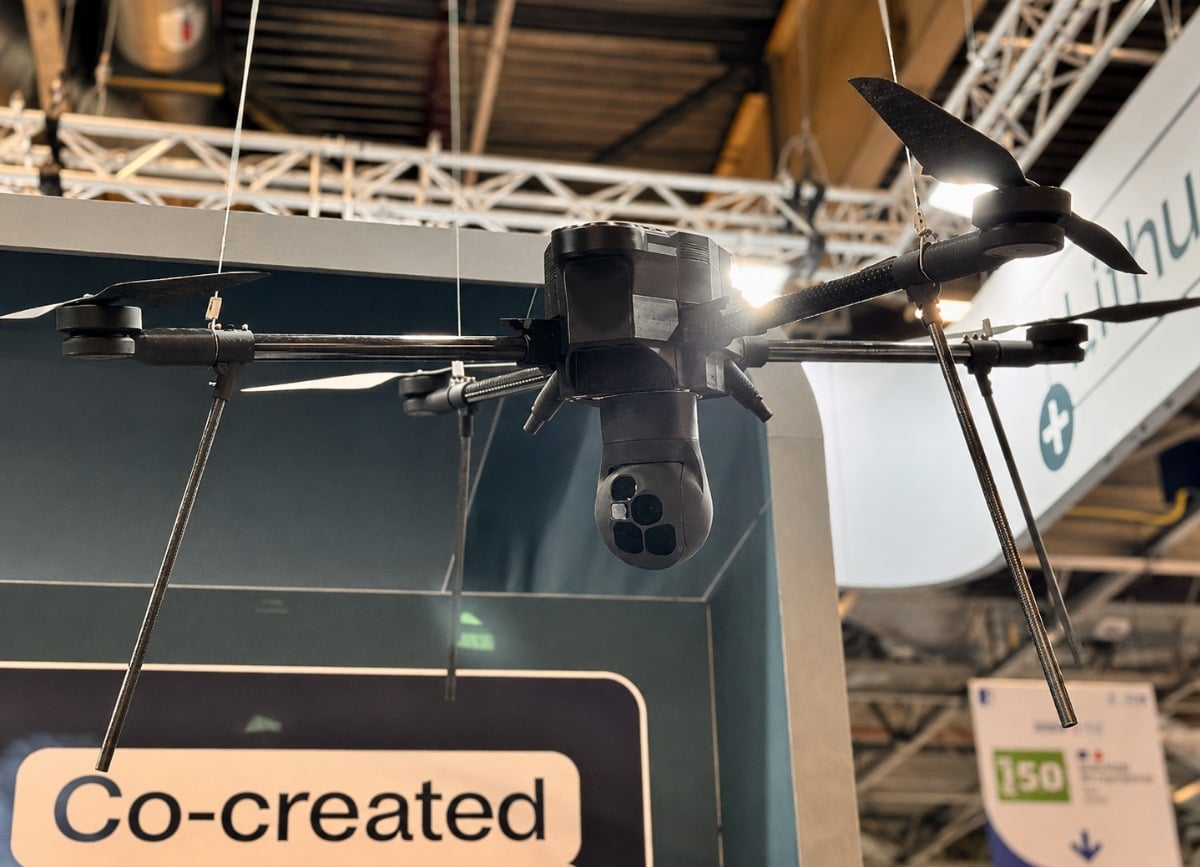
- Tactical Photonics unveiled an ITAR-free laser targeting payload for drones at Eurosatory 2026 in Paris.
- The company says the under 2 kg system hits targets beyond 3 km using four-axis stabilization, with production scaling to 600 units annually from 2027.
A Russian drone struck an apartment building in Galați, Romania, in May 2026, and the incident has become a flashpoint in a broader story about a vulnerability the European defense industry has been racing to address. Separate reporting has linked some stray-drone incidents across the region to heavy electronic warfare, including GPS spoofing and jamming, raising questions about what happens once a drone’s navigation gets scrambled mid-flight. Lithuanian company Tactical Photonics, part of the Aktyvus Photonics Group, unveiled what it describes as a highly precise European laser targeting payload for drones at the Eurosatory defense exhibition in Paris, positioning it as a European-built, ITAR-free laser designator, according to the company. ITAR refers to the International Traffic in Arms Regulations, the U.S. export control regime that governs sensitive American defense technology, and laser designators have historically fallen under it, meaning any military or company outside the United States wanting this capability had to secure approval from the U.S. State Department before buying or even discussing the underlying technology.
That regulatory bottleneck matters more right now than it would have a few years ago, because the threat the new payload addresses has become a near-weekly occurrence across parts of Europe. Russian electronic warfare units have been jamming and spoofing GPS signals across the Baltic states, Romania, and other countries bordering the conflict in Ukraine, a tactic Tactical Photonics says can divert drones far from their intended route. Independent reporting has documented dozens of GPS interference incidents across Europe tied to Russian jamming since the invasion began, including disruptions affecting commercial aircraft, shipping, and military drones, and the Galați crash this year injured civilians and reignited fears that the war’s electronic battlefield has started spilling well beyond Ukraine’s borders. Depending on its autopilot and fail-safe logic, a drone affected by GPS interference may drift, continue a pre-set route, switch to inertial navigation, return, or crash, and in any of those scenarios it can end up delivering whatever payload it carries somewhere far from where it was actually intended to go.
Laser designation works on a different principle than the GPS and radio-link systems that have proven vulnerable to Russian jamming, and that difference is the entire point of the new payload. A laser designator doesn’t navigate the drone itself. Instead, it marks a target with an invisible laser spot that laser-guided munitions, including bombs and missiles compliant with the NATO standard known as STANAG 3733, can then home in on independently, meaning the targeting function keeps working even if the drone’s own navigation has been scrambled by jamming. Laser designation is less exposed to RF and GNSS jamming, but it still requires line of sight and can be affected by weather, smoke, or other obscurants, which is why it functions as a complement to other targeting methods rather than an unconditional fix for every battlefield scenario.
The technical specifications Tactical Photonics is advertising would represent a genuine leap for this weight class if they hold up under independent testing. The company says its payload weighs under 2 kilograms (4.4 lb), can hit small moving targets at ranges beyond 3 kilometers (1.9 miles), and achieves that performance using four-axis mechanical stabilization rather than the two-axis stabilization combined with digital image processing that most comparably sized payloads rely on. Mechanical stabilization across four axes lets the system maintain a locked aim point on a moving target even as the drone carrying it maneuvers, a capability the company says typically requires a much heavier system to achieve. For comparison, Tactical Photonics says the equivalent American-made system from L3Harris WESCAM weighs roughly 15 kilograms (33 lb) and costs about twice as much, though that comparison comes from the company itself rather than independent testing, and L3Harris’s own laser designator products are documented as falling under U.S. export control as items on the United States Munitions List, lending some credibility to the underlying claim that American systems in this category face the licensing hurdles Tactical Photonics is positioning its product against.
Laurynas Šatas, CEO of Aktyvus Photonics Group, framed the new payload as a response to direct requests from the field rather than a speculative product launch. “We built this because we were asked to, by Ukrainian and Baltic national forces,” Šatas said. “Europe has invested billions in the next generation of tactical drones, but it has not solved the targeting problem. And the payload is usually what determines whether the drone is useful or not.” Šatas argued that the ITAR restrictions on comparable American hardware have left European militaries dependent on a U.S. approval process that can move too slowly for programs facing urgent operational needs, a frustration that has become increasingly common across European defense circles as the continent has pushed to reduce its reliance on American suppliers for critical military technology.
That push for what European officials often call strategic autonomy has accelerated sharply since Russia’s invasion of Ukraine, and the broader spending numbers reflect that shift. EU member states’ defense expenditure is estimated at 381 billion euros in 2025, while defense investment, the portion spent specifically on new equipment and research rather than personnel or operating costs, is projected to reach nearly 130 billion euros, according to EU figures, marking a sustained climb from spending levels years earlier as the continent works to rebuild its industrial base. Lithuania’s specific claim to laser expertise isn’t marketing fluff either. The country has built a genuine reputation as a global hub for laser science over several decades, home to companies and research institutions that have contributed meaningfully to photonics technology used well beyond the defense sector, which gives Šatas’s framing of homegrown cost advantages more grounding than a typical sales pitch might otherwise carry.
Production plans suggest Tactical Photonics expects real demand rather than a one-off showcase. Aktyvus and Tactical Photonics say they are targeting more than 600 units annually by 2027, a volume that would put a meaningful number of European-made, export-control-free laser designators into the hands of allied forces within the next two years if the company’s plans hold. Whether that production target gets met, and whether the payload’s claimed performance survives the kind of rigorous testing that separates a trade show demonstration from a fielded military system, remains to be seen.