

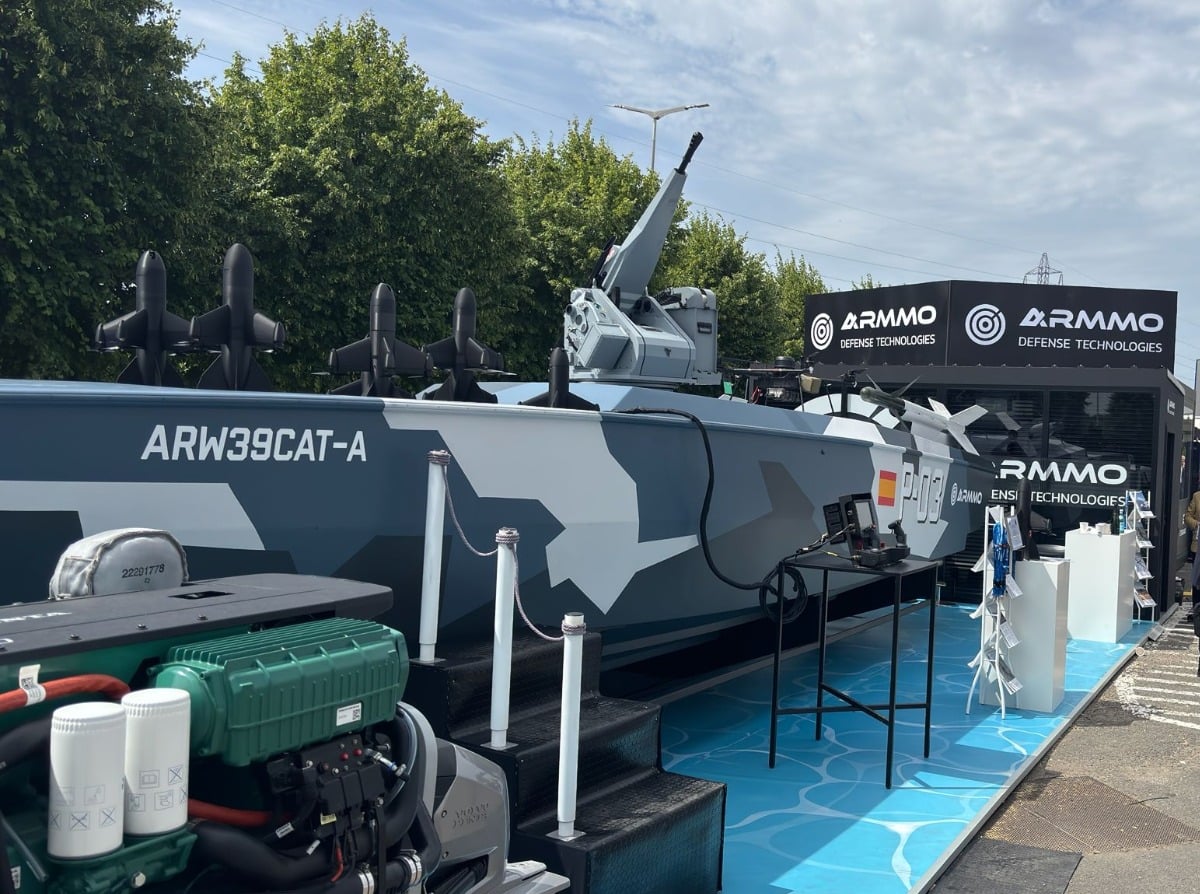
- ARMMO Defense Technologies unveiled the ARW39CAT-A unmanned catamaran at Eurosatory 2026, a 12-meter vessel with 45-50 knot speed, 540 nautical mile range, and 800-1,200 kg payload capacity.
- ARMMO is building a 26,000 square meter defense industrial facility in Zafra, Spain, expected to reach full operational capacity in the coming months.
A Spanish defense technology company used the opening days of Eurosatory 2026 in Paris to publicly debut an unmanned surface vessel that combines the speed of a fast patrol boat, the payload capacity of a logistics ship, and the ability to launch and recover drones, jam enemy electronics, and intercept hostile unmanned aircraft, all without a single crew member aboard and all controlled remotely as part of a networked system of autonomous platforms operating across land, sea, and air simultaneously.
ARMMO Defense Technologies, headquartered in Spain and currently building what the company describes as one of Europe’s largest autonomous systems and defense technology industrial complexes, presented the ARW39CAT-A at Eurosatory 2026, marking the vessel’s first official public unveiling after NATO-linked validation exercises conducted in Slovakia under NATO LANDCOM leadership confirmed the operational readiness of several of the company’s core technologies.
The ARW39CAT-A is a 12-meter (39-foot) tactical unmanned catamaran with a beam of 3.8 meters (12.5 feet), constructed from composite materials in a twin-hull configuration that provides the exceptional stability at high speed that a monohull vessel of similar length cannot achieve. According to ARMMO, the vessel reaches speeds between 45 and 50 knots, or roughly 83 to 93 km/h (52 to 58 mph), giving it the sprint capability to intercept fast-moving surface threats or reposition rapidly across an operational area without the delays that slower patrol vessels impose on mission planning. Its tactical radius extends to 540 nautical miles, or approximately 1,000 km (621 miles), and it can carry between 800 and 1,200 kg (1,764 to 2,646 lb) of payload, a figure that, at the upper end of that range, approaches the carrying capacity of some light utility helicopters and provides enough mass for a substantial sensor and weapons package without sacrificing the performance characteristics that make the platform operationally relevant.
The catamaran hull form is not an incidental design choice for a platform intended to operate in coastal and littoral environments, which is the shallow, complex nearshore zone between open ocean and land where navies fight the most tactically demanding maritime battles. Catamarans achieve their stability advantage over monohulls by distributing buoyancy across two widely spaced hulls rather than concentrating it in one, which reduces rolling in beam seas and provides a more stable platform for sensors that require precise orientation to function accurately, including radar systems, electro-optical cameras, and signal intelligence equipment. At the speeds ARMMO claims for the ARW39CAT-A, a monohull vessel of equivalent displacement would struggle with seakeeping in any significant wave state, while the catamaran architecture allows the vessel to maintain useful performance in conditions that would force a conventional patrol boat to slow significantly or turn away from the threat axis.
ARMMO describes the ARW39CAT-A as integrating intelligence, surveillance, and reconnaissance capabilities, electronic warfare systems, signals intelligence collection equipment, the ability to deploy and potentially recover unmanned aerial vehicles, short-range air defense capability against drone threats, and tactical support functions within its modular payload architecture, which means the specific combination of systems fitted to any given vessel can be reconfigured for different mission profiles without requiring a new platform design. That modularity reflects the same design philosophy that has driven most modern naval unmanned surface vessel programs, including the United States Navy’s Medium Unmanned Surface Vehicle program and the Royal Navy’s work with autonomous platforms in littoral environments, which have consistently concluded that a reconfigurable hull is more operationally flexible and more cost-effective over its service life than a platform locked into a single mission type from the moment of manufacture.
The timing of the ARW39CAT-A’s debut at Eurosatory is directly connected to recent NATO-linked validation work that ARMMO completed before arriving in Paris, and the press release describes exercises conducted under NATO LANDCOM leadership in Slovakia where the company successfully evaluated early warning detection systems, surveillance sensors, anti-drone protection solutions, and its BANDIT-X anti-UAS interceptor, a system designed to neutralize hostile drones in demanding tactical scenarios. NATO LANDCOM, the Allied Land Command headquartered in Izmir, Turkey, coordinates land force activities across the alliance and has been actively involved in validating autonomous systems and emerging technologies in the context of NATO’s eastern flank security requirements, which gives ARMMO’s claimed validation a degree of institutional credibility beyond what a purely commercial test program would carry.
Jaime Abrisqueta, CEO of ARMMO Defense Technologies, framed the ARW39CAT-A’s introduction within the company’s broader vision of multi-domain autonomous operations. “Autonomous systems are transforming the way of operating in all domains,” Abrisqueta said. “With the ARW39CAT-A we expand our capabilities to the maritime environment and advance towards an integrated vision of aerial, land and naval systems capable of operating jointly in complex scenarios.”
The industrial dimension of ARMMO’s Eurosatory appearance extends beyond the platform itself to the company’s development of a major manufacturing and integration complex in Zafra, in the Extremadura region of southwestern Spain, a facility with a total floor area of 26,000 square meters (280,000 square feet) that ARMMO describes as one of the largest European centers specialized in autonomous technologies and advanced defense systems. The company says the facility will reach full operational capacity progressively over the coming months, and its construction represents a multi-million euro investment intended to give ARMMO the industrial scale to move from technology developer to volume manufacturer of autonomous defense systems across land, air, and naval domains simultaneously. Abrisqueta placed that industrial ambition in a European strategic context that goes beyond his own company’s commercial interests. “Europe needs not only innovation, but also industrial capacity to produce, adapt and deploy strategic technologies quickly,” he said. “Our objective is to contribute to that technological autonomy from Spain, developing our own capabilities and generating highly qualified employment.”
The arrival of credible autonomous naval platforms from European companies that are not among the established naval primes, meaning the major traditional warship builders like Naval Group, BAE Systems, or Fincantieri, reflects a broader democratization of unmanned maritime capability that has been accelerating since the Ukraine war demonstrated the operational effectiveness of relatively small, relatively cheap autonomous surface and underwater systems against a major naval power. Ukrainian naval drones, built by a relatively young domestic industry under wartime pressure, have struck Russian naval vessels, disrupted Russian operations in the Black Sea, and demonstrated that unmanned surface systems do not need to be large, expensive, or built by traditional shipyards to have genuine strategic impact, a lesson that has not been lost on the smaller European defense technology companies now competing for the unmanned maritime market that the war has catalyzed.
Spain’s defense industry has historically operated in the shadow of larger European defense industrial nations, but the emergence of companies like ARMMO at major international exhibitions with credible multi-domain autonomous platforms, backed by NATO-linked validation and significant domestic industrial investment, suggests that the geography of European defense technology leadership is shifting as the demand for autonomous systems grows faster than any single country or established prime contractor can satisfy.