

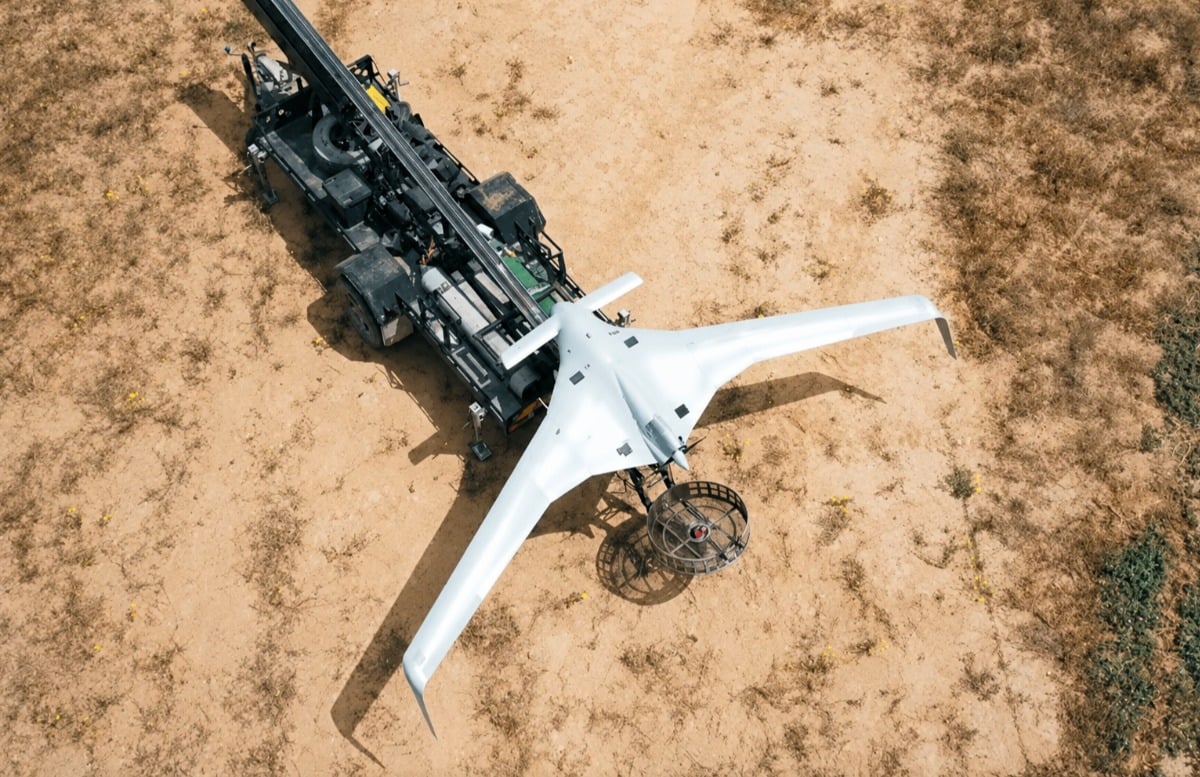
- Aeronautics Group demonstrated single-operator simultaneous control of multiple Orbiter UAS platforms from one ground control station, reducing control handovers during multi-UAS missions.
- The Orbiter 4 platform has 24-hour endurance, a 150 km datalink range, and carries up to 12 kg of payload at an 18,000 ft service ceiling.
The hardest constraint in drone warfare has never been the hardware but the human being sitting behind the ground control station, because many military UAS operations still depend on dedicated operators and crews for each aircraft or mission package, limiting how many platforms any given unit can realistically put in the air at once regardless of how many airframes it possesses or how capable those airframes are.
Israel’s Aeronautics Group, the defense technology company behind the widely fielded Orbiter family of tactical unmanned systems, announced this week that it has achieved and demonstrated a capability that directly attacks that constraint: a single operator simultaneously controlling and managing numerous Orbiter UAS platforms from a single ground control station, with the company saying the system reduces the need for control handovers during multi-UAS missions while maintaining continuous oversight of the mission as it unfolds.
Aeronautics Group, headquartered in Yavne, Israel, has been producing unmanned aerial systems for defense and security customers since the late 1990s, building a portfolio that spans from the man-portable Orbiter 2 mini-UAV through the Orbiter 4, a tactical system with a 5.2-meter (17-foot) wingspan, a maximum takeoff weight of 55 kg (121 lb), and up to 24 hours of endurance at a line-of-sight datalink range of up to 150 km (93 miles). The Orbiter family has seen adoption across a wide customer base that includes Azerbaijan, Finland, Singapore, the United Kingdom, and the United States, establishing the platform’s operational credibility across climates, terrain types, and military doctrines that differ substantially from one another. The multi-UAV capability announced this week applies to that proven platform family, which means it is not a theoretical demonstration on a purpose-built test system but an implementation on hardware already deployed with real military units facing real operational demands.
The operational logic behind multi-UAV operation from a single ground control station is straightforward to explain and genuinely difficult to implement, because a conventional drone operation assigns dedicated operators and crew to each aircraft or mission package, and when control transfers to another station that handover creates a gap in situational awareness during which the incoming operator must reorient, re-establish the picture, and assume responsibility for a mission already in progress. Multiply that handover problem across multiple platforms operating simultaneously over a dynamic battlefield and the friction compounds rapidly, consuming the time and cognitive bandwidth that effective military operations cannot afford to waste. What Aeronautics describes in its announcement is a system that reduces those handovers by allowing a single operator to manage multiple platforms concurrently, maintaining continuous awareness of autonomous activities running in parallel with active mission decisions rather than cycling through a sequence of transfers that each carry their own risk of situational discontinuity.
The distinction the company draws between executing a dynamic mission and concurrently overseeing autonomous operational activities reflects how multi-UAV systems actually function in practice, because not every drone in a multi-aircraft operation requires continuous active control at every moment of the mission. Some platforms hold orbits, maintain surveillance patterns, or execute pre-planned waypoint sequences autonomously while the operator focuses attention on the aircraft engaged in a time-sensitive action that cannot wait, and the skill in building an effective multi-UAV system lies in surfacing the platforms that require human input at precisely the right moment while handling everything else autonomously without generating the kind of cognitive overload that degrades decision-making under pressure. Aeronautics did not disclose the number of Orbiter platforms used in the demonstration, describing the scope only as “numerous.”
The broader military significance of this capability connects directly to how modern warfare has evolved since Russia’s full-scale invasion of Ukraine began in February 2022, with Ukrainian and Russian forces both deploying tactical drones in unprecedented quantities across relatively small frontage areas to generate reconnaissance data, direct artillery fire, and in some cases deliver munitions directly against armored vehicles and personnel. The limiting factor in scaling those operations further has consistently been trained operators, whose shortage constrains the number of effective missions a unit can generate regardless of how many airframes it possesses, and a technology that allows a single qualified operator to oversee what previously required several dedicated crews directly addresses that constraint in a way that purchasing more hardware alone cannot resolve.
The Orbiter 4, the most capable fixed-wing platform in the family relevant to the multi-UAV milestone, carries up to 12 kg (26.5 lb) of payload including electro-optical and infrared sensors, laser target designators, maritime patrol radar, electronic surveillance equipment, and cellular interception systems, flying at a service ceiling of 18,000 feet (5,490 meters) and reaching speeds of up to 70 knots, or roughly 130 km/h (81 mph), figures that make it a credible persistent surveillance platform over areas of genuine operational interest. A single operator managing multiple Orbiter 4 systems simultaneously would be able to maintain coverage over a substantially larger geographic area than any single-aircraft operation could achieve, which changes the intelligence picture available to a ground commander in ways that scale with the number of platforms the operator can effectively manage. The Orbiter 5, the newest member of the family, extends endurance beyond 25 hours and increases payload to 25 kg (55 lb) across two simultaneous payloads, though Aeronautics has not said the Orbiter 5 was part of this multi-UAV demonstration.
What Aeronautics has confirmed is the operational concept the demonstration validates: the number of platforms in the air matters less than the ability to extract maximum effectiveness from each of them, and maximum effectiveness requires continuous human oversight without the friction that traditional dedicated-operator-per-aircraft ratios impose on units that are already stretched thin. Defense forces that can put ten drones in the air with two operators have a fundamentally different intelligence and surveillance capacity than forces requiring ten operators for the same number of platforms, and that advantage compounds as the number of aircraft scales upward beyond what any single unit could previously manage without a proportional increase in trained personnel.