

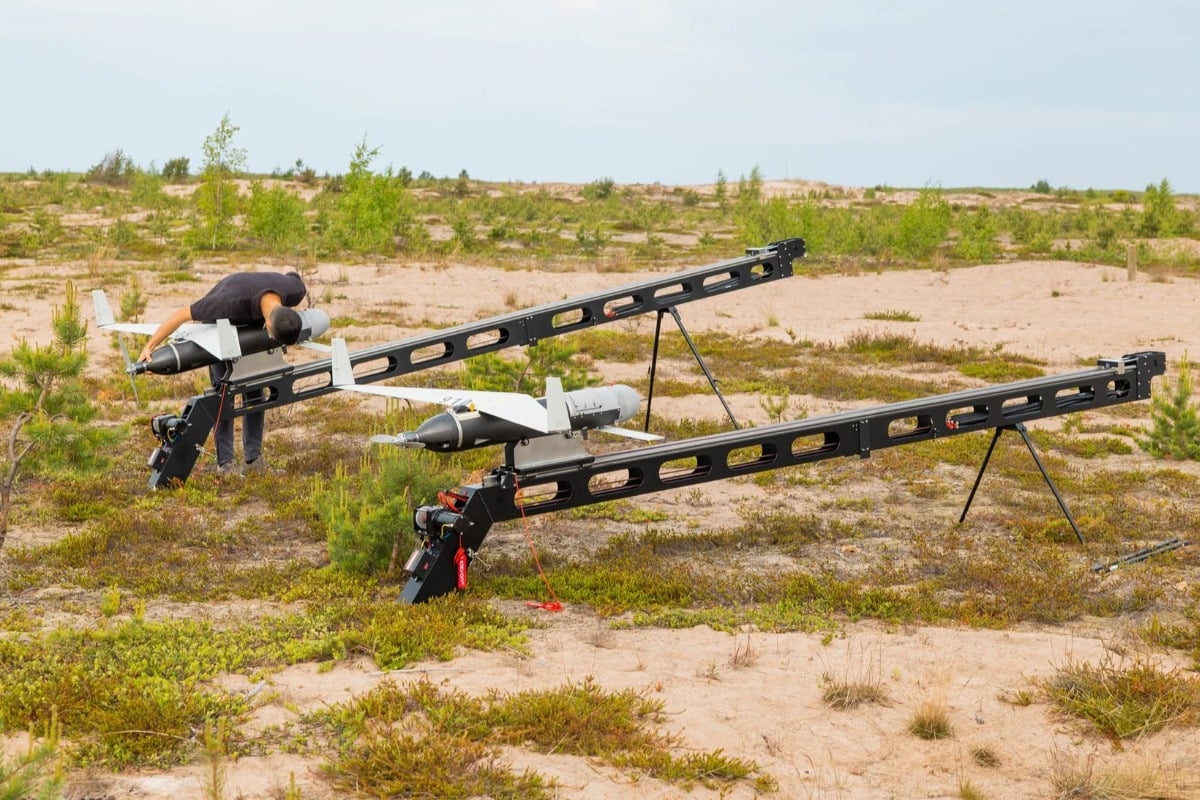
- The Finnish Defence Forces hosted a drone interceptor evaluation event where multiple companies, including Destinus with its Hornet Block 1, demonstrated their systems.
- The Hornet Block 1 has a range exceeding 75 km (47 miles) and a 1.5 kg (3.3 lb) payload, uses AI-assisted terminal guidance, and operates in GNSS-denied environments.
Finland’s military is methodically building its ability to shoot down drones, and recent weeks brought that effort into public view when the Finnish Defence Forces hosted a live testing event where multiple companies demonstrated their interceptor drone systems for evaluation. Among the systems on display was the Hornet Block 1 from Destinus, a European aerospace company whose co-founder served as Ukraine’s Finance Minister and whose drone technology has been quietly supplying Ukraine’s armed forces since 2023.
The Finnish Army confirmed the event on its official social media account, describing it as part of a deliberate, structured effort to build counter-drone capability.
“The Defence Forces are building drone interception capability systematically,” the Finnish Army’s post stated. “This week, a drone interception equipment test event was organized, in which companies presented technological solutions for interceptor drones. Drone interception is based on versatile interception and detection capabilities that enable the detection and neutralization of drones of various sizes. Strong air defense is an entity formed from the capabilities and cooperation of different branches of the armed forces, of which drone interception is one part.”
The Hornet Block 1 has a range of more than 75 km (47 miles) and a 1.5 kg (3.3 lb) payload, according to Destinus. The system uses initial radar guidance to fly toward an incoming threat, then switches to an AI-assisted electro-optical and infrared seeker for the terminal phase of the intercept, the final seconds of the engagement when the interceptor must acquire, track, and destroy the target autonomously. Critically, it operates in GNSS-denied environments, meaning it does not rely on GPS signals that can be jammed or spoofed, a feature that has become a baseline requirement for any serious counter-drone system after years of electronic warfare experience in Ukraine.
The threat category the Hornet Block 1 is designed to address covers Group 3 drones, the military classification for unmanned aircraft weighing between 25 kg (55 lb) and 600 kg (1,323 lb) and flying at altitudes up to 5,500 m (18,000 ft), as well as loitering munitions, the slow-flying explosive-laden aircraft that detonate on contact with a target, and coordinated swarm attacks where multiple cheap drones are launched simultaneously to overwhelm a single defense system. Countering a swarm with expensive surface-to-air missiles is economically unsustainable because the missiles cost orders of magnitude more than the drones they destroy. A purpose-built interceptor drone like the Hornet is designed to close that cost gap by using a relatively inexpensive weapon to destroy a relatively inexpensive threat.
Destinus was founded by Russian-born entrepreneur Mikhail Kokorich, who left Russia years earlier and later renounced his Russian citizenship after opposing Moscow’s invasion of Ukraine, with Oleksandr Danylyuk, former Minister of Finance of Ukraine from 2016 to 2018 and former Secretary of Ukraine’s National Security and Defence Council, serving as co-founder and president. Since 2023, Destinus has been supplying Ukraine with its systems, including the Ruta missile-drone, whose successful testing President Volodymyr Zelensky confirmed in 2024. The company also has Ukrainian investors and manufacturing facilities in Ukraine itself, making it one of the more directly connected Western defense suppliers to Ukraine’s war effort.
Destinus acquired key assets, technology and personnel from Netherlands-based Aerialtronics in March 2025, followed by Swiss autonomous flight startup Daedalean for $223 million in August 2025, and in April 2026 announced a joint venture with German defense giant Rheinmetall called Rheinmetall Destinus Strike Systems, which is expected to become operational in the second half of 2026 and will produce advanced missile systems, including cruise missiles and rocket artillery, for the European and NATO markets. That trajectory, from a startup supplying Ukraine with experimental drones to a joint venture partner of one of Europe’s largest defense conglomerates, reflects how rapidly the European defense-tech sector has matured under the pressure of a sustained land war.
The Hornet system previously demonstrated its capability to autonomously intercept an aerial target during the TEC2 Exercises in Viator, Almería, organized by the Spanish Army under its 2025 Tactical Experimentation Campaign, with more than 70 representatives from the Spanish Armed Forces and Ministry of Defence attending. The Finnish evaluation follows that Spanish demonstration as the system works through the evaluation process with multiple NATO members.
Finland’s interest in autonomous drone interceptors reflects the country’s specific security environment. Finland shares an approximately 1,340 km (833 mile) land border with Russia, the longest such border of any NATO member state, and joined the alliance in April 2023 following Russia’s full-scale invasion of Ukraine. The threat of drone incursions, reconnaissance overflights, and potential drone-based attacks against military installations and critical infrastructure is not hypothetical for Helsinki. It is the same threat that Ukrainian forces have been contending with daily since 2022, and the lessons from that conflict have directly shaped what NATO members along Russia’s border are now rushing to procure.
The Finnish evaluation event, involving multiple companies presenting competing interceptor solutions, follows the established procurement pattern of several Nordic and Baltic states that have accelerated counter-drone programs since 2022. Latvia, Estonia, and Belgium have already fielded the BLAZE interceptor system from Origin Robotics. Poland, Germany, and the Netherlands have invested heavily in layered counter-drone architectures. Finland, with its long Russian border and its history of treating national defense with unusual seriousness, is working through the same problem set, and the companies demonstrating their technology in Finnish military training areas this week know that the country’s procurement decisions carry real operational weight. A drone interceptor that passes Finland’s evaluation will face one of the most demanding potential operating environments in Europe.