


- Ukrainian President Volodymyr Zelenskyy said Shahed drones now pose a greater challenge than ballistic missiles, requiring the use of interceptors, F-16s, and helicopters.
- The Armed Forces are deploying helicopters and modified civilian aircraft to intercept drones and preserve limited missile defense stockpiles.
Ukrainian President Volodymyr Zelenskyy says Iranian-designed Shahed drones now pose a more persistent and unpredictable threat than ballistic missiles, forcing the Armed Forces to use a wide range of countermeasures under increasingly difficult operational conditions.
“Shaheds have now become more dangerous in some cases than ballistic missiles,” Zelenskyy said during a press briefing, according to Suspilne. “We can shoot down ballistic missiles where we have Patriot systems. But to bring down such a large number of Shaheds at those altitudes, we need to use everything — interceptors, F-16s, helicopters — we’re using everything.”
The president emphasized that Ukraine’s ability to intercept drones is also heavily influenced by the weather. “In freezing temperatures, we’ll see how helicopters perform. In the rain, aviation can’t see everything,” Zelenskyy said.
According to the president, Ukraine is currently expanding its use of air interceptors, including self-guided models, to counter the growing volume of drone attacks. “By November, we will reach 500 to 800 interceptors per day. We need to train the operators,” he said.
Zelenskyy stressed that the primary challenge is not production but manpower. Although many mobile fire groups are already deployed, a large number of trained personnel are still required to operate the new systems effectively. “We simultaneously need specialists to respond with long-range weapons, which creates an overall demand for people,” he said.
Ukrainian air defenses now rely on a combination of fixed systems and unconventional airborne tactics to combat Shahed drones, which can carry warheads of up to 90 kilograms. These drones, if not intercepted, have the destructive potential to level large structures, including residential buildings.
One such tactic involves the use of helicopter pairs to engage incoming threats. In this setup, one helicopter is tasked with carrying weapons and engaging targets directly, while the second is equipped with advanced sensors — including the Teledyne FLIR multi-sensor system — to locate, track, and guide the attack helicopter. This coordinated air-to-air engagement method has become a critical component of Ukraine’s defensive doctrine, particularly in regions where ground-based missile systems are unavailable or exhausted.
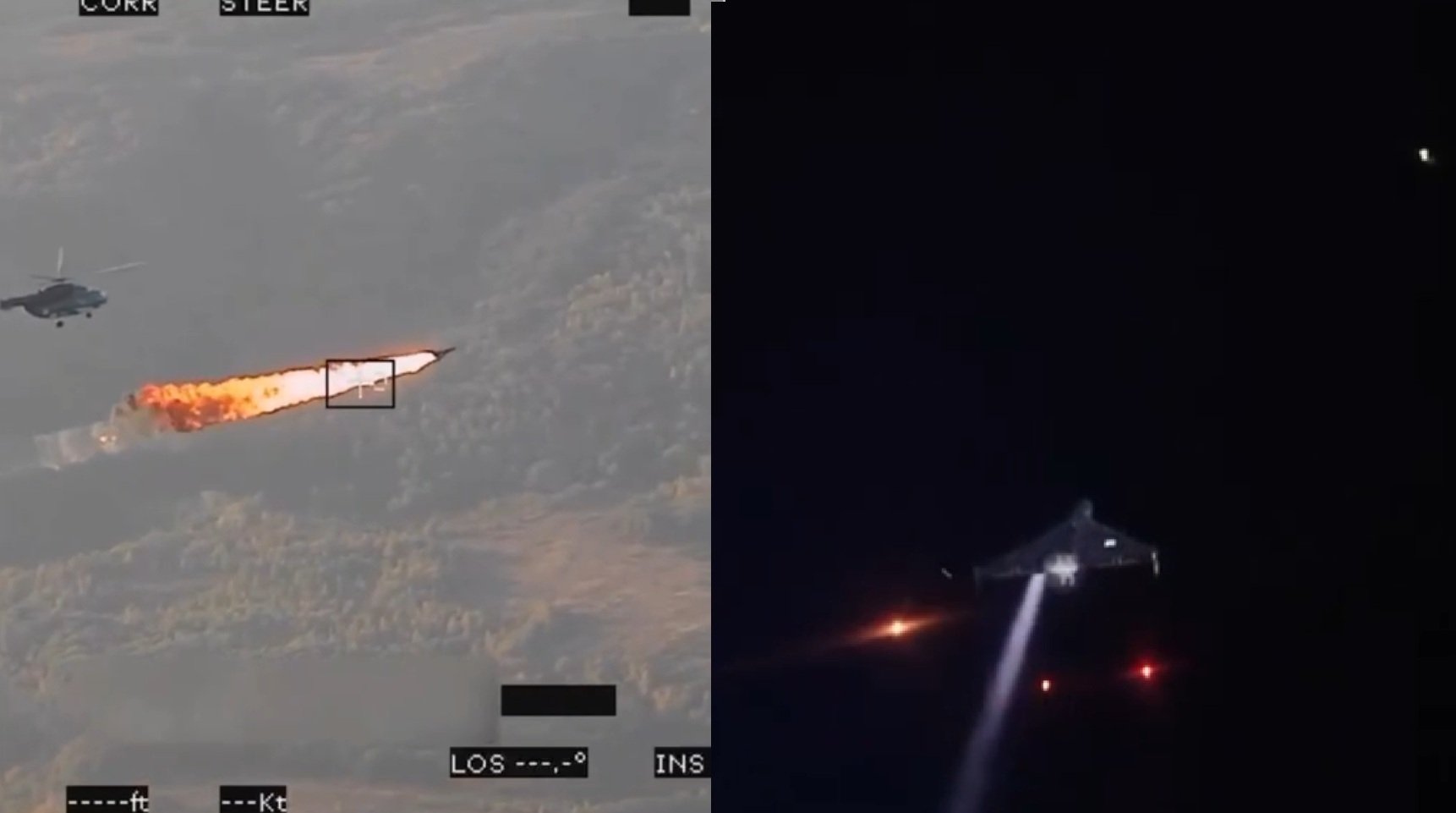
The use of helicopters in this role also helps conserve high-value surface-to-air missiles, which are expensive and remain in limited supply. According to Ukrainian military personnel, a single interceptor missile can cost hundreds of thousands of dollars, and stocks are quickly depleted when confronting swarm attacks.
In addition to helicopters, Ukraine has explored adapting civilian aircraft for military roles. One example, seen in August, involved a modified Zlin Z-137 Agro Turbo aircraft — a type of Czechoslovak-designed crop-duster — which was refitted to carry what appeared to be R-73 air-to-air missiles. The aircraft was reportedly used in direct drone interception missions.

President Zelenskyy has consistently called for greater international support in replenishing Ukraine’s air defense reserves. Ukraine continues to rely heavily on hybrid air defense tactics that integrate both high-end Western systems and rapidly adapted indigenous platforms.
With winter approaching, the president’s remarks underscore the challenge Ukrainian forces face as inclement weather threatens to degrade the effectiveness of visual targeting systems — further complicating efforts to maintain round-the-clock aerial coverage.