


The U.S. Army has unveiled what it describes as a scalable and low-cost production effort for first-person-view (FPV) drones.
On August 7, 2025, the 2nd Cavalry Regiment (2CR) displayed a mass lineup of drones at Balli Army Airfield in Germany, underscoring how rapidly deployable unmanned systems are becoming integral to battlefield operations.
According to the Army, these FPV drones are designed to enhance reconnaissance capabilities, increase operational efficiency, and support the broader modernization of combat forces. The event showcased not only the volume of platforms available but also the simplicity and speed with which they can be assembled and deployed.
Images from the demonstration show soldiers working on compact, quadcopter-style drones—installing propellers, wiring, and onboard electronics—alongside a floor filled with dozens of fully assembled units ready for use. This visual emphasis on mass production reflects a tactical shift toward equipping units with large numbers of expendable yet capable unmanned aerial systems.
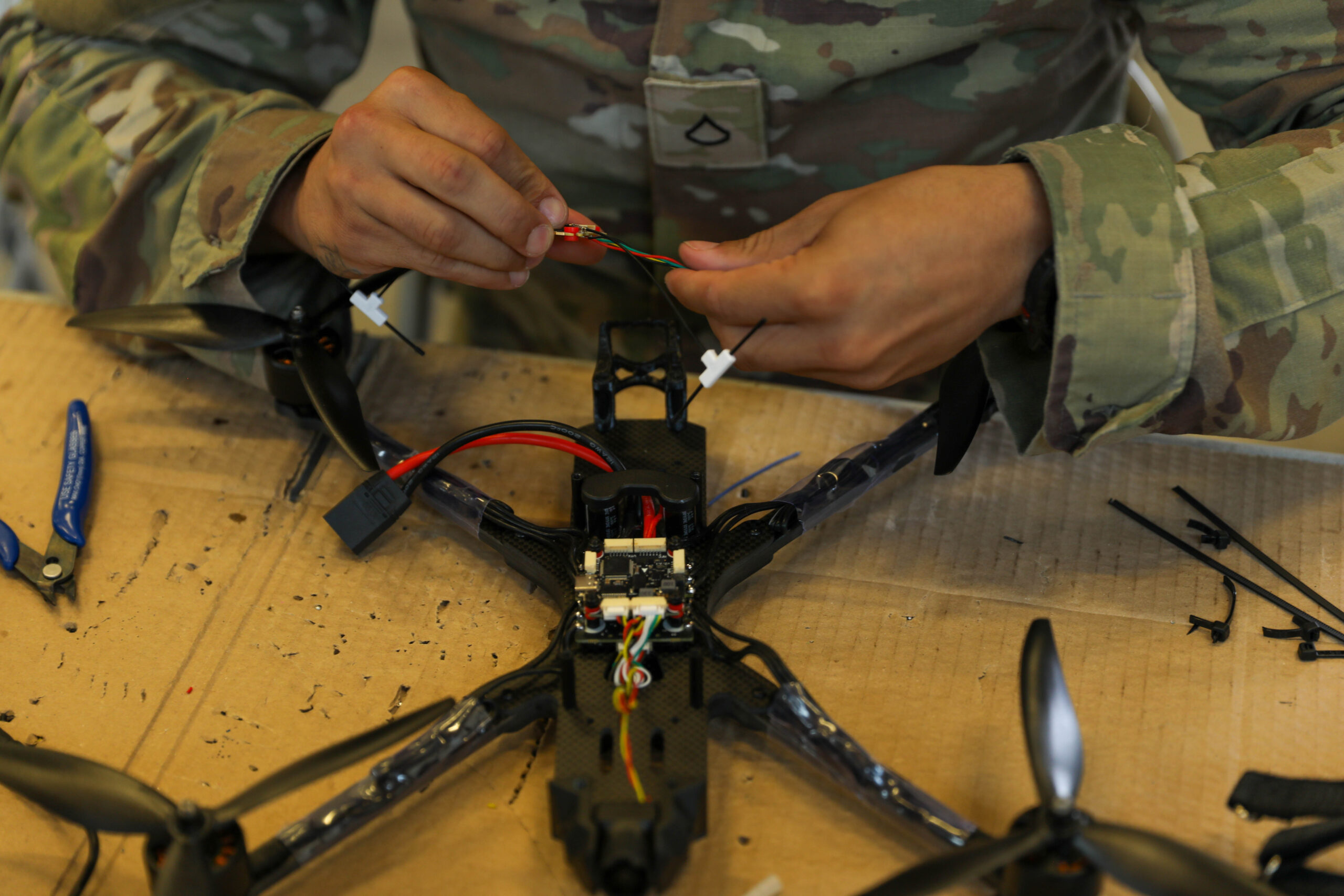
For the 2nd Cavalry Regiment, which operates in Europe as part of U.S. Army Europe and Africa, the deployment of such drones offers a practical enhancement to situational awareness in complex terrain. FPV platforms can be launched from virtually anywhere, providing rapid reconnaissance without exposing personnel to direct enemy observation or fire.
The approach mirrors similar operational production concepts seen in China and France, both of which have publicly demonstrated rapid drone assembly lines in recent years. Those efforts, in turn, draw on lessons learned from Ukraine, where FPV drones have become a key element in reconnaissance, targeting, and strike missions on the battlefield.
While the Army did not disclose specific technical details, FPV drones typically carry small payloads and are operated by pilots using real-time video feeds from onboard cameras. Their affordability and adaptability allow forces to deploy them in high numbers, saturating target areas with surveillance coverage or using them for precision strikes in high-risk environments.