

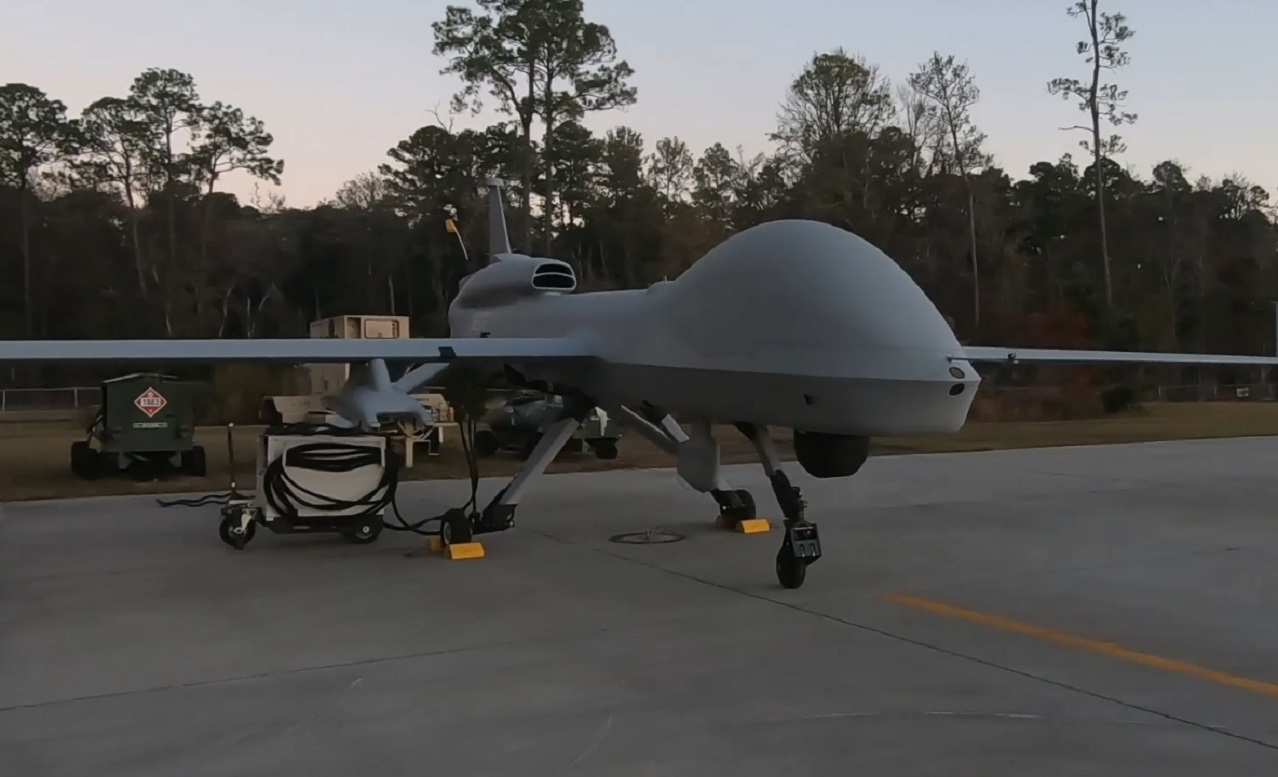
The U.S. Army in collaboration with General Atomics Aeronautical Systems, Inc. (GA-ASI) has successfully tested the advanced datalink capability as part of a development effort to upgrade the MQ-1C Gray Eagle Extended Range (GE-ER) Unmanned Aircraft System (UAS).
The Gray Eagle is manufactured by General Atomics. It is cheaper to purchase and maintain than a helicopter and it can stay in the air for longer stretches of time. Essentially, the Gray Eagle is the latest version of the Predator series of drones, retooled and upgraded for Army-specific needs.
The Air Force’s Predator drones are flown by officers who are usually located back in the USA and connected to the airframes by satellite link. But flying the Army’s Gray Eagle is an enlisted soldier’s affair, done in theater and close to the ground troops that the airframe serves.
During the December tests, the joint U.S. Army and GA-ASI ground demonstration showed the ability of GE-ER to maintain link and support high bandwidth data rates with Geostationary Earth Orbit (GEO) Ku/Ka band satellites and Medium Earth Orbit (MEO) Ka band satellites with common hardware and software. This allows the modernized GE-ER to conduct uninterrupted flight operations over multiple satellite constellations to support continuous operations in contested environments.
“Extensive use of Modular Open Systems Approach (MOSA) principles, along with Model Based Systems Engineering (MBSE), made this capability possible,” said GA-ASI Vice President of Army Programs Don Cattell. “Together with our U.S. Army teammates, we’re making important progress in preparing GE-ER for successful operations in contested environments. Completion of the GE-ER modernization will enable mission success for the Army’s highest priority capabilities.”
Advanced waveform capabilities were also tested during this event. Satellite constellation diversity combined with multiple line-of-sight options for interfacing with the modernized GE-ER provides resilient and robust communications with supported maneuver units and manned aviation assets.
Flight testing of the modernized GE-ER system is scheduled for fourth quarter 2022.