

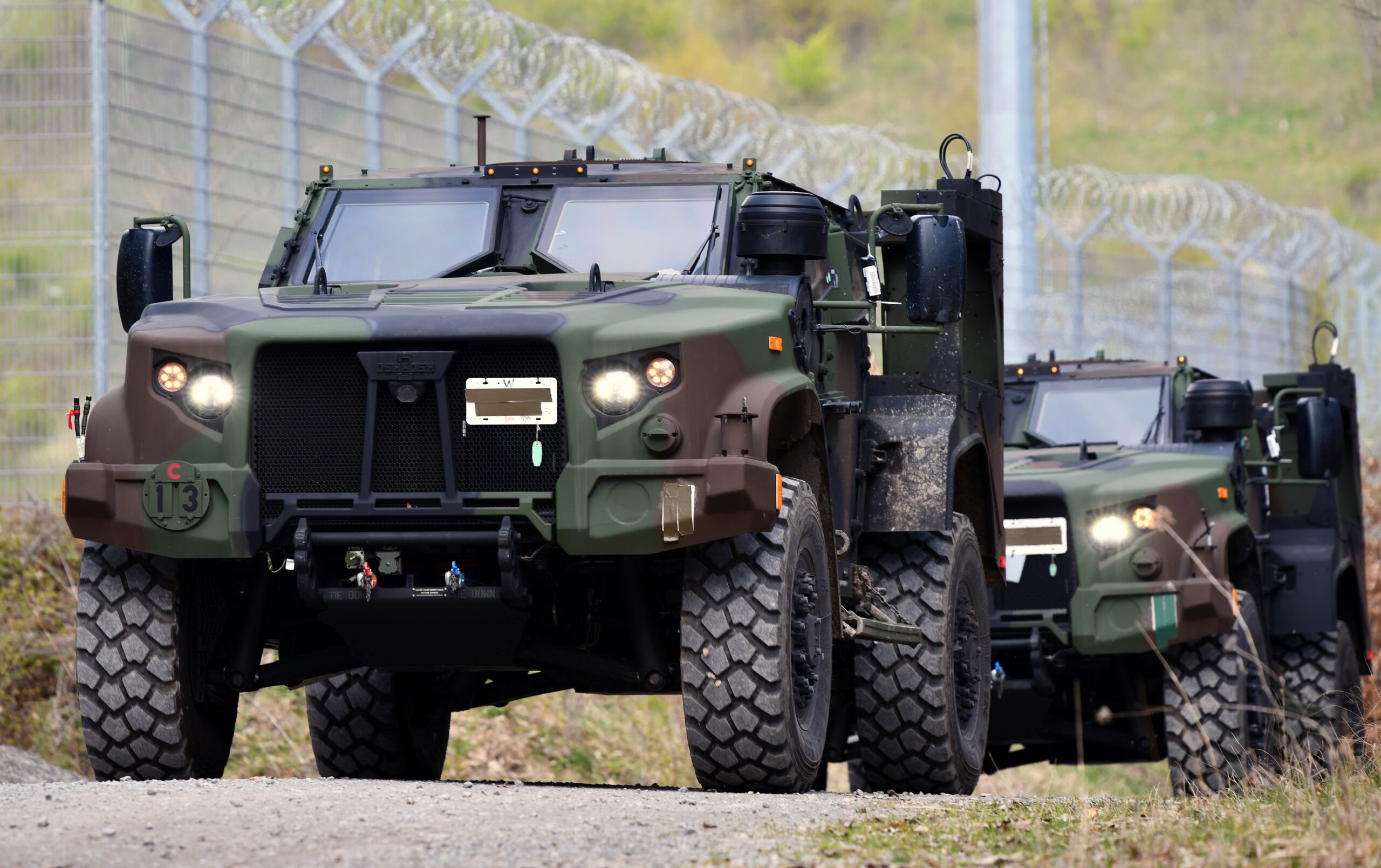
The U.S. Army issued a contract award to develop 3D vision systems for its off-road autonomous ground vehicles.
The Army awarded the $1.67M SBIR Phase II contract to NODAR to develop 3D vision systems for military off-road autonomous ground vehicles.
NODAR will be working with the U.S. Army in developing 3D vision systems for autonomous military vehicles operating in off-road and harsh environments. Rather than detecting pedestrians, traffic signs and signals as done for passenger vehicles, NODAR’s Hammerhead technology will be used to sense terrain, vegetation and other off-road obstacles in degraded visual environments that have low or no light, dust, smoke, rain, or other harsh conditions.
“NODAR is unique in our ability to provide long-range, high resolution, real-time 3D sensing using independently mounted cameras while remaining resilient to unfriendly environmental conditions,” says Leaf Jiang, Co-Founder & Chief Executive Officer at NODAR. “NODAR’s 3D vision system produces dense 3D point clouds with highly accurate distance estimates to each pixel in the scene. These data provide the detail needed to navigate through difficult terrain and around obstacles.”
NODAR’s long-range vision systems can sense up to 1,000 meters, which allows the perception system to detect hidden threats long before the vehicle enters the area. To achieve this, NODAR mounts multiple cameras with overlapping views on the vehicle, and applies patent-pending computer vision software to maintain alignment between cameras. Because of this, NODAR Hammerhead uniquely provides 360 degrees, long-range, high-density, high frame-rate 3D data in real-time to the vehicle’s navigation system.
“The Army Applied Small Business Innovation Research (SBIR) Program connects Army Soldiers and technical and operational subject matter experts with small businesses to provide insight into unique Army technology needs and guide those small businesses through the Army research and development ecosystem,” said Dr. Matt Willis, Director of Army Prize Competitions and Army Applied SBIR Program, in the Office of the Assistant Secretary of the Army for Acquisition, Logistics, and Technology (ASA(ALT)). “Partnering with these small businesses is critical in helping us to develop game-changing technologies in capabilities such as sensing to support the Army and our Soldiers, so we’re excited to be working with this latest round of small-business awardees.”