

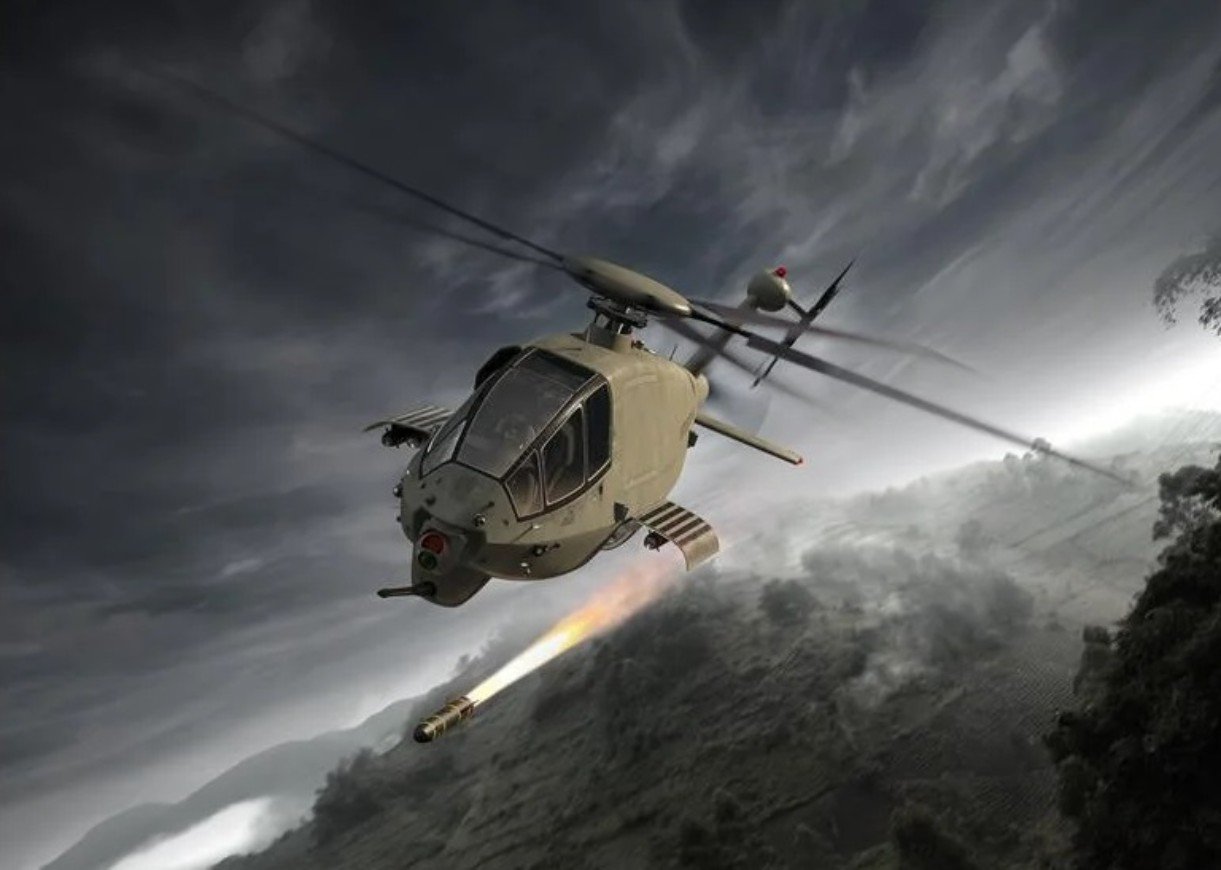
Last week, the U.S. Army posted a notice on the government’s main contracting website, asking for information from contractors about their ability to produce Long Range Precision Munition (LRPM) for integration on future scout-attack helicopters.
The Army is seeking information on new munition solutions that can be demonstrated at an Army conducted shoot-off in the fourth quarter of the fiscal year 2022. It is the Army’s intent to conduct this demonstration to inform the LRPM capabilities development and to inform the selection of a single or multiple vendors to build, integrate, test, and/or qualify on currently fielded and Future Attack Reconnaissance Aircraft (FARA).
In a notice posted on the Federal website, the Army noted that the demonstration event is a critical element of the acquisition strategy to procure and field LRPM.
All tests will be launched from a ground-based fixed test stand. The Government will provide target vehicles, test range time, test range equipment, and an opportunity to perform integration testing with Government Furnished Equipment (GFE) prior to the Shoot-Off.
Results from the demonstration, digital simulation performance, and the evaluation may culminate in an Aviation and Missile Technology Consortium (AMTC), Other Transactional Agreement (OTA) award to a single or multiple vendors to produce up to 60 LRPM munitions to support qualification and testing in support of a planned fiscal year 2026 aircraft integration and qualification.
According to the U.S. Army Contracting Command, the new weapon system should be effective against various target types to include: integrated air defense systems; lightly armored systems command and control nodes; personnel.
It is also noted that Long Range Precision Munition range should be greater than 30 km (time of flight at 30 km is less than or equal to 100 secs) and added that range greater than 40km is an objective capability.
Additionally, the newest weapons system should be able to engage stationary and moving targets in day and night conditions in adverse weather and global positioning system (GPS) denied environments with low collateral damage.
The FARA is an Army-led initiative to design, develop, and deliver the preeminent attack reconnaissance aircraft for Army Combat Aviation Brigades and the Joint Force enabling U.S. dominance on the Multi-Domain battlefield that is expected to be able to descend upon active combat ‘hot zones’. It is the next generation aircraft capable of achieving and sustaining overmatch against potential competitors and enduring asymmetric threats by closing or mitigating gaps in Army Aviation attack reconnaissance.
The FARA will mitigate enemy long-range capabilities through increased reach allowing the commander to fight and operate from relative sanctuary while delivering lethal effects outside enemy sensor/weapons range. FARA must operate in complex and dense urban, mountainous, desert, jungle and maritime environments.