

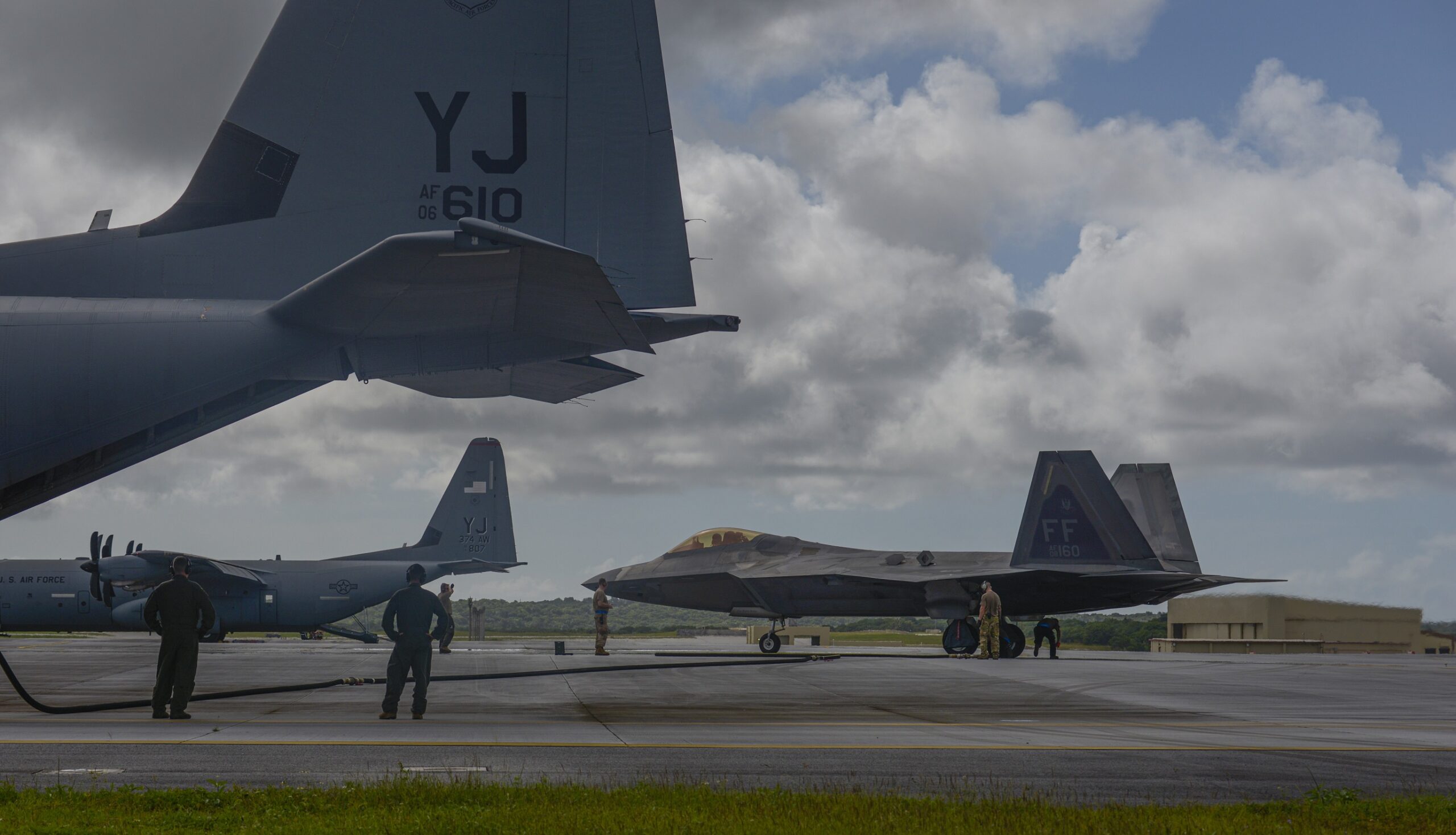
U.S. Air Force F-22 Raptor fighter jets have successfully carried out a hot refueling from a fuel bladder carried by a C-130J Hercules during a Dynamic Force Employment at Andersen Air Force Base, Guam.
According to a recent Air Force news release, a C-130J Super Hercules transport plane conducted a hot-pit refuel of a pair of F-22 Raptors using an Aerial Bulk Fuel Delivery System (ABFDS) in order to be less predictable to possible adversaries.
Hot refueling provides the ability to recover and turn the F-22 fighters to another mission without depowering the aircraft or losing the source of bleed air required to restart the engines. This is one of the capabilities highly desired in combat situations.
According to the Air Expeditionary Force Fuels Management Pocket Guide, ABFDS is an aerial, fuels-delivery system that enables aircraft to transport fuel rapidly to locations close to or behind enemy lines. This system is normally installed on C-130s but can be used on C-5 Galaxies and C-17 Globemaster IIIs.
“Hot-pit refueling operations using ABFDS are relatively new,” said Chief Master Sgt. Steve McClure, Pacific Air Forces command fuels functional manager. “The primary design of the ABFDS system is to refuel or to take bulk fuel to bladders in a contingency location. It has the capability to refuel aircraft and always has, but we’ve stepped that up with [agile combat employment].”
According to McClure, the 374th Airlift Wing developed the checklist to use ABFDS to refuel other aircraft, and this is the second time C-130s from the 36th Airlift Squadron, 374th Airlift Wing, Yokota Air Base, Japan, have hot-pit refueled F-22 Raptors using ABFDS. The first time was during Valiant Shield 20, a biennial, U.S. only, joint field training exercise at Andersen Air Force Base, Guam, in September.
“They’ve been phenomenal and worked a lot on getting us to where we’re at,” he said.
ABFDS supports PACAF’s ACE concept, which envisions the use of agile operations to generate resilient airpower in a contested environment. The system consists of two, 3,000-gallon aerial bladder tanks, two pumping modules, a meter and hoses. It is also capable of delivering 600 gallons per minute with one pump or 1,200 gallons per minute with both pumps.
Should pilots find themselves running out of fuel and they cannot land at the airfield they departed from because it’s under attack or has battle damage, the pilots can divert to a different location knowing they can get refueled.
“If that location doesn’t have fuel support, we can generate a mission to fly in and off load fuel to the aircraft,” McClure said.
Being able to get fuel to places in the USINDOPACOM theater of operations is important due to its size. The command’s area of responsibility is more than 100 million square miles, or roughly 52 percent of the Earth’s surface, stretching from the west coast of the United States the west coast of India, and from the Artic to the Antarctic, making this an important capability.
“There are more airfields than there is capability at those airfields,” McClure said. “You never know when we’re going to land, and you never know when we’re going to need support. It offers us the opportunity to put fuel at a location in a relatively short amount of time as opposed to moving it via maritime.
“We have the capability to load fuel on an aircraft. Take that aircraft and land somewhere, refuel and get back out of there. Once all aircraft are gone, it’s like we’ve never been there.”
ABFDS has been used in other USINDOPACOM exercises and to rotate U-2 Dragon Ladies in and out of the Republic of South Korea. The system was also loaded onto Royal Australian Air Force C-17s and used to refuel a C-130 during Artic Ace 2018.