

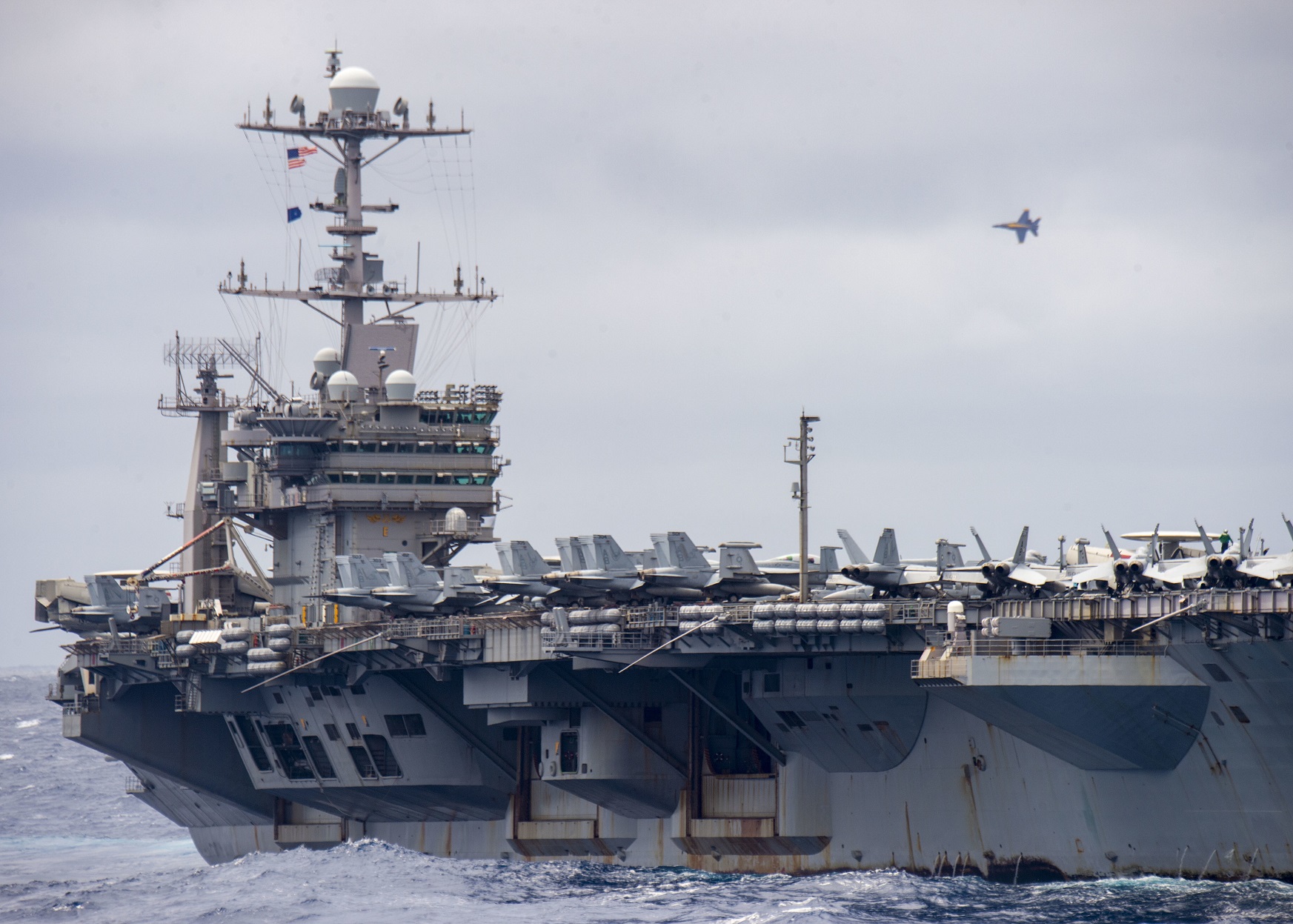
The U.S. Navy has announced that the Nimitz-class carrier USS Harry S. Truman (CVN 75) returned home June 16, marking the end of their deployment after operating in the U.S. 2nd, 5th and 6th Fleets.
Following a return from deployment in March after operating in the U.S. 5th and 6th Fleet, Truman remained underway in the Western Atlantic during their sustainment phase of the OFRP cycle as a certified and ready carrier force ready for tasking. As the COVID-19 pandemic spread across the globe, the Truman continued to conduct operations underway, minimizing the potential spread of the virus aboard the ships, in order to maintain maritime stability and security and ensure access, deter aggression, and defend U.S., allied and partner interests.
Truman sailed over 56,000 nautical miles, deploying dynamically to support dual-carrier operations, air defense exercises, anti-submarine warfare exercises, and interoperability with joint services and with allies and partners. The ship also completed multiple strait and choke point transits, to include the Strait of Gibraltar, the Suez Canal and the Bab-el Mandeb Strait, while operating under three Combatant Commanders – U.S. Northern Command (NORTHCOM), U.S. European Command (EUCOM), and U.S. Central Command (CENTCOM).
Truman demonstrated the Navy’s continuing regional commitment to EUCOM and CENTCOM areas of responsibility by hosting 80 embarked guests, including political and military leaders from eight ally and partner nations. These embarks directly supported U.S. 5th and 6th Fleet theater security objectives and greatly enhanced U.S. relationships and partnerships with multiple NATO ally and partner nations and GCC (Gulf Cooperation Council) members.
“I’m so very proud of all our Sailors!” said Capt. Kavon Hakimzadeh, commanding officer of Truman. “Their resilience, perseverance, and utter dedication to mission has been nothing short of exemplary. It has been my greatest honor to serve as Truman’s commanding officer this deployment!”
Throughout the deployment, Truman performed numerous training exercises to develop tactical competencies. From carrier strike force operations as the flagship of the Harry S. Truman Carrier Strike Group (HSTCSG), to exercises with partner navies and forces, the ship developed key skillsets to maintain readiness and interoperability. While conducting stability operations in the CENTCOM area of responsibility, the strike group was called upon during an international crisis to assert American commitment to the region and act as a primary de-escalatory catalyst.
“The Harry S. Truman Carrier Strike Group has been the ready force for the nation these past months,” said Rear Adm. Ryan Scholl, commander, Carrier Strike Group 8. “Truman operated closely with our allies and partners, supporting our forward commanders in U.S 5th and 6th Fleets and executing missions supporting homeland defense in U.S. 2nd Fleet. All the strike group units performed above and beyond what was asked of them and did so with amazing dedication. It is an honor and a privilege to serve with them as their commander!”
In the Western Atlantic, the HSTCSG conducted a week of naval air integration exercises with Marine Corps elements assigned to the 2nd Marine Aircraft Wing (2nd MAW). The purpose of the high-end training was to improve Navy and Marine Corps integration, communication, power projection in the form of strikes, and enhance readiness of air defense assets.
Truman concluded their operations underway by participating in a U.S. Northern Command-led exercise Vigilant Osprey, a major service-integrated homeland defense exercise aimed to strengthen operational partnerships alongside forces from Canada, Denmark, and the U.S. Air Force. The joint, multi-domain operations with Allies in the Atlantic Ocean, demonstrated North American Aerospace Defense Command’s (NORAD) ability to defend Canada and the U.S. and U.S. Northern Command’s (USNORTHCOM) ability to defend the homeland. The training operation included U.S. Strategic Command (STRATCOM) directed aircraft simulating attempts to penetrate U.S. airspace, U.S. Space Command (SPACECOM) directed capabilities, and USNORTHCOM using the nuclear-powered aircraft carrier Truman and her accompanying carrier strike group to exercise combined, high-end, multi-domain tactics, techniques and procedures.
The HSTCSG proved the U.S. Navy can be a predictable strategic partner, displaying commitment to deterring aggression while facing emerging threats around the globe.
Truman has spent at least one day underway for 32 of the last 36 months, in direct support of global security around the world. Truman is home ported at Naval Station Norfolk.
Truman’s return marks the final homecoming for the strike group. HSTCSG consists of the flagship USS Harry S. Truman (CVN 75) with embarked staffs of Carrier Strike Group (CSG) 8, Carrier Air Wing (CVW) 1 and Destroyer Squadron (DESRON) 28; embarked squadrons of CVW 1; guided-missile cruiser USS Normandy (CG 60); and DESRON 28 guided-missile destroyers USS Lassen (DDG 82), USS Forrest Sherman (DDG 98), and USS Farragut (DDG 99).
Squadrons of CVW-1 include Strike Fighter Squadron (VFA) 11 “Red Rippers;” VFA-81 “Sunliners;” VFA-136 “Knighthawks;” VFA-211 “Fighting Checkmates;” Electronic Attack Squadron (VAQ) 137 “Rooks;” Carrier Airborne Early Warning Squadron (VAW) 126 “Seahawks;” Helicopter Maritime Strike Squadron (HSM) 72 “Proud Warriors;” Helicopter Sea Combat Squadron (HSC) 11 “Dragon Slayers;” and a detachment from Fleet Logistics Support Squadron (VRC) 40 “Rawhides.”