

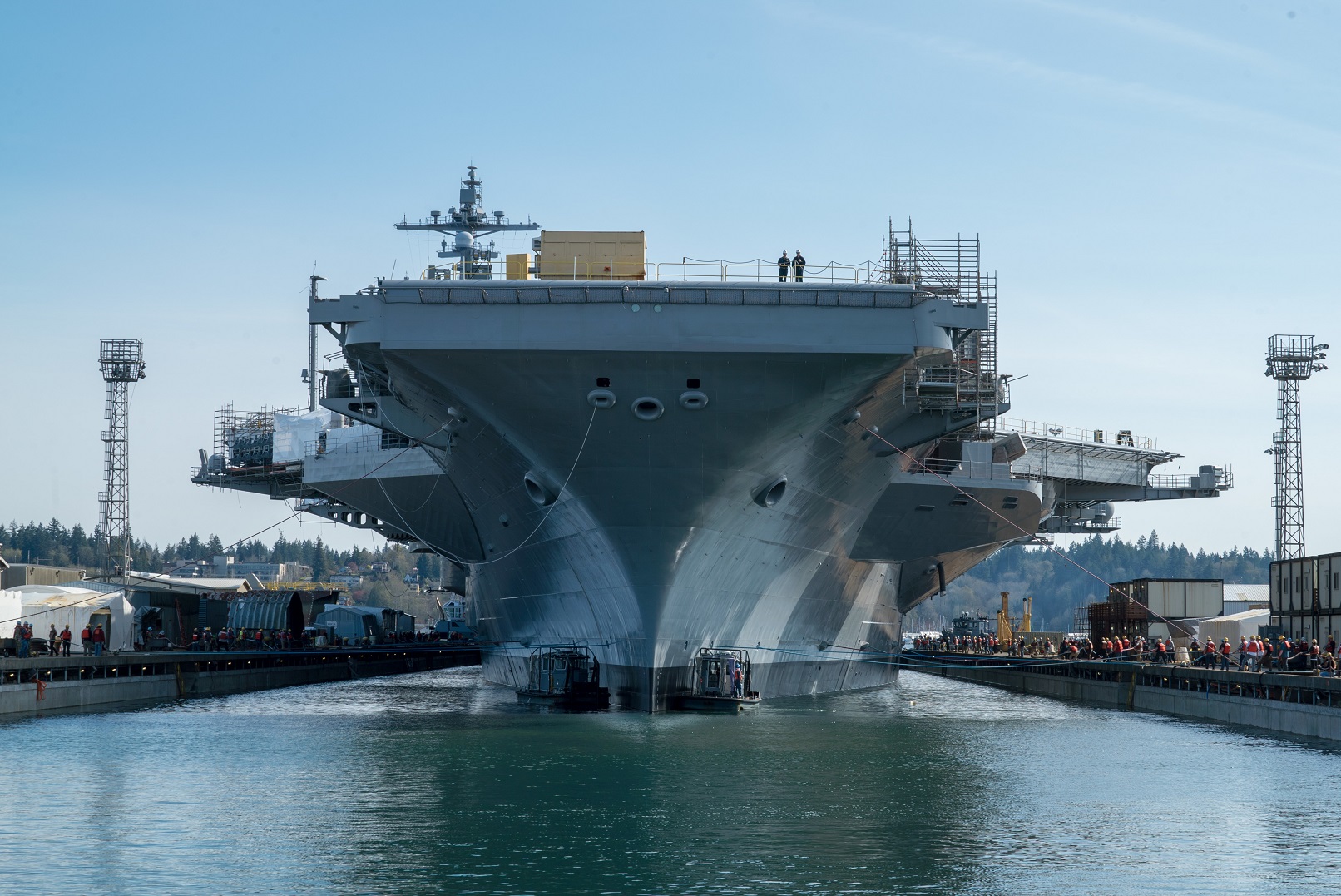
Nimitz-class nuclear aircraft carrier USS Carl Vinson (CVN 70) was returned to the water April 6, nearly year after entering the dry dock at Puget Sound Naval Shipyard.
The U.S. Navy said that USS Carl Vinson departed dry dock after spending 14 months undergoing a Docking Planned Incremental Availability period at Puget Sound Naval Shipyard & Intermediate Maintenance Facility.
While every availability poses challenges to the PSNS & IMF team, depending on the scheduled maintenance and growth work for the platform, the COVID-19 pandemic is posing a unique challenge for everyone involved in getting Carl Vinson back to the operational fleet.
“As we all watch the news and see the ways COVID-19 is challenging our nation and our Navy, we remain committed to delivering ships to support the warfighters’ needs,” said Capt. Dianna Wolfson, commander, PSNS & IMF. “The current pandemic has certainly challenged us, but we pulled together as a team, alongside the ship’s force and all of our other partners to get this aircraft carrier back in the water.”
According to Mike Irby, the project superintendent, the reduction of the workforce due to COVID-19 precautions did not dampen his team’s efforts.
“Despite the challenges, the shipyard and the project team maintained their focus and successfully prioritized undocking the ship,” said Irby.
The Carl Vinson project team got a head start on the DPIA by ensuring certain work was done in San Diego before the ship came to Bremerton in January 2019. The team conducted multiple ship visits and assessments to fully scope the work required before the ship arrived, and leveraged lessons learned and improvements that were implemented during the USS Nimitz (CVN 68) DPIA at PSNS & IMF from March 2018 to June 2019.
Some of the work completed included:
- Upgrades to electrical system.
- Maintenance on rudders, shafts and tanks.
- Upgrades to crew living spaces.
- Work to preserve the ship’s hull.
- Upgrades to Carl Vinson’s combat systems.
According to Irby the shafts, rudders and bearings had significant material deficiencies that delayed the undocking, while both rudders, rudder bores and struts also required extensive repairs. Due to the massive amount of growth work, the availability is currently projected to finish three weeks late.
Irby said he is proud of how everyone has pulled together in the face of COVID-19, and of the growth work executed to limit the impact on the availability.
“The project team continues to be a team,” said Irby. “Despite being late to get the ship out of dock, we are all laser-focused on gaining efficiencies that will, in the end, pull the availability completion date to the left.”
Wolfson said there is no challenge that can overcome the professionalism and dedication of the PSNS & IMF workforce.
“We can never forget that the ships we maintain and modernize here for the U.S. Navy head out across the globe, not knowing the challenges in front of them,” said Wolfson. “I am inspired by how the PSNS & IMF workforce embraced our command guiding principles, assuring quality at the source and creating value for our customer. This ensures USS Carl Vinson will perform as needed and keep our Sailors and our Navy as safe as possible.”