

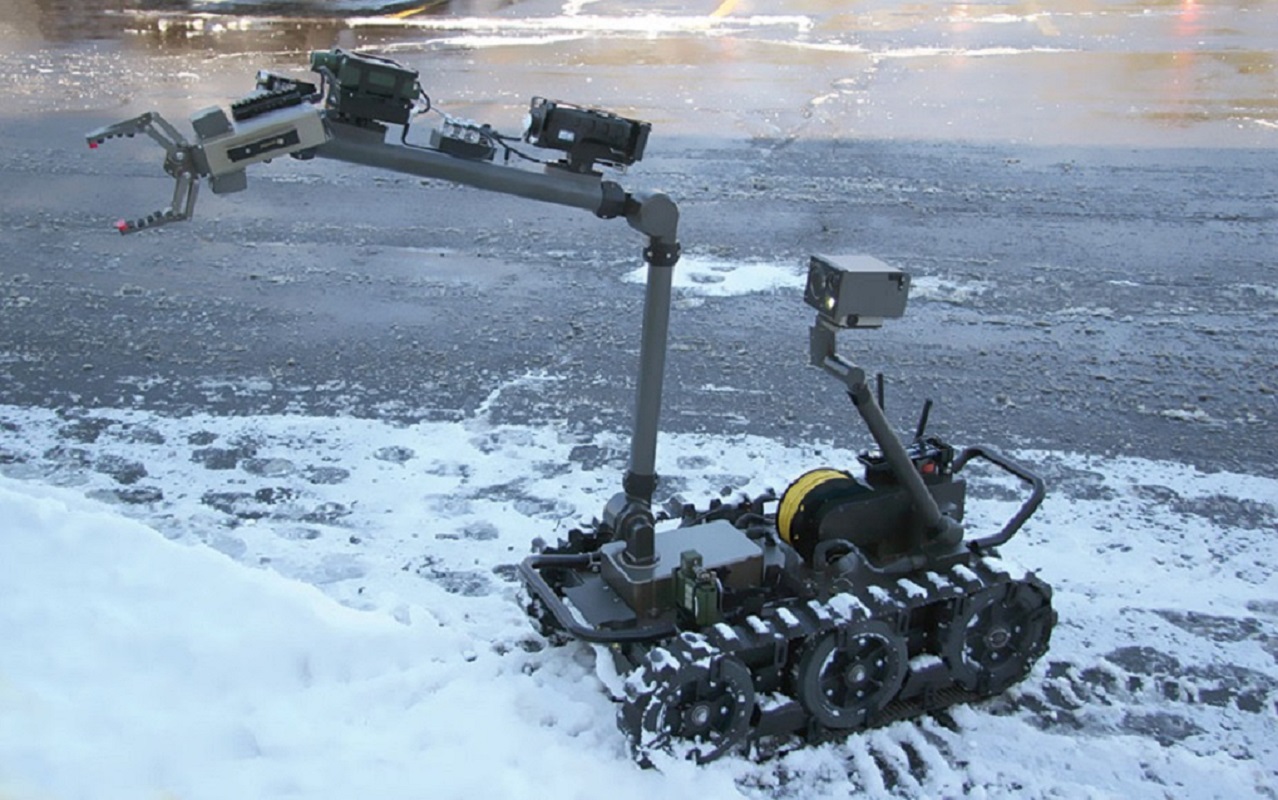
FLIR Systems, Inc., a world-leading industrial technology company focused on intelligent sensing solutions, announced that the U.S. Marine Corps has followed Air Force and ordered more than 140 of the company’s Centaur unmanned ground vehicles (UGV).
The $18.6 million contract is sourced through the Dept. of Defense Man Transportable Robotic System Increment II (MTRS Inc II) program.
Earlier this month FLIR announced the U.S Air Force has ordered almost 200 Centaurs through a $23 million contract. Marine Corps Explosive Ordnance Disposal (EOD) teams will use the FLIR Centaur to assist in disarming improvised explosive devices (IEDs), unexploded ordnance, and similar hazardous tasks. Different sensors and payloads can be added to support a range of missions.
“Centaur gives the Marines a multipurpose, mid-sized UGV that will complement the FLIR PackBot, SUGV and FirstLook robots we continue to provide to the Corps,” said David Ray, president of the Government & Defense Technologies business at FLIR. “We’re honored the Air Force and now Marines are choosing Centaur as an EOD platform-of-choice, and pleased the U.S. Army MTRS Inc II program can serve as a procurement channel.”
In 2017, the U.S. Army chose Endeavor Robotics, acquired a year ago by FLIR, as its medium-sized robot provider for MTRS Inc II. The company designed the all-new Centaur as its MTRS solution. FLIR is delivering robots to the Army under that multi-year program of record, which upon award was valued at more than $150 million, including options. This latest order falls under the current ceiling.
Centaur is a medium-sized UGV that provides a standoff capability to detect, confirm, identify, and dispose of hazards. Weighing roughly 160 pounds, the open-architecture robot features an advanced EO/IR camera suite, a manipulator arm that reaches over six feet, and the ability to climb stairs. Modular payloads can be used for CBRNE detection and other missions.