

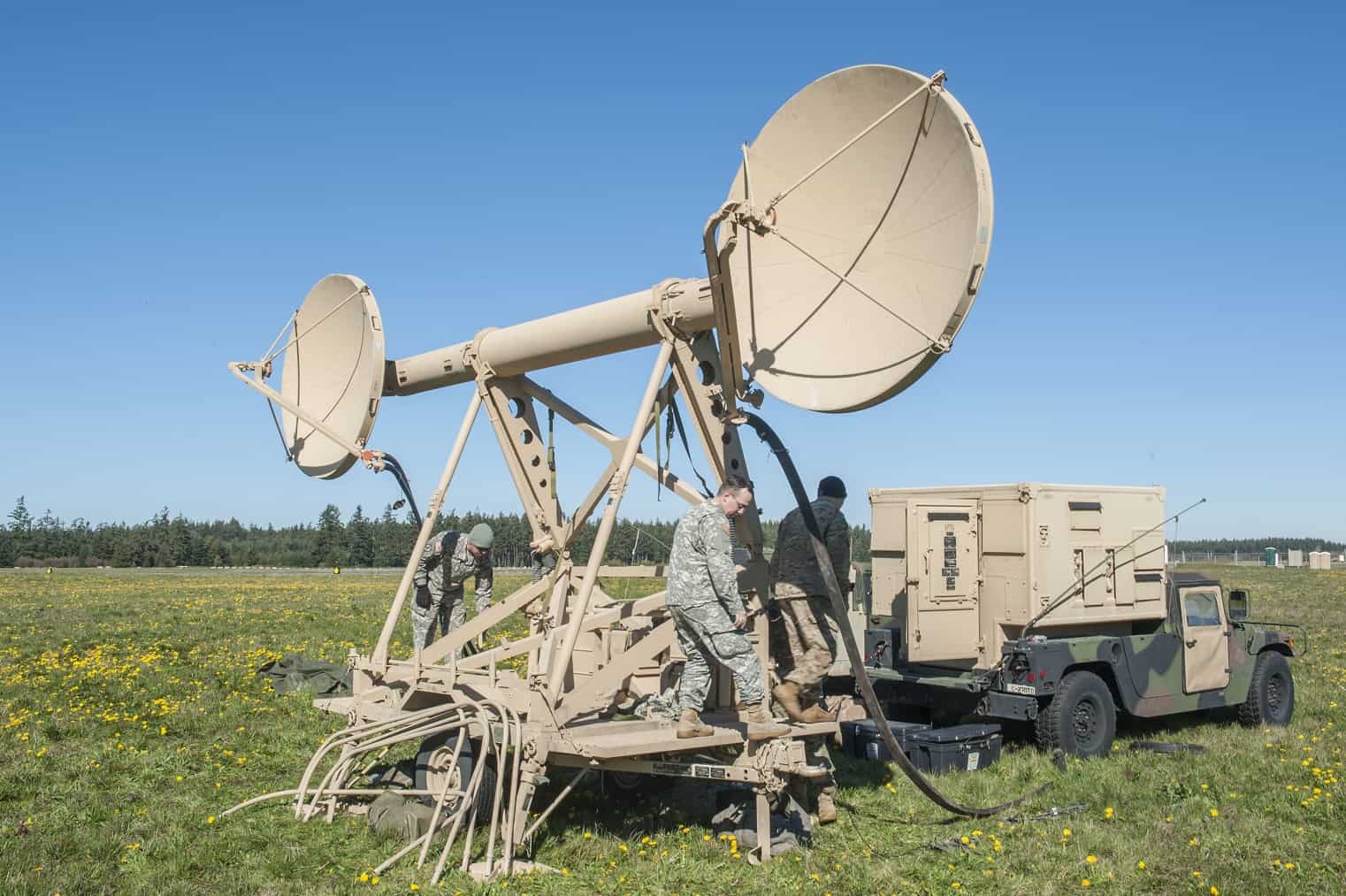
The U.S. Army will receive new troposcatter communication systems as part of a 10-year contract with Raytheon Company.
The indefinite-delivery, indefinite-quantity contract worth up to $663 million and provides ensure troops have access to secure voice and data communications in contested environments, commonly known as WiFi.
“Soldiers on the front lines can’t afford dropped calls,” said Dave Wajsgras, president of Raytheon Intelligence, Information and Services. “Our solution, a secure, reliable and wireless troposcatter system, allows troops to communicate in areas that would otherwise be dead zones. Importantly, it also gives the military a way to communicate in satellite-denied environments.”
Troposcatter – short for tropospheric scatter – technology uses particles that make up the Earth’s atmosphere as a reflector for radio signals. Those signals are aimed just above the horizon in the direction of a receiver station. As they pass through the troposphere, some of the energy is scattered back toward the Earth, allowing the receiver station to pick up the signal. Essentially, it creates a secure communications network without the need for cellular towers or satellites.
In addition to battlefield use, troposcatter systems are ideal for crisis response. One of the key challenges first responders face is a lack of reliable communications after a natural disaster. By deploying a troposcatter system, responders can quickly establish networks even where there’s no available power. The systems are easily transportable and can be set up in less than 30 minutes.
“Think about any natural disaster over the last several years; one of the biggest problems is a lack of reliable communications,” said Todd Probert, vice president for Raytheon IIS. “A troposcatter system easily can be deployed anywhere in the world and can transfer data at extremely high rates – the equivalent to streaming 10 high-definition videos simultaneously at a range of more than 115 miles.”
Raytheon will begin delivering the first units by the end of 2019, according to a news release.