

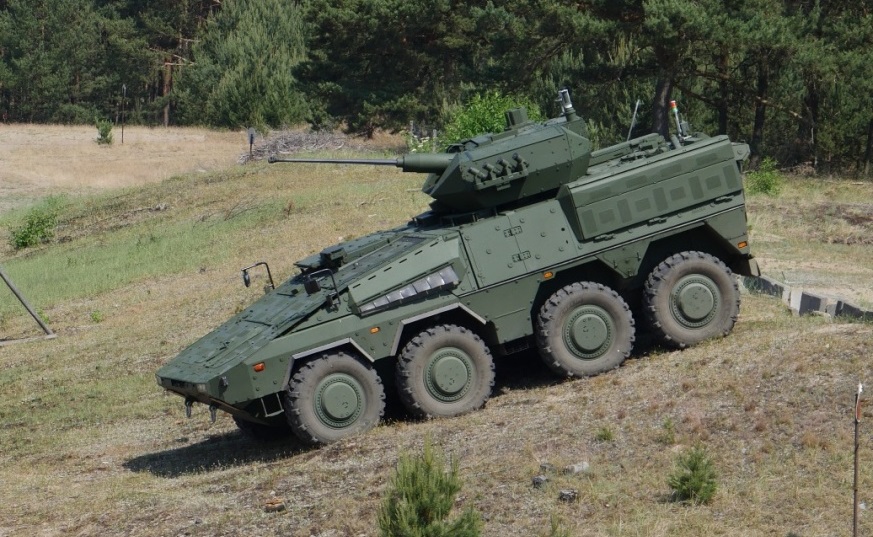
On 18 July, Ministry of National Defence Republic of Lithuania has announced that the new Vilkas infantry fighting vehicles take part in intense tests at the German military training areas.
According to the official statement, the manufacturer of Vilkas Infantry Fighting Vehicles (IFV), ARTEC, is putting two prototypes of IFVS bought by Lithuania, to intense testing at the German military training areas. Both prototypes have been made according to requirements of the Lithuanian Armed Forces, have Israeli-made turrets, 30 mm rapid-fire cannons and Spike LR anti-tank missiles.
“The IFV project is one of the key elements of modernisation and strengthening of the Lithuanian Armed Forces. The Vilkas have been adjusted to the needs of our armed forces and mark a qualitative leap in the modernisation of our forces in providing it with modern equipment and weaponry that brings it to NATO standards and contributes directly to strengthening the security of all of us,” Minister of National Defence Raimundas Karoblis says.
The key task of the prototypes is to assist the manufacturer in identifying the weaknesses in Vilkas IFVs to remove technical deficiencies before mass manufacturing begins thus ensuring high quality and work of all systems. Specialists from the Lithuanian Armed Forces are participating in the testing to gain experience in maintaining and operating the IFVs.
“We call these two IFVs prototypes because these are the first two produced according to the Lithuanian Armed Forces’ requirements with integrated turrets and at this phase are meant for assessment of integration and functioning of all systems. In comparison to the operator training vehicles obtained last year, these prototypes are significantly more complex, include more and different equipment that turns an armoured personnel carrier into a combat vehicle,” head of the project Lithuanian Major Nerijus Šivickas said on the IFV prototype.

Various tests make IFV mechanical and electronic systems to operate in maximum modes seeking to determine whether the prototype constructed on Lithuania’s order match the requirements of requirements – reliability, safety, functioning of components and modules, etc. If weaknesses are identified, manufacturing and assembly processes will be adjusted thus preventing the risk of malfunction over the actual operation period.
Once the testing is completed, technical condition of both prototypes will be reset to the manufacturer’s parameters and the IFVs will be returned to the Lithuanian Armed Forces. First Vilkas IFVs are expected to be brought to Lithuania in early 2019.
Also, Lithuania sent a letter of intent earlier in July to join the NATO Support and Procurement Agency (NSPA) Boxer program for supplying and maintaining the vehicles to ensure a proper logistical provision to the IFVs procured by the Lithuania Armed Forces. Participation in the program would allow access to common central and spare parts storages, service capabilities for major systems, engineer and technical support, etc., over the IFVs operation period.

The 88 IFVs bought for EUR 386 million to the Lithuanian Armed Forces on the basis of the contract signed on 22 August 2016 will be equipped with rapid-fire cannons and anti-armour missiles. The IFVs will be given to the Lithuanian Grand Duke Algirdas Mechanised Battalion and the Lithuanian Grand Duchess Birutė Uhlan Battalion of the Mechanised Infantry Brigade Iron Wolf.
The combination of firepower, manoeuvre and crew safety in the Vilkas IFVs match the needs of the Lithuanian Armed Forces and will be perfect for both national defence and multinational deployments. Lithuania agreed with the manufacturer ARTEC that the IFVs ordered by Lithuania will be renamed from Boxer into Vilkas to maintain the link with Lithuania’s history and the traditions of the Lithuanian Armed Forces.
